

UNSC Considers PoE Report Findings Ahead of Yemen Sanctions Vote
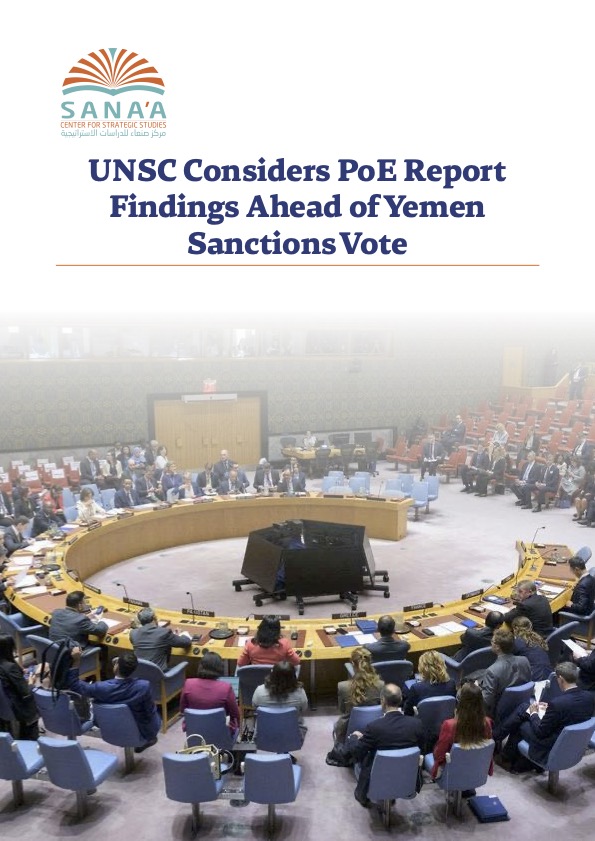
The UN Security Council will decide on the renewal of its targeted sanctions regime and mandate of the Panel of Experts (PoE) for Yemen in a vote scheduled for November 13. In preparation for this, the Panel has released its final report for the past year. It includes detailed findings, with over 100 annexes of supporting material, on Houthi violations of the sanctions regime, highlighting emerging smuggling trends and revenue generation.
The Security Council is expected to at least agree on the annual renewal of the sanctions regime. However, it remains to be seen whether any updates will be introduced, based on the Panel’s findings and recommendations. The renewal is also not the only chance for action. Following this, the Council may further examine steps to strengthen the effectiveness of the sanctions, close gaps, and establish the costs of non-compliance.
PoE Select Findings
The Panel’s latest report describes how Houthi violations align with the group’s broader strategic objectives. The Houthis “consolidate power through systematic repression”[1] while “their ideological penetration of society is based on long-term strategic planning.”[2] A clear illustration of this is their recruitment of children, which intentionally breaks down traditional family structures, ensuring they “face no meaningful counterbalance.”[3] Their all-women security force and intelligence unit, known as the Zaynabiyyat, is accused of playing a key role in facilitating conflict-related sexual violence.[4] “Widespread arbitrary detentions, torture and extrajudicial killings,”[5] notes the report, continue to be effective in creating a chilling effect that restricts dissent and freedom of expression.
Regarding the Houthis’ evolving relationships and supply chains, the Panel noted a strengthening of ties with Al-Shabaab, an Al-Qaeda affiliate in Somalia, over the past year. There are indications that Al-Shabaab is learning from the Houthis how to conduct drone attacks.[6]The Panel’s findings corroborate previous reporting by the Carnegie Endowment for International Peace on the Houthis’ expansion to Somalia.
As anticipated, no discussion of UN activity regarding Yemen can overlook the Houthis’ ongoing detention of and brutal crackdown on UN and NGO personnel. The Panel summarized that “the inability of the international community to robustly respond to this unprecedented move reinforces the Houthis’ perception of themselves as being an intractable force.”[7] The Panel further pointed out that the Houthis use the tactic of detaining personnel as a means to negotiate for concessions, with 23 UN personnel still in detention.[8]
PoE Recommendations
The Panel emphasized the importance of prioritizing humanitarian support and the protection of civilians in Yemen, as well as taking steps to improve the enforcement of the arms embargo on the Houthis. They urged armed groups to prohibit the use of anti-personnel mines and allow full access for demining organizations.[9] In response to the reported prevalence of conflict-related sexual violence, the Panel highlighted the need for strengthened protection mechanisms and increased access to medical, psychological, and legal support.[10]
Regarding the Houthis’ systematic policy of indoctrination of children, the Panel outlined long-term needed measures, explicitly calling for states and international bodies to monitor the Houthis’ “militarization and politicization of education.”[11] This should be an area for more attention and timely follow-up. The Secretary-General issues a report specifically on Children and Armed Conflict in Yemen, with the last report released in March 2025, covering the period until December 2023. Findings from that reporting period observed lower levels of violations of children’s rights, after the Houthis agreed to an action plan with the UN “to end and prevent the use of children in armed conflict.” However, the Panel of Experts noted a sharp increase in child recruitment after October 7, 2023, and the outbreak of regional conflict.[12]
Another concerning finding by the Panel that deserves the Security Council’s careful attention is the Houthis’ “full control over the telecommunications sector,”[13] along with its use for surveillance and revenue extraction. Control over telecommunications, including preventing “access to impartial information,”[14] demonstrates the ability of an armed group to use technology to amplify its power and embed its control at scale. Such authoritarian practices extend to the repression of journalists, academics, and activists,[15] forming a pillar of the Houthis’ strategy of long-term social control.
There are opportunities for the Panel to draw further links between these findings and the work of other UN bodies, including to help the Security Council identify cross-regional trends. For example, the Panel of Experts for Libya documented patterns and phases of retaliation by armed groups against human rights defenders. The Security Council’s Counter-Terrorism Committee should also draw on findings related to Houthi control of the telecommunications sector to inform its examination of new and emerging technologies used by terrorist groups.
The Panel of Experts appropriately focused several recommendations on improving the implementation of and compliance with the sanctions measures. The report concludes with a stark warning: “Without effective implementation by Member States, the arms embargo established in resolution 2216 (2015) is totally ineffective and has made no significant dent in the capabilities of the Houthis.” The Panel acknowledged that states have mechanisms to “detect and prevent illicit transfers,” yet it received no information on investigations undertaken in response. In other words, the “absence of visible deterrence measures”[16] continues to fuel widespread violations. The Panel also noted that third-party countries, such as Djibouti, should have notified the Security Council’s Yemen Sanctions Committee about inspections following relevant seizures of material.[17]
Strengthening Implementation
Shortcomings in implementation are not unique to the UN sanctions regime for Yemen. Darfur in Sudan remains among the most urgent cases, where the atrocities committed in El-Fasher are a blatant violation of the arms embargo in place. UN Human Rights Chief Volker Türk expressed the link between firm compliance with the arms embargo and ending these atrocities, calling for an end to the “continuing military support to sustain parties committing serious violations”.
Proper documentation lays the groundwork for accountability, with the Panel of Experts’ independent and thorough reporting contributing to this effort. The Panel observed that for there to be deterrence and accountability, states need to name violators and conduct investigations.[18] The Security Council’s Informal Working Group on General Sanctions Issues provides a platform to examine how to increase national investigations across the UNSC’s sanctions regimes, which would demonstrate appropriate follow-up to the Panels’ reporting.
One illustrative question ahead of the renewal of Yemeni sanctions is whether the Security Council will adopt the recommendation to expand inspection of cargo destined for Yemen on the high seas and in government-controlled areas.[19] If implemented, it would suggest progress in the negotiations in New York, in contrast to previous renewals, which largely maintained the existing regime. The concern is that new additions to the renewal could compromise unanimous adoption, as evidenced by votes on other resolutions, such as the July resolution renewing UN reporting on Houthi attacks in the Red Sea, in which China, Russia, and Algeria abstained. An example of growing divisions among Security Council members over the situation in the Red Sea and Yemen can also be seen in China and Russia’s criticism of the US for its military strikes in Yemen.
While the renewal resolution places Yemen’s targeted sanctions regime and the Panel of Experts’ latest report at the center of the Security Council’s attention in New York, its importance lies in what comes next. The Panel documented a range of escalating tactics by the Houthis, from indoctrination of children to increased smuggling of weapons and equipment. It is now up to states to use the evidence gathered by the Panel to take appropriate action in response.
This analysis is part of a series of publications produced by the Sana’a Center and funded by the government of the Kingdom of the Netherlands. The series explores issues within economic, political, and environmental themes, aiming to inform discussion and policymaking related to Yemen that foster sustainable peace. Any views expressed within should not be construed as representing the Sana’a Center or the Dutch government.
- “Final Report of the Panel of Experts on Yemen established pursuant to Security Council resolution 2140 (2014) S/2025/650,” United Nations Security Council, October 17, 2025, https://docs.un.org/en/S/2025/650. Paragraph 23.
- Ibid, Paragraph 35.
- Ibid, Paragraph 155.
- Ibid, Paragraph 146.
- Ibid, Paragraph 162.
- Ibid, Paragraph 78.
- Ibid, Paragraph 23.
- Ibid, Paragraph 136.
- Ibid, Paragraph 188.
- Ibid, Recommendation (e).
- Ibid, Recommendation (f).
- Ibid, Paragraph 150.
- Ibid, Paragraph 115.
- Ibid, Paragraph 35.
- Ibid, Paragraph 162.
- Ibid, Paragraph 177.
- Ibid, Paragraph 176.
- Ibid, Paragraph 177.
- Ibid, Paragraph 187.
Author