

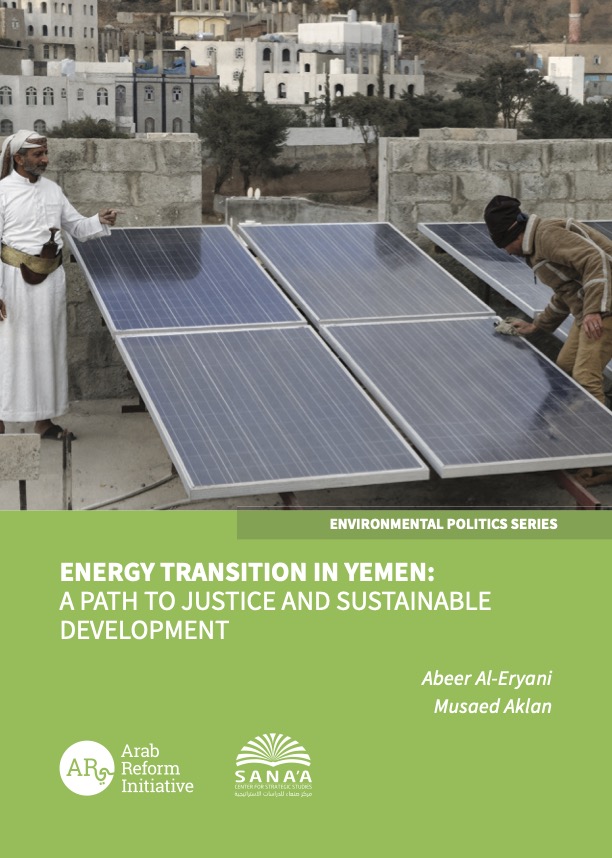
Energy Transition in Yemen: A Path to Justice and Sustainable Development
Executive Summary
Yemen’s energy sector is currently facing a severe crisis. For millions of Yemenis, accessing reliable electricity is a daily struggle, characterized by prolonged blackouts, limited fuel supplies, and deteriorating infrastructure, which in turn exacerbate the country’s humanitarian conditions. This policy brief underscores the importance of a just and conflict-sensitive energy transition in Yemen, addressing the interconnected challenges of conflict, economic instability, and energy poverty. It emphasizes the urgent need for an energy transition that enhances energy access, promotes decarbonization, and supports peacebuilding and socioeconomic recovery.
The brief outlines the current energy landscape in Yemen, identifies critical policy gaps, and highlights both top-down and grassroots opportunities for sustainable energy development. It acknowledges the significant challenges in the energy sector, including its fragmentation, weak institutional capacity, and limited resources, further compounded by the lack of coordinated governance structures since the war, and the rise of multiple centers of power, including the internationally recognized government (IRG), the Houthi group (Ansar Allah), and other armed groups.
Despite these challenges, the study identifies key opportunities for transformative action, particularly at the community and local levels. Experience in Yemen shows that interventions in rural areas encounter fewer technical, political, and financial challenges.[1] Rural areas are remote from power and influence centers, are home to the majority of the country’s population, and are largely disconnected from public energy networks. They also offer a more conducive environment for piloting energy projects compared to urban centers, providing successful examples that help build momentum for broader reform.
To guide Yemen’s energy transition, the development of a comprehensive, evidence-based framework is essential. This framework should prioritize components such as equitable access to energy, institutional capacity, and economic recovery, all of which should be analyzed through a conflict-sensitive lens. It must also ensure meaningful participation from marginalized groups, particularly women and youth, in both policy and implementation processes.
Realizing these objectives will also require coordinated action from multiple actors. The government should reform energy subsidies in a phased and socially sensitive manner, while creating incentives for decentralized and community-led energy projects. International and regional partners should adopt flexible and conflict-sensitive funding mechanisms and promote energy as a tool for peace-building by supporting collaboration across conflict divides. Civil society actors, meanwhile, can play a vital role by facilitating community participation and raising public awareness on energy–climate–justice issues, with a strong emphasis on the needs and voices of rural populations. Finally, the private sector should actively engage in developing technical standards and aligning business models with conflict-sensitive approaches that enhance equitable access for underserved and remote communities.
This policy brief was prepared by the Sana’a Center for Strategic Studies in partnership with the Arab Reform Initiative as part of the SIDA-funded project “Strengthening Civil Society Actors and Networks Advocating for a Just Environmental Transition in the Middle East and North Africa”.
- John M. Cohen et al., “Development from Below: Local Development Associations in the Yemen Arab Republic,” World Development 9, no. 11 (1981): 1039–61, https://doi.org/10.1016/0305-750X(81)90019-X; Benoit Challand and Joshua Rogers, “The Political Economy of Local Governance in Yemen: Past and Present,” Contemporary Arab Affairs 13, no. 4 (2020): 45–69, https://doi.org/10.1525/caa.2020.13.4.45.
Author
Senior Researcher
(Environment and Water)