

Sana’a, One of the World’s Oldest Treasures, Must Not Become the Next Casualty of the Iran War
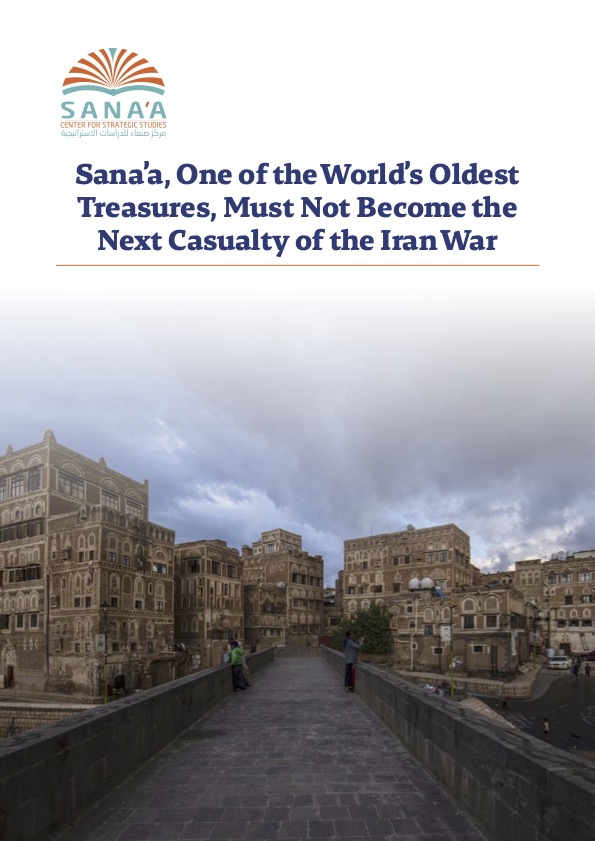
As the war on Iran continues to wreak havoc in the region, Yemen has been conspicuously absent from the escalating conflict. All eyes are on the Houthis, who have so far been reluctant to join the war. Should the Houthis mobilize, or should Israel and the US attack Yemen unprovoked, the threat to Sana’a, Yemen’s crown jewel and one of the best-preserved living ancient cities in the world, should worry us all. The damage by US and Israeli strikes to Tehran’s 400-year-old Golestan Palace last week, and the ongoing devastation in southern Lebanon, whose millennia-old Phoenician and Roman archaeological sites are also under serious threat, serve as a cautionary tale. Sana’a, a city as culturally significant as Jerusalem, might face its greatest test yet.
Sana’a is one of the world’s oldest living capitals, with urban origins dating back over 2,500 years. It boasts one of the region’s most cohesive and visually striking architectural legacies. UNESCO declared its old city a World Heritage Site in 1986. Like many Arab cities, it is a sprawling, chaotic capital, today bearing the scars of war. For over a decade, Yemen has been locked in an intractable conflict that has led to the fragmentation of the country, with multiple warring factions and their regional backers vying for its control. But Sana’a is no Mosul, nor is it Aleppo. Its architectural heritage is remarkably vast, still lived in, and much of it intact. The city’s ancient urban fabric stretches beyond the UNESCO-protected boundaries of the historical old city and landmarks such as Bab al-Yemen, Bab Shaoub, and Bab as-Sabah, encompassing a living ecosystem of old neighborhoods and historic districts that stretch for miles to the outskirts of central Sana’a.
Astonishingly, the city’s historical patrimony has weathered a decade of conflict, a devastating campaign of Saudi-led coalition airstrikes in 2015, recurrent summer floods, and urban neglect due to war. But in the last two years, Sana’a, the seat of Houthi power since 2014 but a symbol of identity for all Yemenis, has come under British, American, and Israeli strikes, the latter of which have also struck deep into its historic core.
Last September, weeks after assassinating the Houthis’ prime minister and several members of the cabinet, Israel struck a newspaper headquarters in Sana’a, killing 31 journalists and media workers — the deadliest single attack on media workers in the past 16 years. What most headlines overlooked then was that the building was located in a densely populated neighborhood just beside the protected old city of Sana’a, and on the grounds of the former Royal Citadel of Al-Mutawakkil, which also houses the country’s National Museum. The force of the strikes sent shockwaves through the surrounding historic quarter, damaging nearby ancient mosques and residences, shattering old qamarriyas and alabaster windows, and leaving extensive destruction in its wake.
The threat to ancient cities in the region and the plundering of their cultural heritage is not just about the damage to buildings or UNESCO World Heritage sites. These cities’ ancient souls remind us of and bear witness to our universal shared humanity and civilizational legacy. In the early 2000s, my late father visited me in Sana’a, a city I had made my home for more than half a decade. Shortly after landing at Sana’a airport, I took him for a walk through its Old City. We made our way through its narrow alleyways, markets, mikshama (urban gardens), and old samasir (caravanserais), passing rows of stone-and-baked-brick tower houses that typify Yemeni architecture. Many of these houses, dating back to the 10th and 12th centuries, rise to five, six, or even seven floors, their facades decorated with elaborate white gypsum patterns and colourful stained-glass windows known in Yemen as qamariyyas. When we reached the outskirts of the Great Mosque, my father stopped suddenly to rest against an old archway. He was in his late sixties and had just begun experiencing the first signs of Parkinson’s. I thought the long journey had taken its toll, but it turned out the Old City of Sana’a had touched his soul. “Give me a moment,” he said. “I need to take this city in.”
We tend to shy away from addressing the threat to ancient cities, monuments, and their prized heritage when lives are being lost on such a large and devastating scale. But when the dust settles, and we reconcile the true catastrophic consequences of such misguided campaigns, we will find that the heritage of an ancient past, legacies that belong to all of us, is being recklessly sundered at the hands of leaders whose only moral compass is power and greed. Over the past decade, Yemen’s cultural heritage, one of the richest in the region, if not the world, has been severely compromised by conflict. Four of its five UNESCO-designated heritage sites are currently on the List of World Heritage in Danger. The calculus of whether Yemen will enter this war or not, a decision tragically not in the hands of Yemenis, should not forget the existential threat to Yemen’s unparalleled living cultural legacy, whose crown will always be Sana’a.
This publication was produced as part of the second phase of the Yemen Peace Forum (YPF), a Sana’a Center initiative that seeks to empower the next generation of Yemeni youth and civil society activists to engage in critical national issues. The YPF is funded by the Government of the Kingdom of the Netherlands.
Editor and Researcher