

The War on Yemen’s Antiquities
Yemen’s antiquities have endured centuries of looting, smuggling, and trafficking, rooted in a consistent pattern of colonial exploitation that dates back to the 19th century. In his travel memoir Vision of Yemen, Yemeni-Jewish scholar Hayyim Habshush captured Western orientalists’ fascination with Yemeni cultural and archeological wealth, drawing on his experience accompanying French orientalist Joseph Halévy on an archaeological expedition to Yemen. Such fascination often turned predatory. Under British colonial rule, Aden emerged as a major hub for the trafficking of antiquities. Yemeni scholar and archaeologist Mohammed Abdulqader Bafaqih, in his 1980s book Orientalists and the Antiquities of Yemen, notes that “law in Aden was the will of the colonizer, which did not conflict with encouraging the trade in antiquities despite knowing that they were stolen.” Consequently, British museums today remain replete with thousands of Yemeni artifacts.”[1]
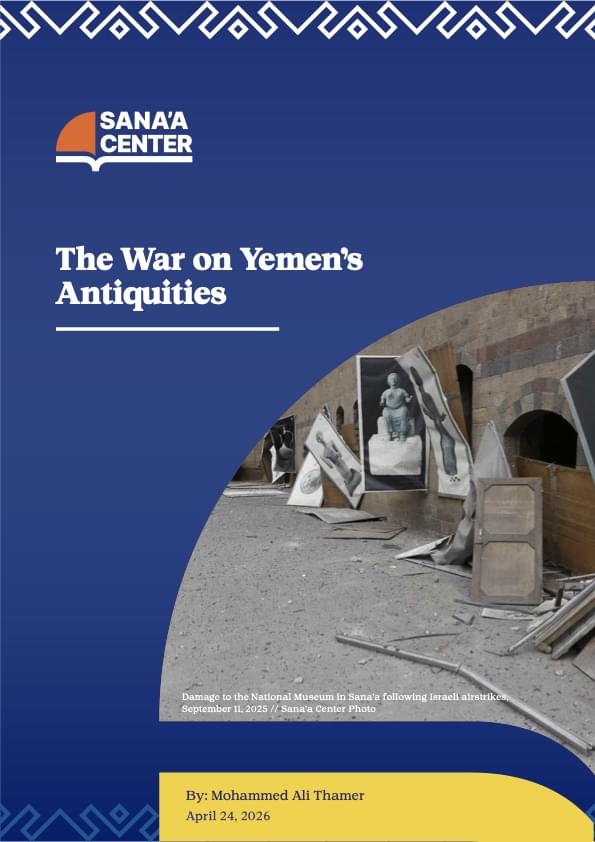
A significant number of Yemen’s valuable artifacts have been smuggled out of the country, with many now residing in museums around the world. Compounding matters, Yemen’s ongoing conflict has led to a substantial increase in violations against archaeological sites, historical landmarks, and museums. These violations include aerial bombardments, ground attacks, bombings, demolition, and other forms of damage; many of these attacks were coordinated and intentional. Some cultural sites have been deliberately used for military purposes by warring parties involved in the conflict. Cultural sites have also been indiscriminately targeted, including aerial raids by the Saudi-led coalition and, more recently, US and Israeli strikes, the damage from which still needs to be adequately assessed. Taken together, these attacks have created a profound and irreplaceable loss, rapidly undermining Yemen’s cultural heritage.
The attacks on cultural heritage listed in this article cover a twelve-year period from 2014 to 2025. Information is drawn from the author’s experience and expertise as the Director General of Cultural Statistics at the Sana’a-based Ministry of Culture[2] since 2011, his own contributions to the development of the Yemeni Archaeological Atlas (2014), “A Storm over History”, a catalog on cultural heritage destruction (2018), and various annual cultural indicators reports prepared by the ministry. While several of these works, including the annual cultural indicators, remain unpublished internal records, they constitute data-collection efforts by the ministry’s technical staff during this period. The analysis also draws on data from the Sana’a-based Yemen’s Central Statistical Organization and the Yemen Data Project, an independent initiative to collect and disseminate data on the war for purposes of transparency and accountability.
A Legacy Under Threat: Attacks on Heritage
The Yemeni Archaeological Atlas, published by the Sana’a-based Ministry of Culture, documented 2,318 distinct archaeological sites throughout the republic as of 2014, the year surveys and expeditions in Yemen were halted.[3] Based on data synthesized from the Annual Indicators of the Ministry of Culture for 2015-2025, the 2023 Annual Statistical Book from the Sana’a-based Central Statistical Organization,[4] and the Yemen Data Project (2015–2025),[5] approximately 477 of these sites have been destroyed in Yemen over the course of the war (Figure 1). This destruction, whether total or partial, extends to Yemen’s most prestigious landmarks, including damage to the five Yemeni cities inscribed on the World Heritage List— the Old City in Sana’a, Zabid, Shibam in Hadramawt, and the Ancient Kingdom of Saba in Marib and Sirwah. In addition, eight sites from the World Heritage Tentative List — Sa’ada, Thula, Baraqish, Jibla, Taiz, Al-Makha, Hareeb, and Shibam Kawkaban — have sustained damage, as have other nominations submitted to UNESCO, including the Old City in Ibb and Aden, and several locations in Hajjah.
Figure 1
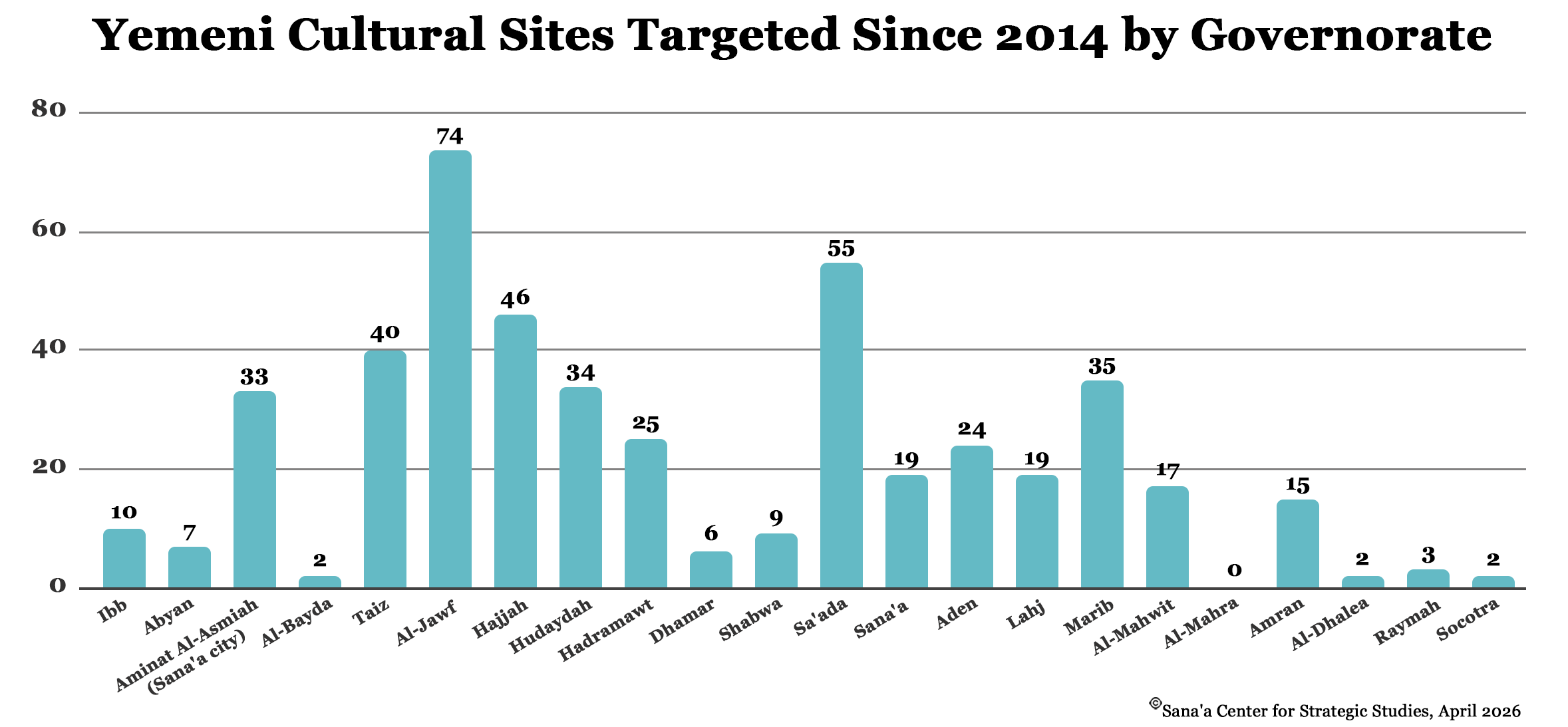 Source for Figures 1-3: Data synthesized from the Annual Indicators of the Ministry of Culture for 2015-2025, the 2023 Annual Statistical Book from the Sana’a-based Central Statistical Organization, and the Yemen Data Project (2015–2025).
The governorate of Al-Jawf ranked first in the number of attacks on cultural sites, followed by Sa’ada, Hajjah, Taiz, Marib, and Sana’a city (Amanat al-Asimah), with the remaining incidents distributed across other governorates, culminating in a total of 775 documented destructive operations carried out by the various warring parties (see Figure 2).
Figure 2
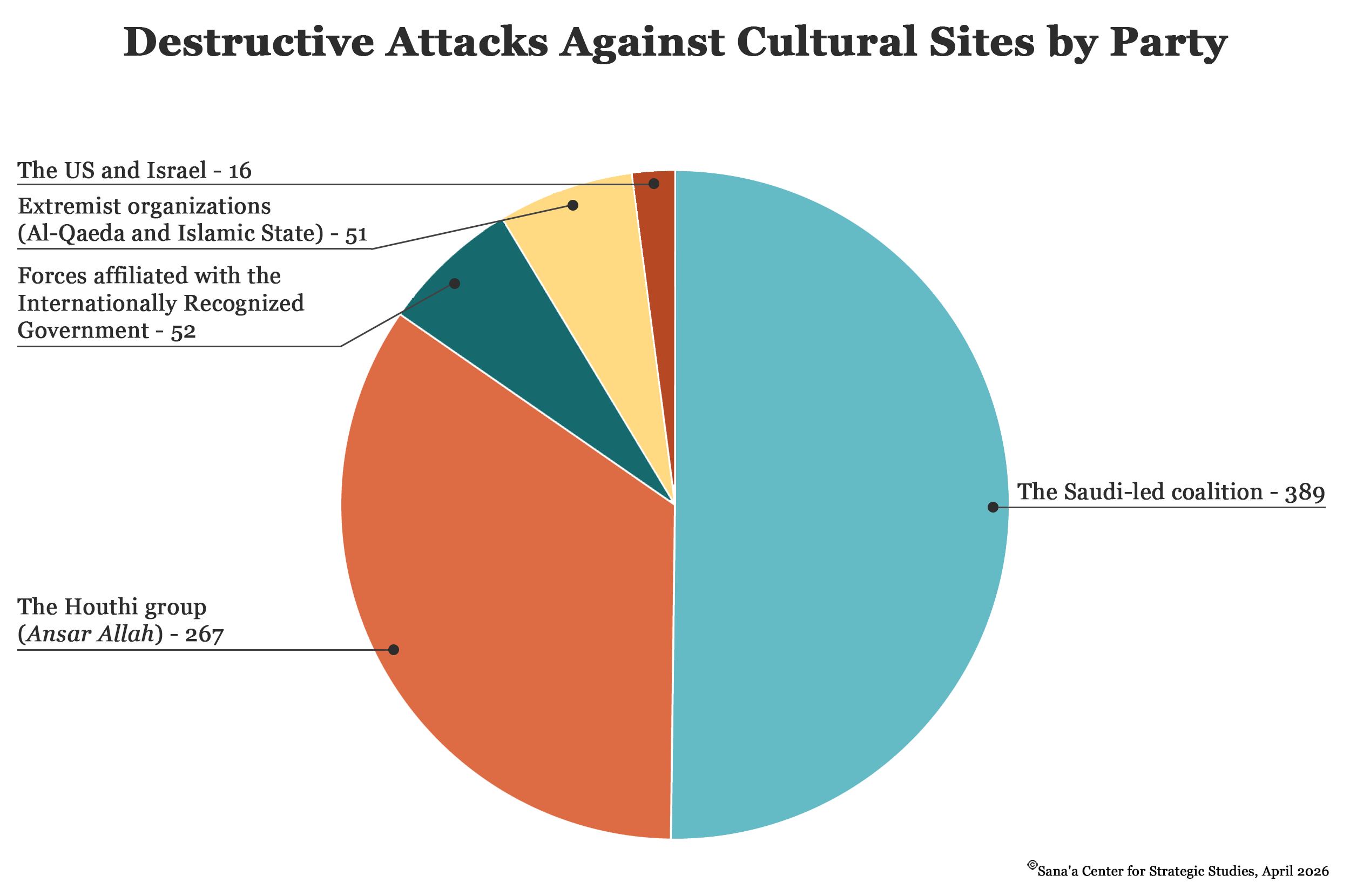
The Saudi-led coalition accounted for the lion’s share with 389 attacks,[6] followed by the Houthi group with 267. The Houthis have also been documented using archaeological sites for military purposes and launching hostile actions from historic fortresses. In August 2014, their fighters seized the ancient city of Baraqish and used it as a military site, which resulted in it being targeted by numerous Saudi-led coalition airstrikes by the coalition. Before their withdrawal in early April 2016, Houthi forces planted landmines on its outskirts. Elsewhere in Yemen, several religious shrines have been damaged or completely obliterated, including in deliberate demolitions by extremist groups such as Al-Qaeda and the Islamic State.
Figure 3
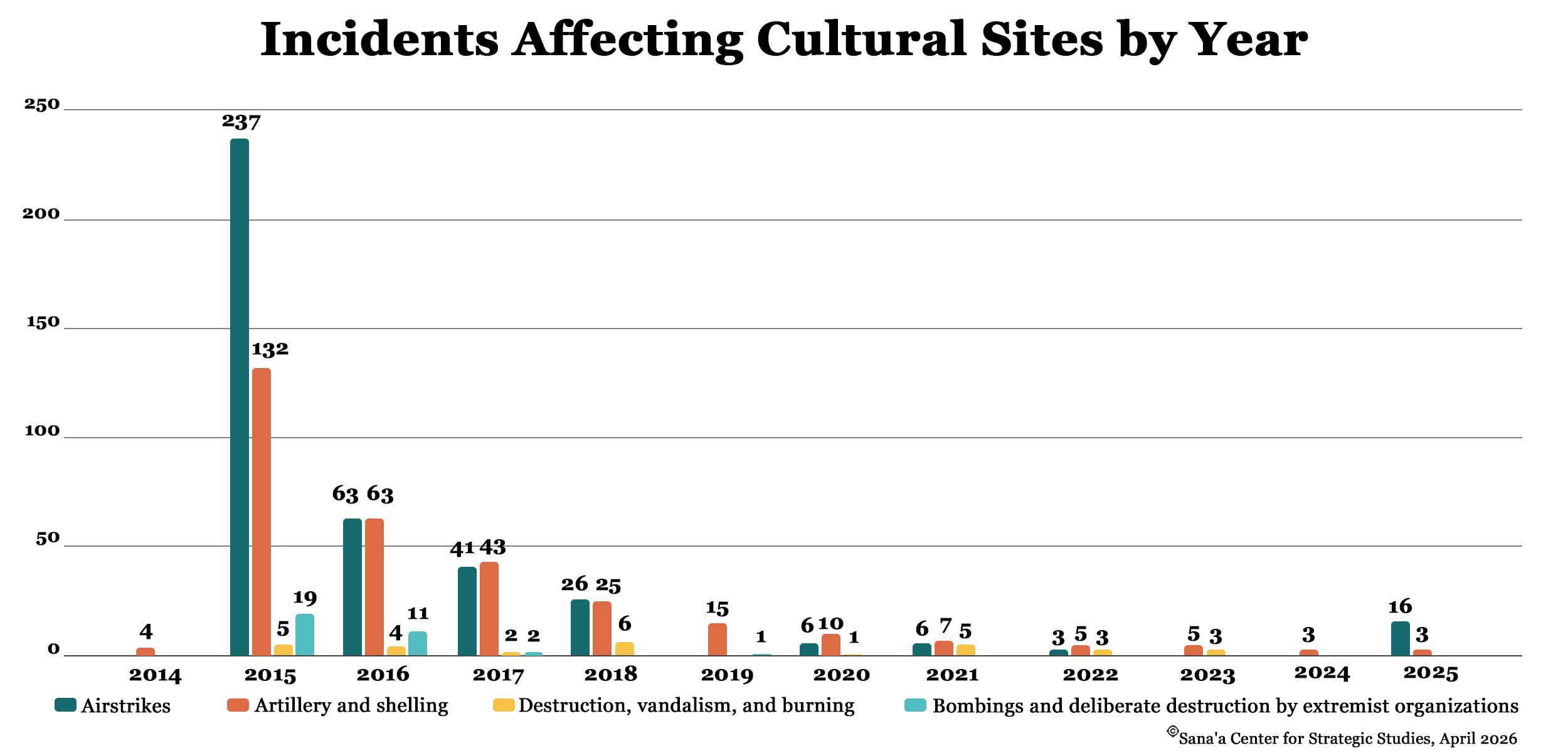
The year 2015 stands as the most devastating period for Yemen’s archaeological heritage. While airstrikes accounted for a significant portion of the damage, the date reflects a complex reality: a single military operation often comprised multiple strikes and bombings, though these are frequently recorded as a single event. Beyond aerial bombardment, cultural sites were further decimated by ground-based attacks, including the use of landmines and car bomb attacks by extremist organizations, foremost among them Al-Qaeda in the Arabian Peninsula (AQAP).
The Plundering of Yemeni Museums
During the conflict, Yemen’s national museums have faced extensive looting and destruction of their artifacts. Twelve of the country’s 22 museums were looted or damaged. Foremost among these was the destruction of the Regional Museum in Dhamar, which contained 12,500 pieces. The War Museum in Aden and the National Museum in Taiz, which housed 45,000 artifacts, were destroyed. Other museums in Aden, Mukalla, and Ataq were looted. The museums in Ibb governorate (Al-Oud, Al-Mashneh, Dhafar, Jibla) were almost completely looted, and most of the War Museum’s collection in Sana’a was confiscated. Museums that were shelled during the conflict became especially vulnerable to looting, and several thefts of their collections occurred, all of which happened with the consent or facilitation of the warring parties, despite repeated international appeals to protect antiquities.
Looting and Illicit Trade
The ongoing war has also ushered in a new wave of looting of Yemen’s cultural sites, particularly in Marib, Al-Jawf, and Shabwa. Looters, who have grown increasingly ruthless, now fall into two categories: gold hunters and artifact hunters. Gold hunters often target ancient tombs, especially those carved into mountains by the Sabaeans and Himyarites, digging, vandalizing, and tunneling in pursuit of treasure. This often results in the desecration of these historical sites, as seen in regions such as Mawiya in Taiz and Dhafar in Ibb Governorate, and in the vandalization of ancient mummies.
Meanwhile, artifact hunters have turned the antiquities trade into a lucrative black market, with brokers and dealers facilitating the flow of stolen goods to international auctions and private collections. As demand grows, looting has become more precise, further damaging Yemen’s archaeological heritage. The security vacuum, ongoing military operations, and the lack of coordination between warring factions make it extremely difficult to protect these sites.
Hundreds of archaeological sites have reportedly been subjected to looting during the war, with 2023 recorded as the peak year. However, there are no comprehensive national statistics that provide precise figures, as data typically comes from field studies, local documentation projects, or reports and assessments from international organizations, none of which have been possible amidst the war.[8] As a result, it is impossible to determine the exact number of artifacts stolen or the precise sites from which they were looted. Many artifacts have lost a significant part of their scholarly value and the contextual information that could have been obtained from them because the sites from which they were taken are unknown.[9] Estimates of the number of Yemeni artifacts abroad range from 10,000 to 14,000. According to the Sana’a-based General Authority for Antiquities and Museums, which has issued lists of looted antiquities, 8,000 were smuggled out of Yemen during the war.
An Absence of Oversight and Transparency
Yemen’s antiquities have traditionally fallen under the authority of the General Organization for Antiquities and Museums (GOAM) in Sana’a, the official body mandated to protect, study, and promote them.[10] The institutionalization of Yemeni archeology began in the wake of Yemen’s 1962 September Revolution. This led to the creation of the General Directorate for Antiquities in 1963, followed by the General Authority for Antiquities and Libraries in 1973. Parallel efforts took place in southern Yemen, where an antiquities department was established in Aden in 1962. Following unification in 1990, these entities were merged under the Ministry of Culture. GOAM serves as the primary successor to these early initiatives, overseeing the preservation and promotion of Yemen’s vast historical legacy.
Since the war, however, GOAM’s work has largely ceased, archaeological surveys have stopped, and foreign missions have departed. Antiquities are no longer a priority for any of the warring parties, who are preoccupied with the conflict and unwilling to assume responsibility for preserving cultural heritage.[11]
But this responsibility cannot be shirked or blamed on others, nor can it be addressed simply through press releases and condemnation. It is grounded in local and international legal frameworks, including Yemen’s Antiquities Law (1994), the 1954 Hague Convention for the Protection of Cultural Property, the 1970 UNESCO Convention on the Illicit Trade in Cultural Property, and the 1972 World Heritage Convention, among others. The repeated calls from UNESCO further underscore the responsibility to act to protect cultural heritage. Initiatives have included a UN Security Council meeting focused on the protection of cultural property on November 30, 2017, the adoption of UN Resolution 2347 on the protection of cultural heritage, and a demand by French researchers for the Security Council to issue a resolution banning the smuggling and trade of Yemeni antiquities, similar to those for Iraqi and Syrian antiquities. Antiquities authorities, international experts, foreign diplomatic missions, civil society organizations, and Yemeni professors have all made appeals to hold the parties to the conflict responsible for what is happening to Yemeni antiquities.
How Do We Save Our Heritage?
If the situation remains as it is, Yemen’s antiquities face a very grim future. There is an urgent need to raise awareness and educate the public on the importance of antiquities and cultural sites as invaluable historical treasures that must be preserved, and to advocate for their inclusion in school curricula, development plans, and national policy. A comprehensive guide should be issued that catalogs and describes destroyed archaeological sites and antiquities smuggled and sold abroad. This would serve as a legal reference for competent authorities and an academic reference for researchers. Concurrently, all parties to the conflict should be urged to sign a code of honor to refrain from targeting antiquities and their sites. Additionally, a UN resolution should be issued to criminalize the sale and trade of Yemeni antiquities.
The Yemeni civil war has not only claimed human lives but has also struck at the very soul of Yemen, embodied in its ancient heritage and antiquities. If urgent measures are not taken, the world stands to lose the legacy of one of humanity’s oldest and richest civilizations.
Editor’s note: This text was updated to correct a sourcing error related to antiquities at the National Museum in Sana’a. The Sana’a Center regrets the error.
This publication was produced as part of the second phase of the Yemen Peace Forum (YPF), a Sana’a Center initiative that seeks to empower the next generation of Yemeni youth and civil society activists to engage in critical national issues. The YPF is funded by the Government of the Kingdom of the Netherlands.
- Mohammed Abdulqader Bafaqih, Orientalists and the Antiquities of Yemen, Yemeni Center for Studies and Research, Sana’a, Vol. I, 1988, pp. 33–34.
- The Ministry of Culture, like all Yemeni governmental ministries, has been bifurcated during the conflict, with one entity operating under Houthi authorities in Sana’a and another operating in Aden under the internationally recognized government.
- “The Yemeni Archaeological Atlas: Archaeological Sites and Historical Landmarks Across Yemen,” Ministry of Culture, Sana’a, 2014, pp. 1-10.
- The Central Statistical Organization has also split during the conflict, with one entity in Sana’a and another in Aden.
- The Yemen Data Project database is publicly accessible and provides excel datasets documenting airstrikes conducted by the Saudi-led coalition, the US, and Israel. See: https://yemendataproject.org/
- The Yemen Data Project database provides detailed information on the number of airstrikes targeting Yemen during the period 2015-2025, with Excel dataset provided for each actor. These include: air raids conducted by the Saudi-led coalition (Published Air Raids Database from March 26, 2015 to April 30, 2022); Israel (Israeli Strikes, July 2024-June 2025); and the United States (Operation Rough Rider, March 15-May 6, 2025).
- Interview with Dr. Hussein al-Aidarous, Director General of Antiquities in Seyoun, September 11, 2025.
- Munir Ariki, “Yemeni antiquities and the dangers of war and natural disasters [AR],”Journal of the General Union of Arab Archaeologists, Issue (24), 2021, p. 560.
- The General Authority for Antiquities and Museums (GOAM) in Aden previously operated as a branch of its counterpart in Sana’a. Since the war, it has become a separate entity, with no coordination between the two.
- Munir Ariki, “Yemeni antiquities and the dangers of war and natural disasters,” Journal of the General Union of Arab Archaeologists, Issue (24), 2021, p. 557.
Author