

The Economy
Government Adopts Fiscal Discipline Amidst Regional Shifts
The first quarter of 2026 has witnessed a significant shift in support for the internationally recognized Yemeni government, following the sidelining of the Southern Transitional Council (STC) and the termination of its military operations. Seeking to restore the government’s legitimacy amid a massive political and military reorganization, Saudi Arabia has launched a series of financial packages to prevent a fiscal collapse and improve service provision.
On January 15, the Kingdom announced a US$90 million package to pay delayed public-sector salaries, including those of military and security personnel. Shortly after, another package worth 1.9 billion Saudi riyals (US$507 million) was announced to fund development projects in the health, education, energy, transportation, and water sectors. The support was intended to bridge the funding gap left by the UAE’s withdrawal earlier that month. It was followed in late February by a 1.3 billion Saudi Riyal (US$347 million) grant aimed at covering the budget deficit and national wage bill. Riyadh has also begun directly sponsoring southern security forces previously funded by Abu Dhabi.
In early March, the new cabinet enacted a 2026 state budget, a milestone after years of informal, ad hoc spending, and the first official budget since 2019. The move was a prerequisite set by Riyadh for continued aid, designed to ensure transparency and fiscal accountability. However, the budget was not based on realistic fiscal indicators, but was instead built on the 2014 budget, which had projected a deficit of approximately US$3 billion.
Notwithstanding the fiscal challenges, the Presidential Leadership Council (PLC) formally approved the 2026 government program, a strategic blueprint designed to address Yemen’s political and economic instability. The program is built upon three core pillars: a situational diagnosis, a strategic framework, and a practical implementation matrix. The objectives are anchored in the Economic Recovery Plan 2025–2026 and PLC Resolution No. 11 of 2025. The government further clarified that the implementation matrix will focus on six strategic priorities: political and security stability; economic and monetary recovery and stimulating growth; sustainable access to essential services; strengthening governance and the rule of law; enhancing social resilience to protect livelihoods; and maintaining proactive international development partnerships.
The government asserts that its new plan is feasible and that it will shift from vague promises to concrete policy interventions by year-end, but in practice, the plan echoes past reform efforts. The overly ambitious approach overlooks complex, entrenched realities on the ground and the significant institutional gaps that have historically hindered implementation. A close analysis of the highly inflated state budget projections reveals fiscal superficiality: total revenues are estimated at YR3.96 trillion, with 41.5 percent from taxes and 35 percent from property income and sales of goods and services. Recurrent and capital grants, heavily reliant on Saudi support, are estimated at YR858.7 billion (22 percent of revenue). These figures are nearly double the YR2.07 trillion actually collected in 2024, of which 61 percent consisted of external grants, according to the last published annual report from the Central Bank of Yemen in Aden (CBY-Aden).
On the expenditure side, the budget was estimated at YR4.8 trillion, a 180 percent increase over the YR2.7 trillion spent in 2024. Projected spending on salaries and goods and services was set at YR1.35 trillion each, significantly higher than historical figures. While the inflated wage bill reflects the integration of various military and security units into the state budget, the government’s capacity to meet these immense obligations remains its primary challenge. For instance, the plan proposes increasing the budget for goods and services by 355 percent (from YR298 billion in 2024 to YR1.35 trillion) to address collapsing essential services—a target that would severely test the government’s actual fiscal capacity. Without addressing entrenched realities and existing institutional gaps, the 2026 program risks repeating the failures of previous attempts at fiscal and institutional reform.
Rial Remains Stable
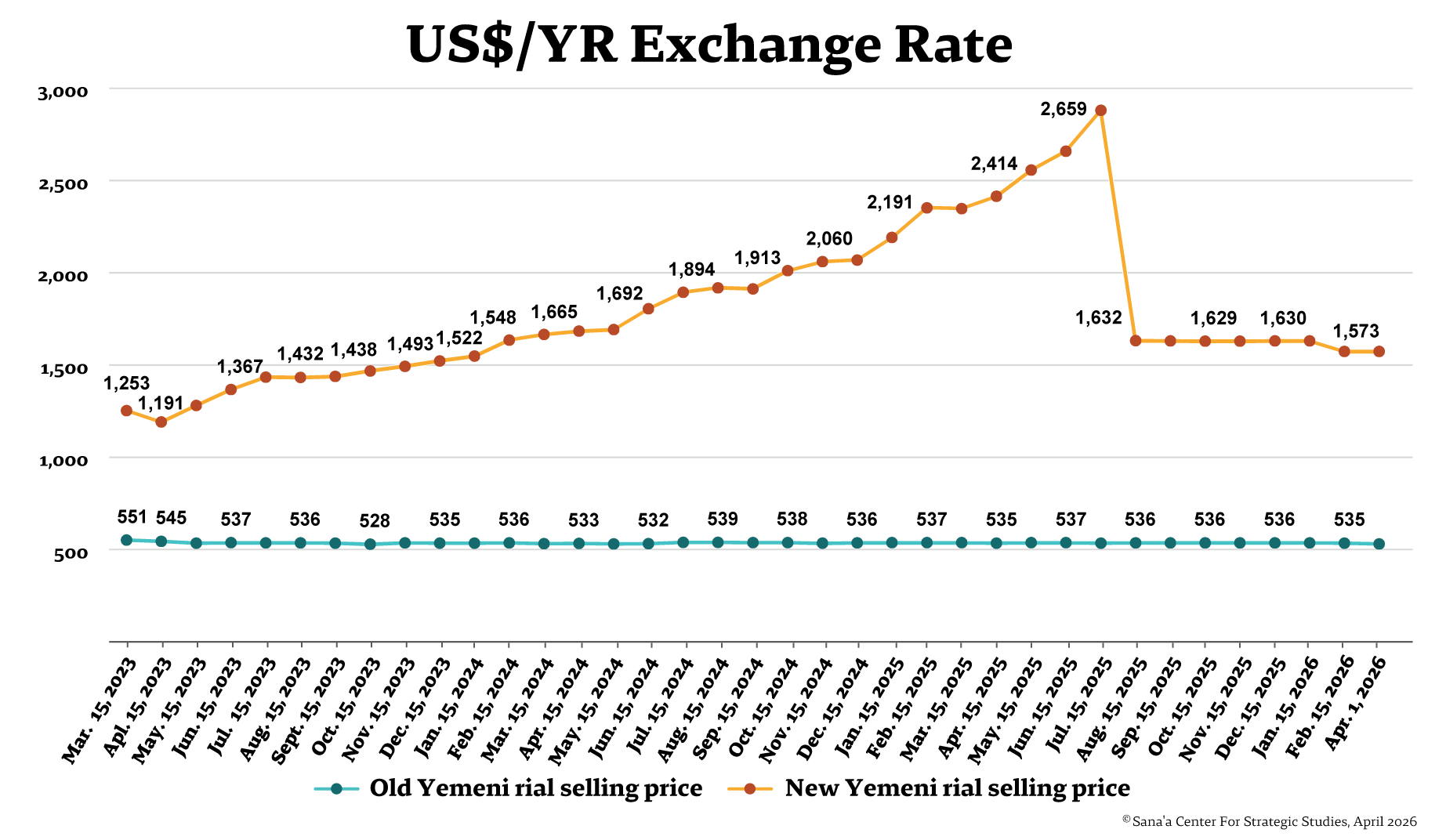
The price of the new rial appreciated by over 3 percent toward the end of February, from YR1,630 to YR1,573 per US$1 on average. The currency then maintained this price through the close of the reporting period.
This recovery followed a series of trends that temporarily improved the government’s monetary and economic position. The major determinant has been the Saudi financial grants, and the rial is expected to retain its current value in light of continued support.
The rial has been stable since mid-last year, following the government’s implementation of wide-ranging reforms to institutionalize import financing, curb destabilizing speculation, and enforce the use of the rial in all domestic transactions. In early February, the National Committee for Regulating and Financing Imports announced that it had approved US$600 million during January to finance the import of basic commodities. This brought the committee’s funding for imports since it began its work in August of last year to over US$3 billion. The CBY-Aden has also maintained rigorous oversight of the banking and exchange sectors. Conducting regular on-site inspections of money exchange outlets, the bank has identified and revoked the licenses of dozens of entities involved in currency speculation.
The price of old rials circulating in areas controlled by the Houthi group (Ansar Allah) remained relatively flat, trading between YR531-536 per US$1 over the first quarter of 2026.
Yemen’s Humanitarian Situation Remains Dire
Yemen continues to face a severe food security crisis. Driven by the worst funding gap in a decade and a dramatic escalation in operational risks, Yemen remains one of the world’s most severe humanitarian crises, with over 22 million people in need of assistance.
The latest Food Security Update from the World Food Programme (WFP) paints a complex picture of the humanitarian landscape as of February 2026. While the report highlighted a temporary seasonal improvement in food consumption, the gains were precarious and sit atop a foundation of severe systemic deprivation and a shrinking humanitarian footprint. Nationwide, food consumption improved by nine percent month-on-month, bringing the prevalence of inadequate intake down to 57 percent in February. This shift was largely driven by the unique economic and social conditions surrounding the holy month of Ramadan. Increased religious charity and a surge in remittance inflows provided a vital lifeline for many families, while the appreciation of the rial in government-controlled areas and the distribution of partial public sector salaries offered a brief moment of financial stability. By the end of the month, inadequate food intake stood at 61 percent in government-controlled regions and 55 percent in areas under Houthi control.
However, the WFP warned that these marginal improvements mask a much harsher reality. Despite the seasonal uptick, severe food deprivation continues to plague nearly one in every three households across the country. Due to severe funding shortages, the WFP began implementing its new targeted emergency food assistance program in government-controlled areas in early February, reducing the number of beneficiaries from 3.4 to 1.7 million across 53 districts. By mid-March, around 1.1 million people had been assisted under the first cycle of the program. In Houthi-controlled areas, all WFP operations have remained suspended since September 2025, due to the constrained operational space and the arrest and detention of humanitarian workers. The WFP decided to suspend food aid distribution across northern areas due to security risks and critical funding shortfalls. As part of this operational downsizing, the WFP notified 365 employees in these areas that their contracts would be terminated by the end of March. Houthi authorities have further hindered relief efforts by seizing UN equipment, confiscating vehicles, and blocking the UN Humanitarian Air Service (UNHAS) from flying into Sana’a. While the internationally recognized government has urged organizations to relocate to Aden, this could sever a lifeline for the densely populated northern highlands.
The UN’s 2026 Yemen Humanitarian Response Plan, which requested US$2.16 billion to assist 12 million people, has seen a severe funding shortfall. As of late March 2026, OCHA data showed that only about 10 percent of the required funds had been secured. The current crisis is rooted in the unprecedented financial shortfall of 2025: OCHA reported that the 2025 aid plan received only US$687.9 million, equivalent to about 28 percent of the requested US$2.48 billion. This represents the lowest funding level in ten years. Despite escalating needs, this severe funding shortfall forced all clusters to scale back critical services.
With a muted response from Yemen’s major foreign donors, severe underfunding is expected to continue. This will force aid agencies to further cut critical services, despite Yemen remaining one of the world’s largest humanitarian crises, with escalating hunger and disease.
Hadramawt Bears the Economic Cost of Military Escalation
The STC’s military escalation in Hadramawt in early January had far-reaching economic consequences, leading to the disruption of state institutions, the looting of economic assets, and the interruption of essential public services.
On January 5, both Seyoun and Al-Rayyan airports were subjected to widespread looting by people taking advantage of the turmoil. As a result, both airports were taken out of service, preventing thousands of passengers from reaching their final destinations. The government announced the resumption of flight operations following a brief suspension.
In addition, Hadramawt witnessed a decline in service provision, including electricity. Since late last year, Hadramawt has experienced severe power outages due to a fuel shortage for power plants. Following military clashes in areas surrounding its oilfields, diesel supplies from state operator PetroMasila declined still further, causing massive power failures and cutting off over 85 percent of the electricity grid’s generating capacity across most of the Wadi Hadramawt region.
In response to the worsening situation in the governorate, recently appointed PLC member and Hadramawt Governor Salem al-Khanbashi threatened escalatory measures against the central government on March 28. He warned that the governorate could halt oil exports and withhold revenue transfers if its financial demands remained unaddressed. The heart of this dispute lies in a 2017 presidential order that was intended to decentralize Yemen’s oil wealth. The order mandated that 20 percent of oil revenues generated within oil-producing governorates—specifically Hadramawt, Shabwa, and Marib—be returned directly to the local administrations to fund regional budgets and infrastructure. Al-Khanbashi argues that the central government has failed to honor this commitment, leaving Hadramawt to face what he described as systemic injustice.
Power and Gas Crises Worsen Despite Temporary Respite
The government has initiated a series of interventions to address the dual crises of electricity blackouts and cooking gas shortages, which have severely affected citizens in Aden and neighboring governorates. Through a combination of emergency fuel grants, strategic supply allocations, and promises of enhanced regulatory oversight, the government has attempted to restore basic services while navigating complex political and security challenges.
In late January, the Saudi Development and Reconstruction Program for Yemen (SDRPY) initiated a fuel derivatives grant to operate over 70 power stations across government-controlled areas. The grant includes provisions for a total of 339 million liters of diesel and mazut, valued at US$81.2 million. In mid-January, Saudi Arabia also announced 1.9 billion to support vital infrastructure, including the energy sector. Accordingly, the SDRPY and the government-run Ministry of Energy and Electricity signed an agreement to regulate the provision of the fuel grant. The deal involves purchasing fuel derivatives from PetroMasila, which began transporting supplies to power plants on January 25. The impact was immediate: by mid-February, electricity provision in Aden surged to over 20 hours per day, a dramatic improvement from the 15-hour daily blackouts that plagued the city throughout 2025.
This stabilization occurred during a period of upheaval in the renewable energy sector. In mid-January, the Ministry of Electricity reported that the Emirati firm Global South Utilities (GSU) abruptly and remotely shut down solar power plants in Aden and Shabwa without any prior coordination with the ministry or the relevant local authorities. In response, GSU confirmed that its action was part of arrangements for a complete withdrawal from Yemen. The company clarified that, following the Yemeni government’s request for the exit of all Emirati firms, it would evacuate all maintenance and operations personnel from the 120-megawatt Aden and the 53-megawatt Shabwa power plants, handing operation over to the government’s Public Electricity Corporation. The solar power plants in these two cities are among the most prominent renewable energy projects to come online over the past two years, helping reduce the near-total reliance on expensive fossil fuels and decrease longstanding power outages, especially during the summer months. The Emirati company had operated and provided maintenance services for the power plants, but its role had become controversial amid complaints about its operating procedures and coordination with government entities, according to sources in the electricity sector.
Aden has also been plagued by a severe cooking gas shortage crisis in the past three months. In mid-January, the Ministry of Oil and Minerals announced an agreement to allocate 2 million liters of liquefied petroleum gas to meet market demand across the provinces of Aden, Lahj, and Taiz. This immediate relief was intended to alleviate supply shortages caused by disruptions to tanker deliveries.
Supply disruptions are being driven by a combination of localized blockades disrupting supply routes and broader political instability. There have been recurring tribal clashes in Marib that have prevented shipments from moving from Block 18 in Marib city, operated by the Safer Company. Even after these shipments were released, their progress toward Aden has been further obstructed by roadblocks in Abyan. The fragmented status quo of security and governance systems has fostered an environment conducive to the creation of artificial shortages, with poorly regulated gas distributors seeking to maximize profits by charging inflated prices on the black market.
There have been widespread accusations of extortion and monopolistic practices. Dozens of gas tankers were seen waiting for hours at the Al-Alam checkpoint at the entrance of Aden, where they were charged illegal tolls. On leaving the checkpoint, they were not directed to distribution stations but instead reportedly diverted to private traders’ yards, part of an effort to create artificial shortages, inflate prices, and generate illicit profits. In mid-January, the price of a 20-liter gas cylinder was at YR14,000, over 64 percent above the official price of YR8,500.
The government’s stated intent to enforce the rule of law, as evidenced by directives from both the prime minister and the Ministry of the Interior, signals recognition that long-term stability will require more than imported fuel alone. Despite emergency measures, Yemen’s energy and gas sectors remain highly vulnerable. Chronic power outages and supply shortages have consistently eroded public trust and triggered waves of popular unrest. While the Saudi fuel grant provides a necessary degree of breathing room, long-term stability remains elusive. Progress continues to be threatened by aging infrastructure, inefficient distribution networks, and deep-seated institutional deficiencies.
Government-Held Areas Suffer Liquidity Shortage
Government-controlled areas continue to suffer from an unprecedented liquidity crisis. The shortage of rials has challenged the CBY-Aden’s efforts to maintain equilibrium in the currency market and monetary stability. The shortage has also affected the state’s ability to meet vital spending requirements and hampered commercial trade and financial transactions across government-controlled areas.
By the end of February, the Yemeni rial had largely disappeared from the exchange market. Hard currency holders have had to stand in long queues at banks and money exchange companies. This has led money exchangers to refrain from converting foreign currencies altogether, while others set a limit of only 100 Saudi riyals or US$50 per person per day. In electronic cash transfers, banks now allow account holders to transfer only 200 Saudi riyals or US$50 into Yemeni rials per day. The Saudi riyal in particular has been widely traded in the money market following increased Saudi support for the Yemeni government to address the massive budget deficit.
The current currency shortage has been driven by a number of factors, but is primarily caused by the disintegration of the state’s traditional monetary and fiscal functions. In a healthy economy, the monetary cycle operates as a continuous loop: the central bank issues currency to the market, which enters the private sector to facilitate trade and investment, before being reclaimed by the government through tax mobilization and then re-injected via public spending. However, this whole process has been dysfunctional in government-controlled areas. While the monetary base in these areas—totaling approximately YR4.4 trillion as of December 2025—is theoretically sufficient to meet market needs, the CBY-Aden has failed to effectively control it. Yemen’s economy is heavily cash-based, with extremely low financial inclusion, a situation driven by conflict, a divided banking system, and low levels of trust. Shrinking public confidence in formal financial services has created a mass migration of financial flows outside the banking system. The amount of money circulating outside the system now stands at YR3.3 trillion, limiting the CBY-Aden’s capacity to influence the supply through primary and secondary monetary interventions. The monetary base is now dominated by a less-regulated network of commercial traders and exchange outlets that operate beyond the reach of the state and central bank oversight. These actors have leveraged the large cash base to influence monetary conditions and exchange rate dynamics. When hard currency inflows rise, these traders and exchange outlets tend to withhold local currency in anticipation of its appreciation, later releasing it at more favorable exchange rates to maximize gains from arbitrage.
To address the scarcity of Yemeni rials, the CBY-Aden has adopted a series of measures, including ordering Yemeni banks to purchase foreign currencies from citizens with a daily ceiling of 10,000 Saudi riyals. The CBY-Aden also elected to adopt a fixed exchange rate policy, setting the price of one Saudi riyal at YR410, down from YR420. The Yemeni rial was set at YR1,558 per US$1, down from YR1,617. While this policy is intended to curb outward speculation and the CBY-Aden has largely succeeded in maintaining the stability of the rial, it has struggled with internal liquidity management, unable to force hoarded rials back into the formal economy.
The crisis is compounded by the staggering fiscal deficit, exacerbated by the 2022 Houthi drone attacks on hydrocarbon facilities. These attacks halted oil exports, depriving the government of its primary source of revenue and causing a massive contraction in revenue mobilization. By late 2025, public expenditures reached YR2.8 trillion, against revenues of YR1.43 trillion. This creates a dangerous fiscal paradox: the government continues to inject liquidity into the market to cover public salaries and essential services, but it lacks the fiscal “vacuum” in the form of taxation and export returns necessary to pull that currency back in. This one-way flow of cash further empowers informal money exchangers who capture the injected liquidity, deepening the state’s dependency on external aid to bridge the gap.
US Expands Sanctions on Houthi Networks
On January 16, the US Department of the Treasury’s Office of Foreign Assets Control (OFAC) escalated its campaign to financially isolate the Houthis, designating 21 individuals and entities and one vessel that have transferred oil products, procured weapons and dual-use equipment, or provided financial services for the Houthis.
Building on previous Treasury actions, the new sanctions targeted financial channels between the Iranian government and the Houthis in order to restrict the Iranian regime’s use of its oil wealth to fund regional terrorist proxies. Targeted networks included key front companies, facilitators, and operatives located in Yemen, Oman, and the UAE. These networks have been accused of enabling the group to sustain its ability to conduct destabilizing regional activities and attacks on commercial vessels in the Red Sea.
The sanctions targeted four categories of Houthi smuggling and illicit revenue generation networks. The first concentrates on oil companies and financial facilitators that have enabled Houthis to mobilize US$2 billion annually from illicit oil sales, despite the pressure of international sanctions. These companies receive financial support from the Iranian government and maintain ties to Iranian nationals.
The second category of sanctions targeted Houthi procurement operatives that rely on a sprawling network of front companies, logistics firms, and shipping facilitators to transport weapons and other military-grade materials into Yemen. Among the most notable was the Wadi Kabir Co. for Logistics Services, a shipping facilitator based in Sana’a with a branch in Oman that has allegedly conducted weapons smuggling for the Houthis.
The third category of sanctions targeted Houthi aviation companies and procurement networks. OFAC indicated that Houthi procurement and financial operatives have attempted to utilize the group’s international networks to purchase aircraft for use in smuggling and revenue-generation schemes. The group has collaborated with a US-designated, Houthi-aligned Yemeni businessman, Muhammad al-Sunaydar, to establish two new airlines based in Sana’a: Barash Aviation and Sama Airlines. Barash Aviation, an air cargo transportation company, has assisted the Houthis’ efforts to purchase a commercial jet aircraft, which Houthi leaders planned to use to transport illicit cargo through Sana’a Airport. In early 2025, Barash Aviation and Sama Airlines attempted to partner with US-designated and convicted arms dealer Viktor Anatolijevitch Bout to purchase suitable commercial aircraft.
The last category of sanctions targeted vessels, as well as their owners and operators, that violated US sanctions by discharging oil derivatives at the Ras Issa port after an April 4 deadline. The Albarraq Shipping Co. and its sole director, Ebrahim Ahmed Abdullah al-Matari, were designated for facilitating the delivery of oil products to Ras Issa via the vessel Albarraq Z, as was the ship’s captain, Ahmad Ismail. OFAC also designated the captains of four previously designated vessels that delivered petroleum products to Houthi-controlled ports in Hudadyah between April and June last year.
The new sanctions are part of an intensive US campaign to suffocate the group financially. But the Houthis’ established black-market activities and trade with other sanctioned entities make it unlikely that sanctions will erode their funding sources completely.
Chief Economist