

Military and Security
Saudi Leadership Revamps Southern Security
Following the dissolution of the Southern Transitional Council (STC) and the UAE’s sudden withdrawal from Yemen in early January, the country’s southern security architecture has undergone significant upheaval in the first quarter of 2026. In the three months since the STC withdrew troops and heavy weaponry from Al-Ma’ashiq Palace, Saudi Arabia has quickly moved to fill the resulting power vacuum, and is now attempting to impose a new order on the fragmented anti-Houthi camp through a sweeping overhaul of southern security forces.
Early efforts to impose control in the south centered on securing Aden, which had been under STC stewardship since late 2019. Leadership in Riyadh has tasked the Giants Brigades forces under the command of Presidential Leadership Council (PLC) member Abdelrahman al-Muharrami (Abu Zara’a), along with Saudi-trained-and-funded Nation’s Shield forces, to secure the city. But while the troops were able to consolidate control over the interim capital’s core areas, Saudi leadership was still left with a broader security challenge: despite the official dissolution of the STC and the departure of several of its leaders from Yemen, the majority of military forces in Aden and across the south were still administratively affiliated with the STC, and the loyalties of dozens of commanders remained unclear.
To address this, Riyadh adopted a top-down approach, placing power in the hands of a few trusted individuals on whom it could rely to assess the loyalties of lower-ranking commanders and “trim the fat” accordingly. To this end, the Kingdom quickly dispatched senior military adviser Falah al-Shahrani, whom it tasked with centralizing decision-making through a newly formed Supreme Military Committee. This body reports directly to the Saudi-led coalition and is effectively intended to streamline command structures under close Saudi oversight.
At the same time, Riyadh has moved to empower key members of the PLC, placing Abu Zara’a in charge of Aden’s security, alongside newly appointed PLC member and former defense minister Mahmoud al-Subaihi. Together, the two are leading the coordination and restructuring of military and security forces in the interim capital and other southern governorates. Saudi Arabia has also installed Taher al-Aqili – a former army chief of staff – as Minister of Defense. At the local level, the security overhaul in Aden began in early January with the appointment of Abdelrahman Sheikh as governor. Sheikh is a co-founder of the Security Belt forces, one of the most prominent security units in the interim capital. With strong Yafei roots and a Salafi orientation, he brings both the tribal credibility and military standing needed to command authority.
With Sheikh in place, attention shifted to preparing the interim capital for the new cabinet’s arrival from Riyadh in mid-February. For weeks before the government’s formation, Aden had experienced weekly pro-STC demonstrations (see below), with protestors demanding a return of ousted STC leader Aiderous al-Zubaidi and local STC branches threatening to prevent the new government from setting foot in the city. In response, military leaders elected to relocate military camps outside the city limits. Units with uncertain loyalties would be distanced from the seat of power, while more trusted forces would be allowed to remain.
Units that have been kept in the city so far include the Aden Police, the Emergency Road and Patrol Police, and the Security Belt forces, the latter of which have since been placed under the Ministry of Interior, rebranded as the “National Security forces,” and stationed at checkpoints across Aden and its environs. A number of other STC-aligned units in the city, including elements from the Saiqa Brigades, have also reportedly been folded into this structure. The movement of units and forces in Aden is indicative of another Saudi approach at play: rather than dismantling groups altogether, the Kingdom is attempting to carve up and repackage the myriad of southern militia networks into a more state-centered framework. No stranger to checkbook diplomacy, Riyadh has facilitated this effort with a generous US$90 million grant to pay public-sector and security salaries.
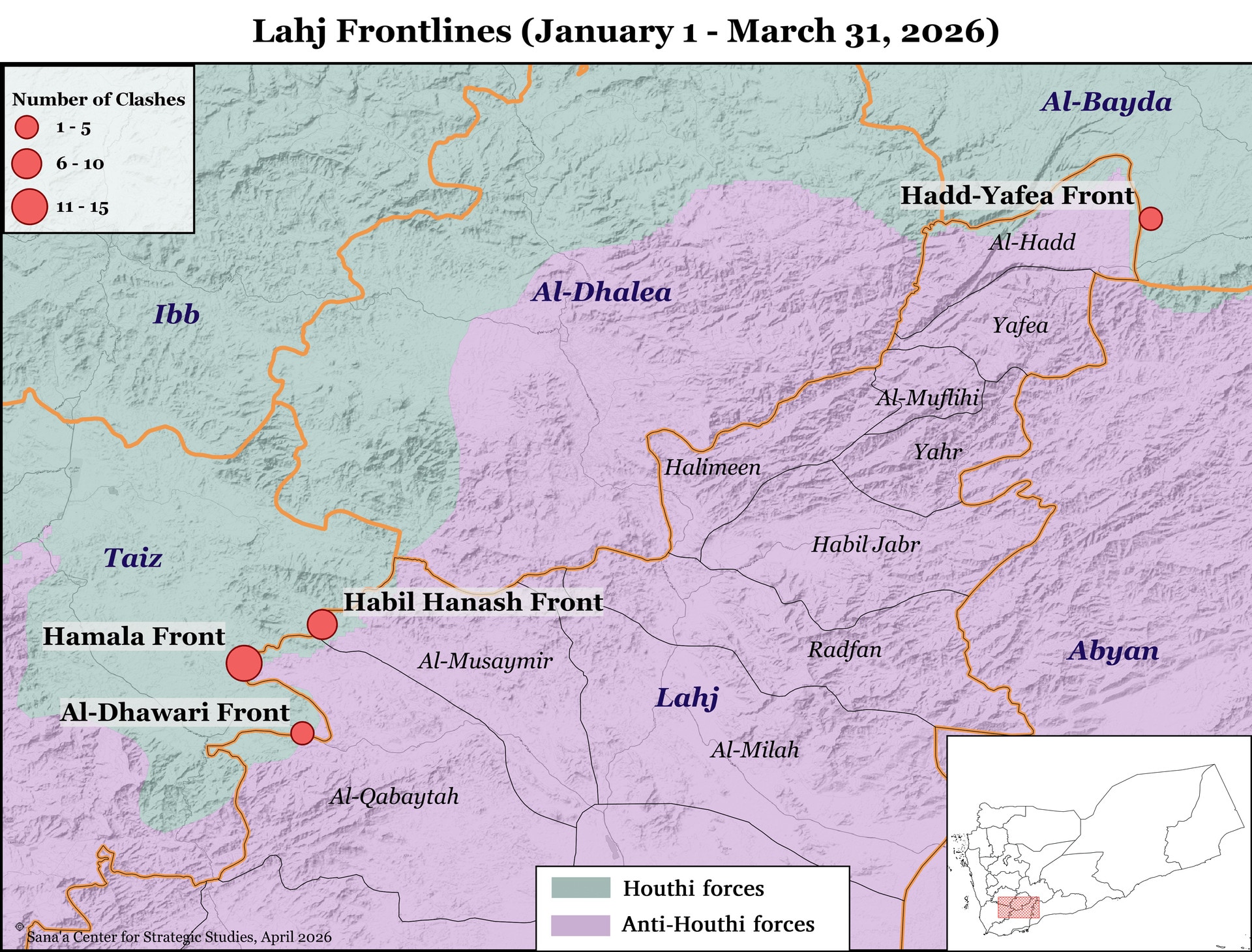
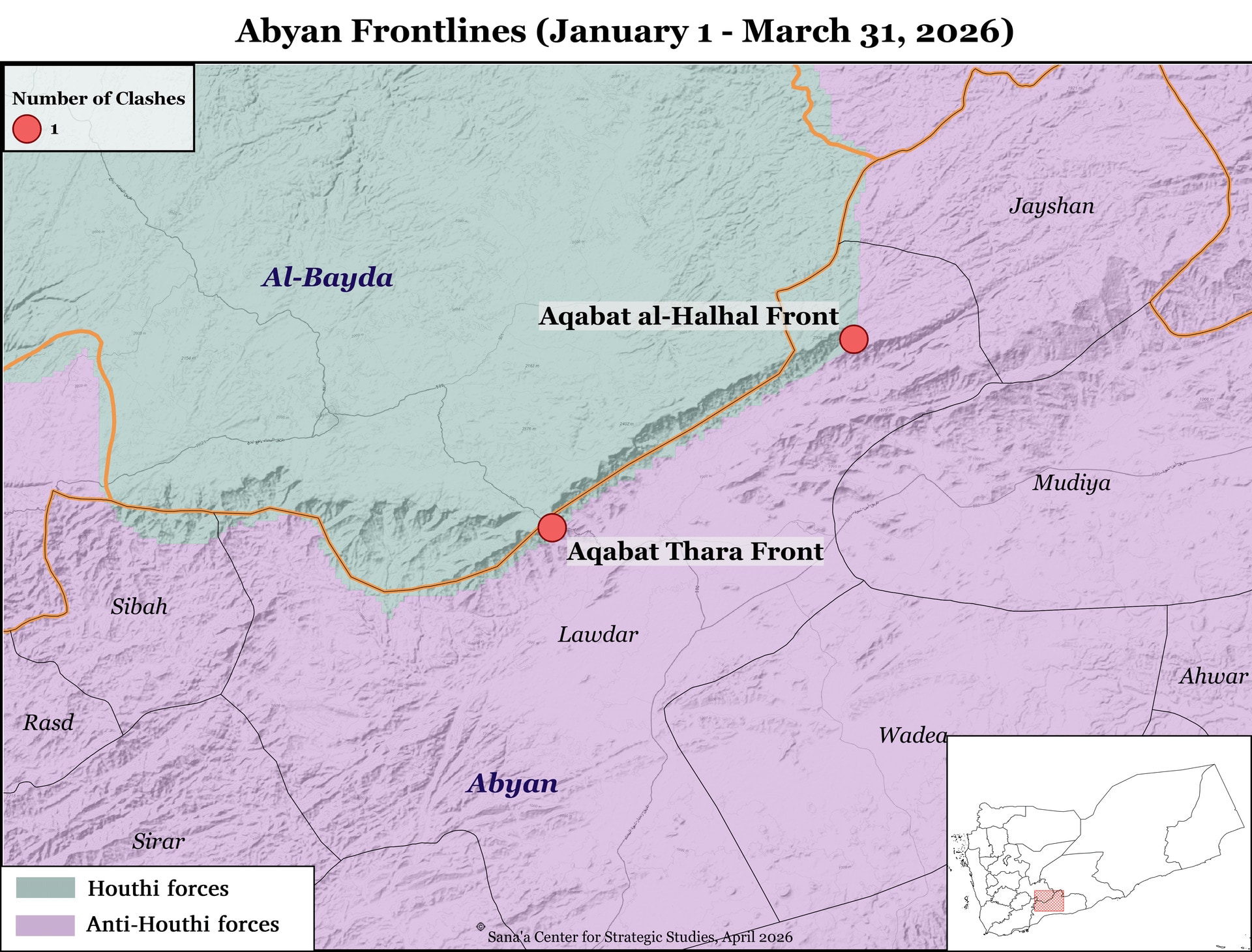
Beyond Aden, Saudi Arabia has pursued a similar approach to securing leadership in key STC strongholds, including Lahj, Al-Dhalea, Shabwa, and Abyan. As part of this effort, a number of southern military leaders were summoned to Riyadh in late January, including commanders from the Saiqa Brigades, the Support and Backup Brigades, and the Security Belt forces (now National Security forces). At the same time, several commanders were removed from their positions. In late March, Abu Zara’a oversaw a series of dismissals targeting military leaders, particularly those previously appointed by the STC leadership or directly by Aiderous al-Zubaidi himself. Not all have accepted their fates quietly. In Abyan, several leaders refused to step down, mobilizing fighters and sparking clashes. Governors in three former STC strongholds — Lahj, Al-Dhalea, and Abyan — were also replaced with a new team of leaders with strong tribal and military ties (see Politics and Diplomacy).
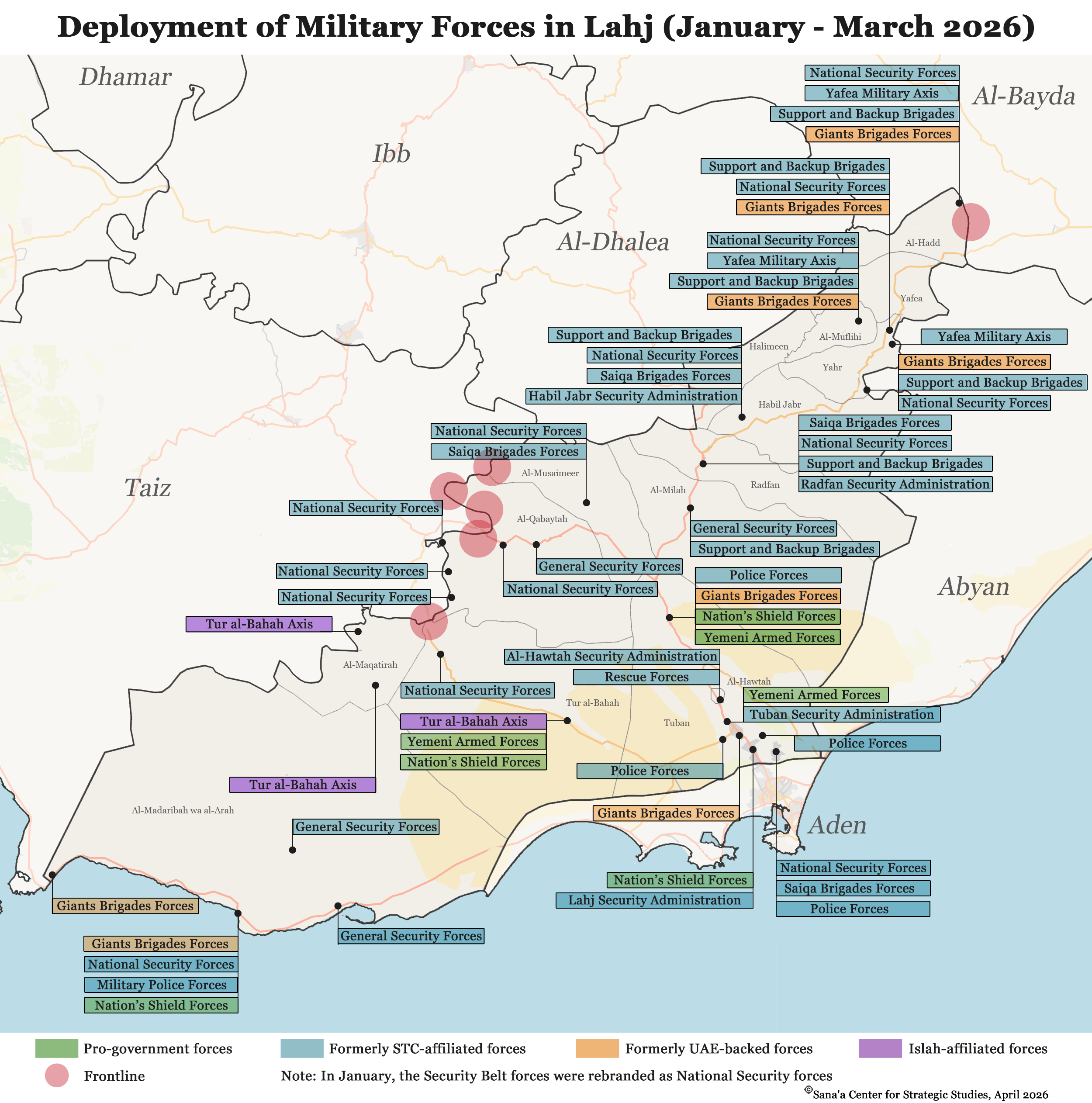
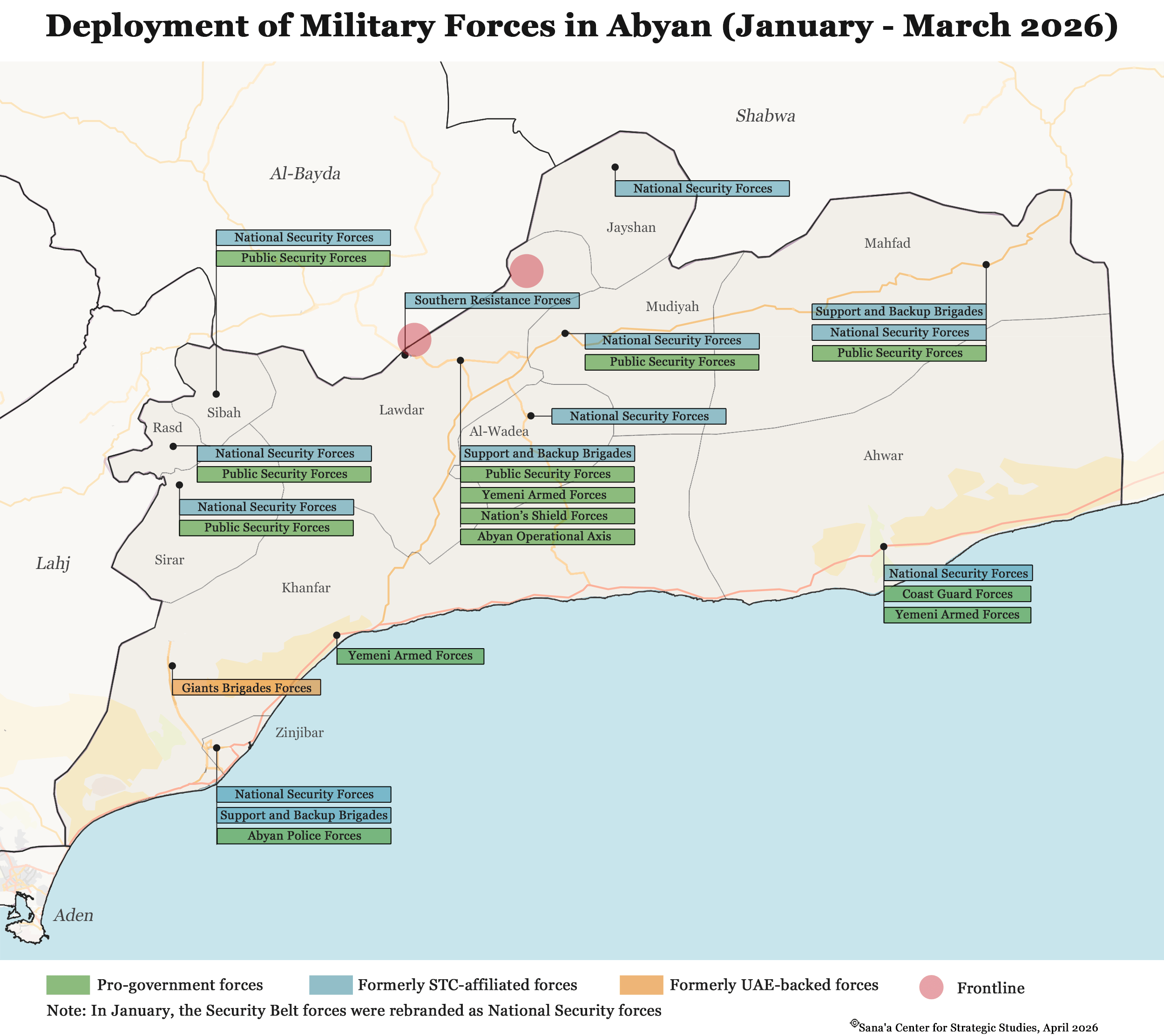
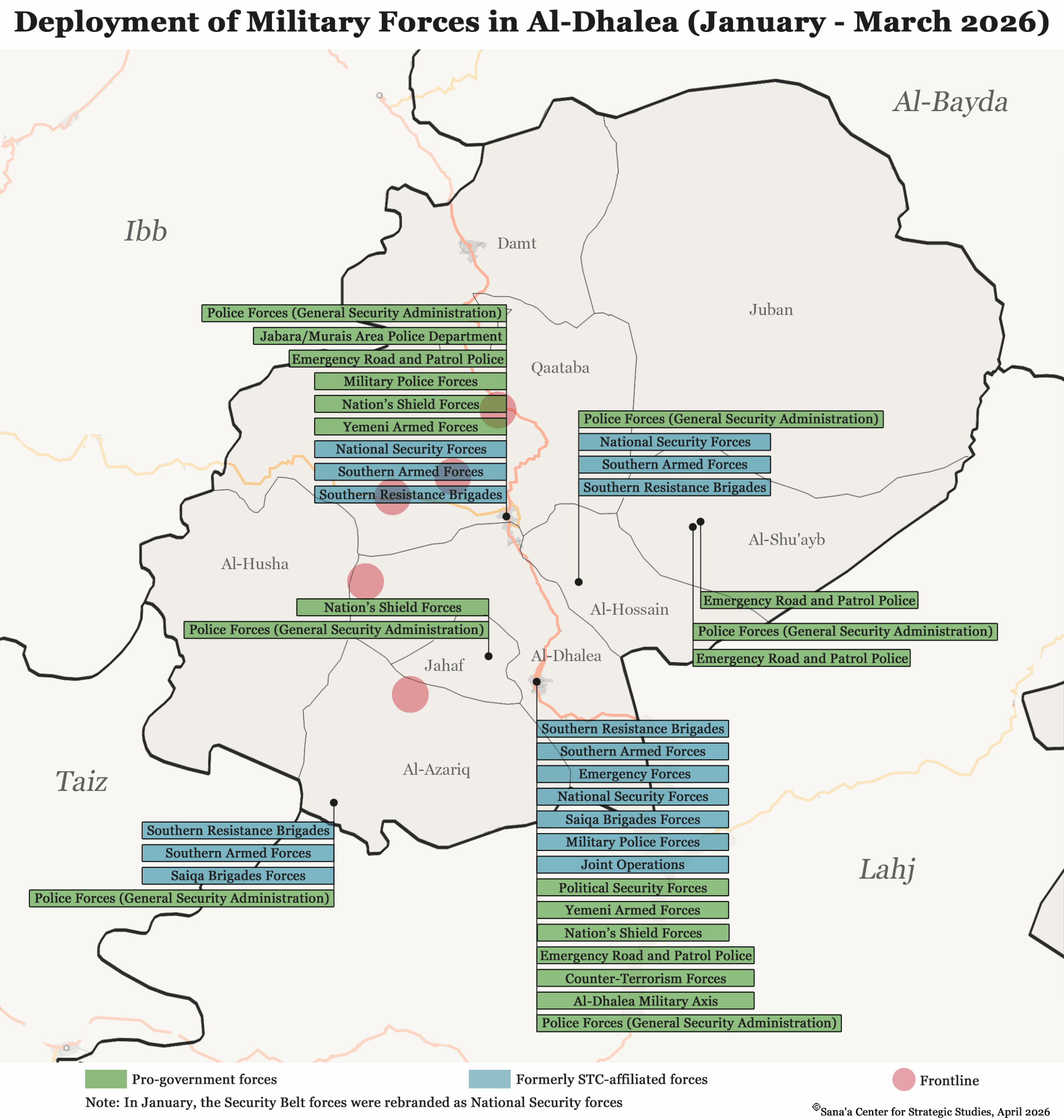
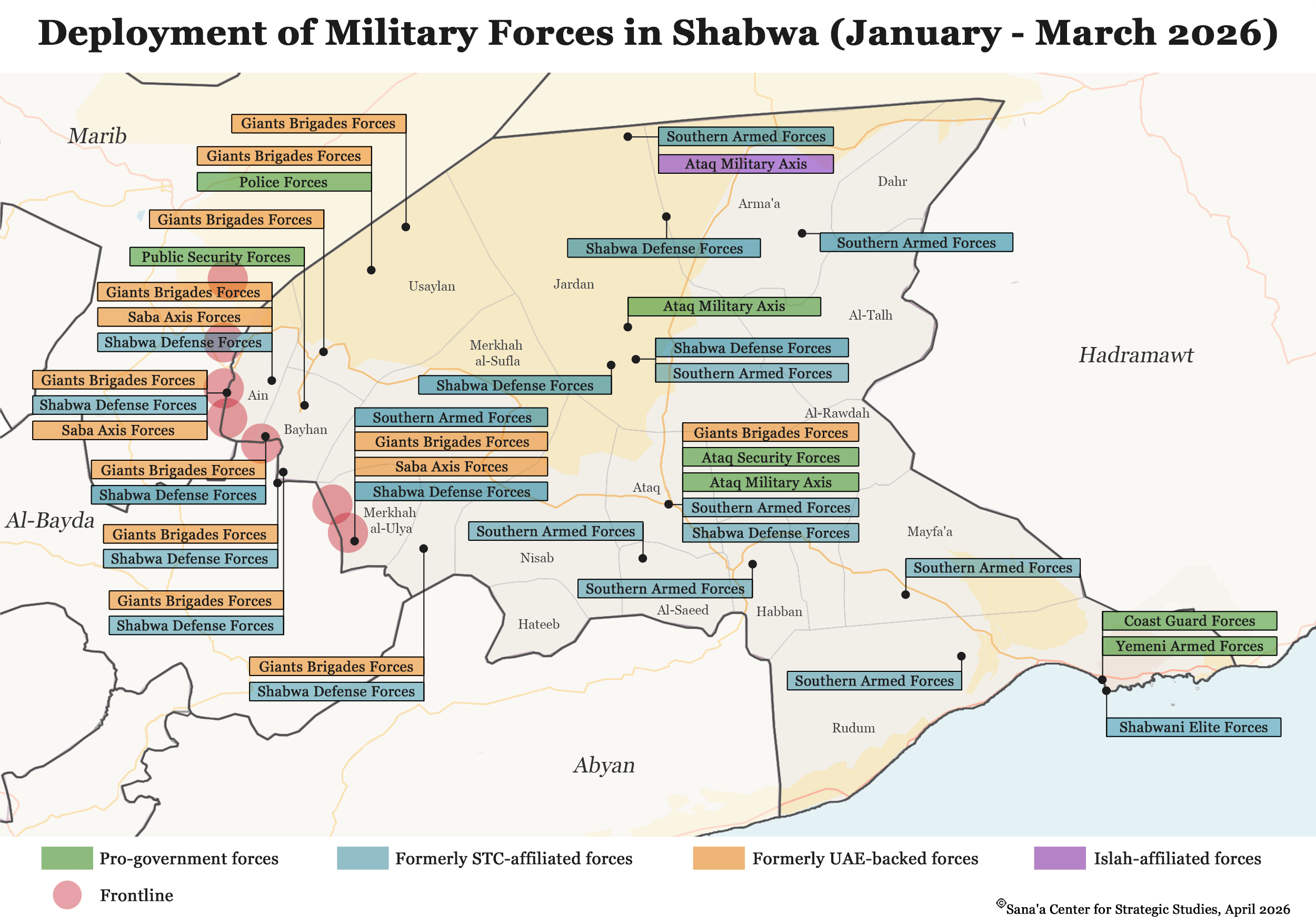
Editor’s Note: Locations shown on the maps above are approximate and intended for illustrative purposes. Data was collected by the Sana’a Center between January and March. Military and security forces in southern Yemen are still undergoing significant restructuring and redeployments; some recent changes may not be reflected.
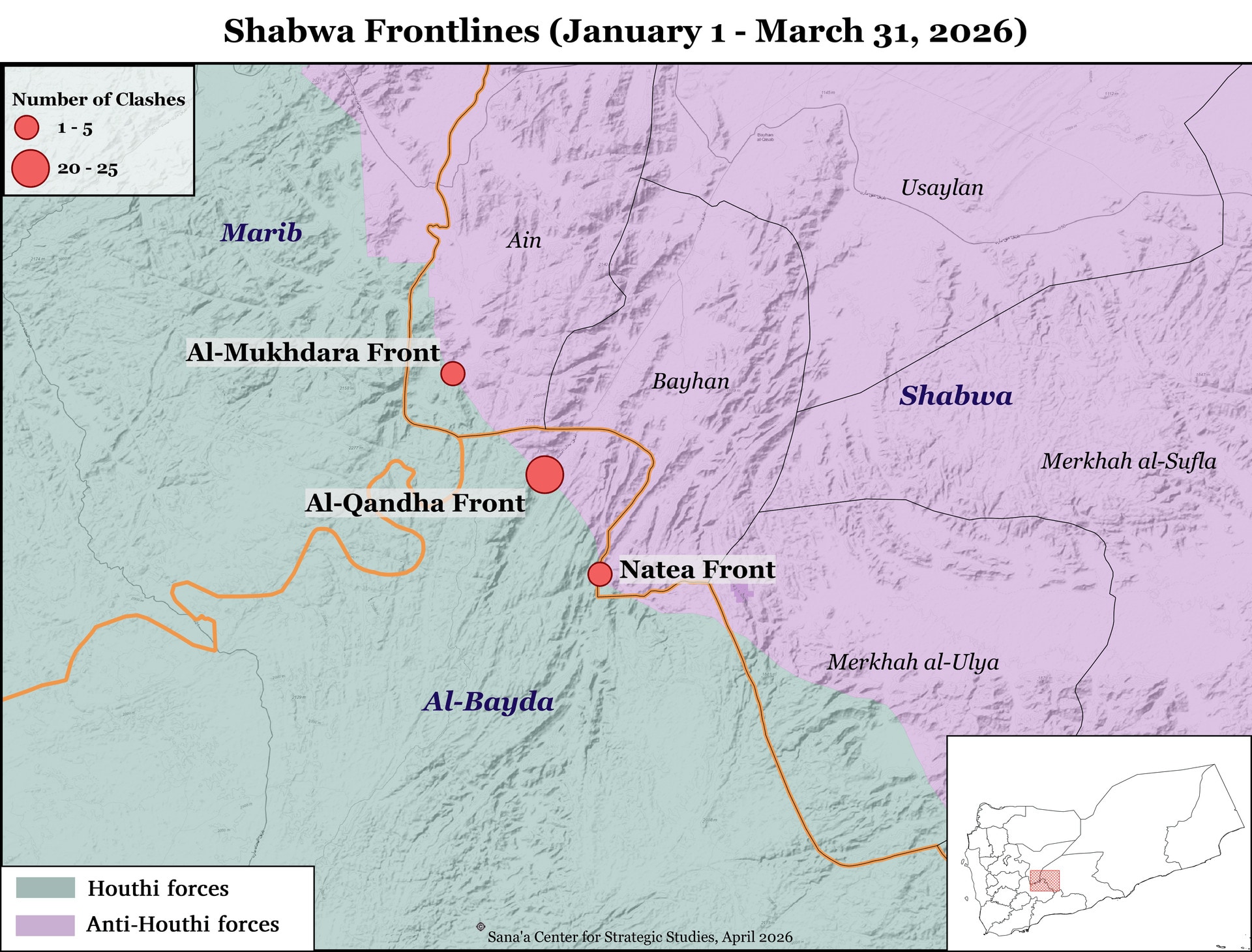
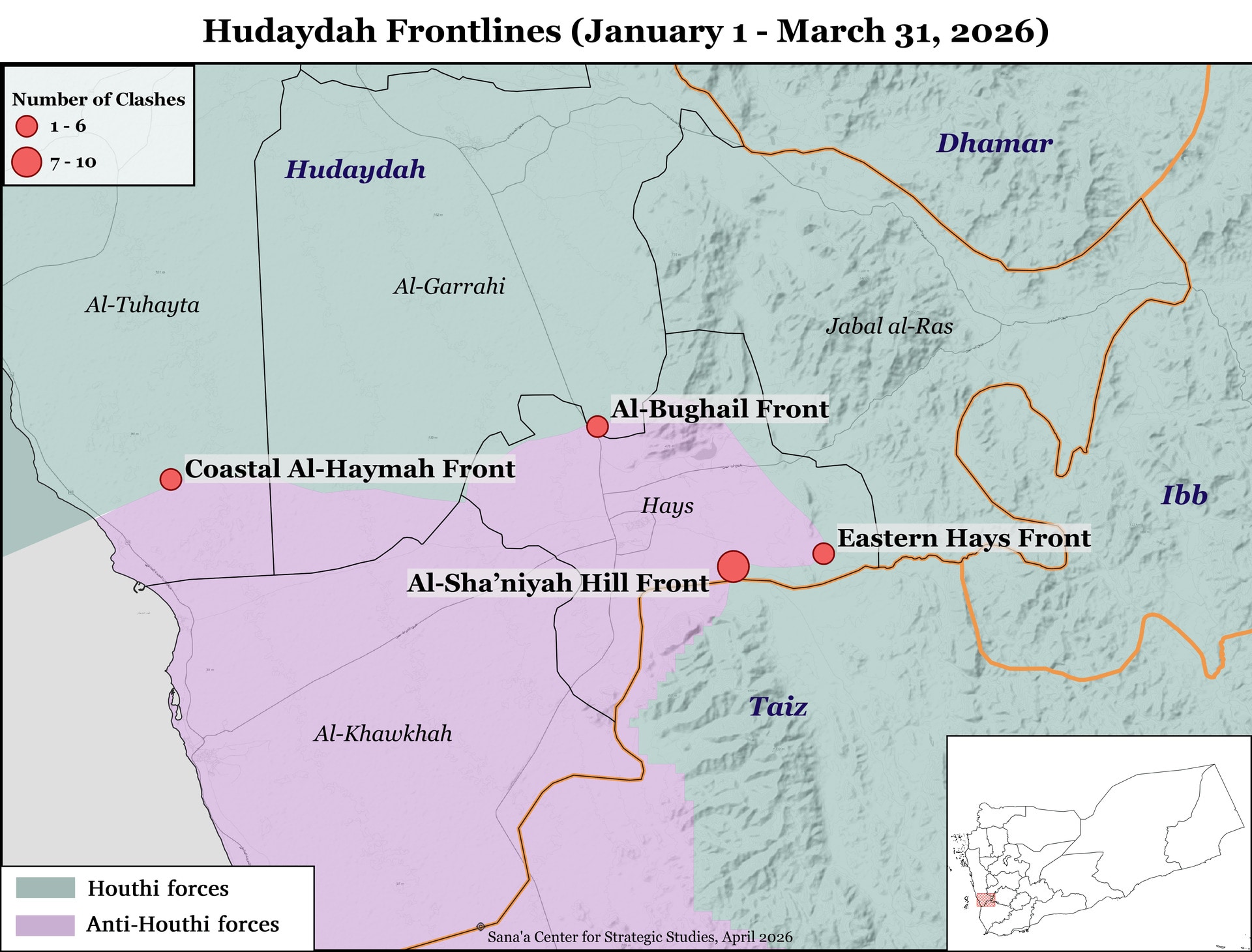
The first major redeployment of ground forces came in mid-March, with the movement of Shabwa Defense forces to Marib’s Hareeb district and Shabwa’s Bayhan and Ain districts, where they replaced units from the Giants Brigades. Shabwa has so far led the way in security reorganization and military redeployments. There is less clarity regarding Saudi plans for the former UAE-backed forces stationed on Yemen’s West Coast, including the National Resistance forces led by PLC member Tareq Saleh, but local sources reported that forces from Saleh’s 2nd Commando Brigade began to redeploy in late March from frontlines in Al-Dhalea to Taiz’s Al-Makha city, Saleh’s base, and on frontlines in southern Hudaydah.
The Saudi approach to restructuring, which has relied heavily on high-ranking individuals, risks alienating lower-level actors and fueling resentment. By privileging a narrow circle of elites, the process could leave rank-and-file personnel feeling excluded from the emerging order. To its credit, Riyadh has taken some steps toward institutionalizing the system. In March, the Supreme Military Committee announced plans to create a comprehensive database of military personnel and integrate them into a unified command structure under the Ministries of Interior and Defense. The government has also rolled out a biometric census linked to salary payments, allowing authorities to inventory forces more systematically and formalize their incorporation into state institutions.
While these measures remain limited in scope, they represent meaningful steps toward centralized control of Yemen’s military sector, something the government has long struggled to achieve. Saudi Arabia has an opportunity to shift the country’s fighting forces from a patchwork of militias toward a more coherent military structure. Realizing this, however, will require sustained engagement and greater investment at the operational level. The Kingdom’s past involvement in Yemen has demonstrated patterns of intense activity followed by disinterest and passivity. More fundamentally, the challenge of securing loyalties remains unresolved. While payroll integration and personnel registries are important tools for reestablishing a semblance of state authority, they are still operating within a system that remains largely unconstitutional and vulnerable to fragmentation. Without a strong, institutionalized security and military apparatus, Yemen, and particularly the south, will continue to be shaped and divided by overlapping affiliations to tribe, family, political identity, and material incentives. The central challenge for the government – and its Saudi backers – will be consolidating authority across this fragmented landscape without provoking backlash from competing actors.
STC Protests Plague New Government
While Riyadh has worked to mitigate the high-level security challenges stemming from the STC’s dissolution, it has had more difficulty containing the group’s grassroots base. The sudden shift in power ushered thousands of STC supporters to the streets, where they have staged numerous protests across the south over the past three months. With the STC’s activities still banned in multiple districts, these protests have emerged as a primary vehicle for southern resistance, creating a dynamic that threatens to deepen the longstanding tensions between the state and the thousands of pro-STC civilians who still see the group as the legitimate governing authority.
Initially, demonstrations in Aden and beyond focused on political representation and opposition to the STC’s dissolution, but over time, they have become more reactionary, decrying many of the strict security protocols imposed by Abu Zara’a and the new cadre of Saudi and southern military leaders. A repeated challenge for the government has been maintaining the delicate balance between asserting control and avoiding draconian measures that risk further alienating the STC’s base. While protests have largely been tolerated thus far (the government simply does not have the capacity to fully suppress them), government officials have repeatedly signaled that violence and attacks on state institutions would not be tolerated. This message was driven home following a January 21 car bombing targeting the convoy of 2nd Giants Brigade commander Hamdi Shukri. Although Shukri survived, five soldiers were killed in the attack. In response, Saudi-led coalition spokesperson Turki al-Maliki warned that any future attacks targeting Aden would be met with an “iron fist.” But such warnings have done little to deter demonstrators, and only two days later, a fresh protest was held in Aden’s Khormaksar Square.
The following weeks were marked by ever-more tenuous confrontations, as protestors grew more aggressive in response to authorities imposing tighter restrictions on public activity. The result has been a self-exacerbating loop that has pushed Aden and the southern cities closer to the brink. Tensions rose again on February 1, after Abu Zara’a ordered the closure of the STC General Assembly headquarters in Aden. The building has since become a central point of contention, with protestors repeatedly reopening it and the government again shuttering it as political leverage. The PLC has justified the closure by claiming that the building had been illegally seized by the STC, and has announced plans to repurpose it as an office for the Tax Authority. In response to the February 1 closure, hundreds of pro-STC demonstrators gathered outside the building before forcing their way inside and compelling security forces to reopen it. On the same day, unarmed pro-STC protestors stormed the offices of the Aden al-Ghad newspaper, looting and damaging equipment after the outlet published commentary critical of the STC.
By mid-February, protests had spread across much of the south, with demonstrations breaking out in Hadramawt, Lahj, Al-Dhalea, Abyan, and Shabwa. STC offices were similarly shuttered and activities banned, drawing hundreds of tribesmen, particularly from Lahj’s Radfan district, to the interim capital to participate in demonstrations in Khormaksar, creating a growing sense of anxiety across the south. On February 11, tensions came to a head after a demonstration in Shabwa’s capital, Ataq, celebrating Southern Martyrs’ Day. While the event started peacefully, protestors moved toward the local authority building, against the scheduled program, and began throwing stones and tearing down the Yemeni flag. Security forces opened fire, killing at least four people and wounding 30 others, including minors.
Violence soon spread to other cities. On February 19, bullets fired by security forces in front of Al-Ma’ashiq Palace, where demonstrators were protesting the government’s return, left one person dead and 11 others wounded. On April 4, two demonstrators were killed in Mukalla after security forces opened fire on protestors who defied a government ban on STC-affiliated gatherings in the governorate. PLC head Rashad al-Alimi called for an investigation into the incidents.
Despite a brief lull in protests in late March, confrontations have since resumed with heightened intensity and following a series of government crackdowns. Security forces again closed the STC General Assembly building on February 21 and March 9, while protests in Aden were restricted to Khormaksar Square. The government ordered the arrest of Lahmar Ali Lasoud, head of the STC’s Shabwa branch, on suspicion of involvement in the Ataq clashes. In Hadramawt, tensions likewise intensified, and Governor and PLC member Salem al-Khanbashi threatened to ban public displays of Aiderous al-Zubaidi’s image. Officials in Aden took similar steps to curtail the STC’s visibility, removing images of the exiled secessionist leader from public spaces. In response, thousands of people gathered in Aden on April 1, condemning another closure of the group’s General Assembly headquarters and punitive measures against other branches. Despite the deployment of security forces, protestors broke into the General Assembly building and forcibly reopened it.
The absence of any major political concessions in favor of the STC and or the broader Southern Movement (Al-Hirak), particularly the postponement of an envisioned South-South dialogue (see Politics and Diplomacy), raises questions about Saudi Arabia’s long game. For its part, the STC has managed to carve out limited space for itself in recent weeks despite the mounting pressure. Its General Assembly has remained open for over a week following government concessions after the deadly protests in Hadramawt, and the Mukalla office has been reinstated. Looking forward, the group’s trajectory will likely depend on its ability to assert authority without provoking further government repression. Both the government and its Saudi backers face a similar constraint. A key test of whether this stalemate will hold will be the upcoming May 4 celebrations, marking the anniversary of the 2017 Aden declaration, the STC’s founding charter. Protestors are likely to be out in full force, and the government’s handling of the demonstrations will be an important marker of its standing and ability to manage the transformed political landscape.
Notable Pro-STC Protests
January 8 – Al-Dhalea: Pro-STC demonstrations are held across Al-Dhalea governorate. Protesters, carrying flags of the former South Yemen and the UAE, chant against Saudi Arabia and denounce Saudi airstrikes against STC forces in the governorate.
January 10 – Aden: Thousands of pro-STC demonstrators hold a rally in Khormaksar Square in Aden, rejecting the group’s dissolution and carrying photos of STC chief Al-Zubaidi. Many appear to be from Lahj and Al-Dhalea.
January 16 – Aden: A large pro-STC demonstration is held in Khormaksar Square, with demonstrators chanting in support of Al-Zubaidi.
January 23 – Aden: A new round of pro-STC demonstrations is held in Khormaksar Square, with protestors raising the southern flag and decrying the party’s dissolution.
February 1 – Aden: Pro-STC demonstrators protest in front of the group’s General Assembly building in Aden and force security forces to reopen the building. STC branches across the south hold executive council meetings despite a ban. Protestors raid the Aden al-Ghad newspaper headquarters and loot office materials, reportedly in response to comments critical of the STC.
February 2 – Hadramawt: Hundreds of people march in Mukalla during a nighttime demonstration in support of the STC.
February 6 – Hadramawt: A large pro-STC rally is held in Seyoun city in Wadi Hadramawt. Rally organizers publish a statement decrying the storming of STC buildings in the Tarim and Al-Qatn districts and a raid on the home of local leader Mohammed al-Zubaidi. A number of protestors are arrested.
February 7 – Aden: Tens of thousands of STC supporters gather in Aden for a rally calling for the return of the STC. Additional marches are held on February 10 and 11.
February 10 – Hadramawt: A large pro-STC rally is held in Mukalla. Aiderous al-Zubaidi posts on X for the first time in nearly a month, calling on supporters to “continue the struggle” in a new chapter in the revolution for a free South.
February 11 – Shabwa: The STC’s Shabwa branch announces plans for a public commemoration of Southern Martyrs’ Day, leading to clashes between pro-STC demonstrators and security forces, who reportedly opened fire on stone-throwing protesters. Armed protesters, who local sources indicated were ununiformed members of the STC’s armed forces, fire back, leading to hours of fighting that leave at least four people killed and 30 wounded.
February 12 – Aden: Pro-STC demonstrators hold a march in Al-Buraiqa district to condemn violence against STC supporters in Hadramawt and Shabwa.
February 14 – Abyan: Pro-STC demonstrators stage a rally in Zinjibar district in response to a call by the local STC branch in Abyan.
February 16 – Al-Dhalea: Thousands gather in Al-Dhalea city for a pro-STC demonstration. It is the first protest in Al-Dhalea, the STC’s main stronghold, since the group’s official dissolution.
February 20 – Aden: Violent clashes break out around Al-Ma’ashiq Palace after Nation’s Shield forces open fire on pro-STC demonstrators, who were reportedly attempting to storm the seat of government. One person is killed in the clashes; the number of wounded is variously reported as between 11 and 23.
February 20 – Hadramawt: Pro-STC demonstrations break out in Mukalla.
February 27 – Aden: Thousands of pro-STC demonstrators protest in Khormaksar Square after an STC call to rally.
March 3 – Aden: Members of the STC General Assembly stage a protest in Aden, rejecting the government’s decision to dissolve the STC, close its offices, and remove the southern flag.
March 20 – Aden: Dozens of STC supporters gather near Al-Ma’ashiq Palace to protest during the Eid al-Fitr prayer being held on the palace grounds.
April 1 – Aden: Thousands of people gather for a pro-STC rally in Aden, condemning the closure of the group’s General Assembly headquarters by government forces and crackdowns against its other branches, particularly in Hadramawt. Despite the deployment of security forces, protestors managed to break into the General Assembly building and forcibly reopen it.
April 4 – Hadramawt: Dozens of STC loyalists take to the streets of Mukalla, despite warnings against public gatherings. Clashes break out between security forces from the 2nd Military Region and protestors, leaving at least two STC supporters dead.
April 5 – Aden: Dozens of soldiers loyal to the STC gather in Aden’s Al-Buraiqa district to protest the new biometric fingerprinting system linked to military salary payments, which the government recently implemented in coordination with the Saudi-led coalition.
April 7 – Lahj: Pro-STC rallies are held in Lahj in the districts of Radfan, Habil Jabr, Halimeen, Al-Milah, Al-Hawtah, Al-Musaymir, Yafea, Al-Hadd, Yahr, and Al-Muflihi.
Frontline Developments
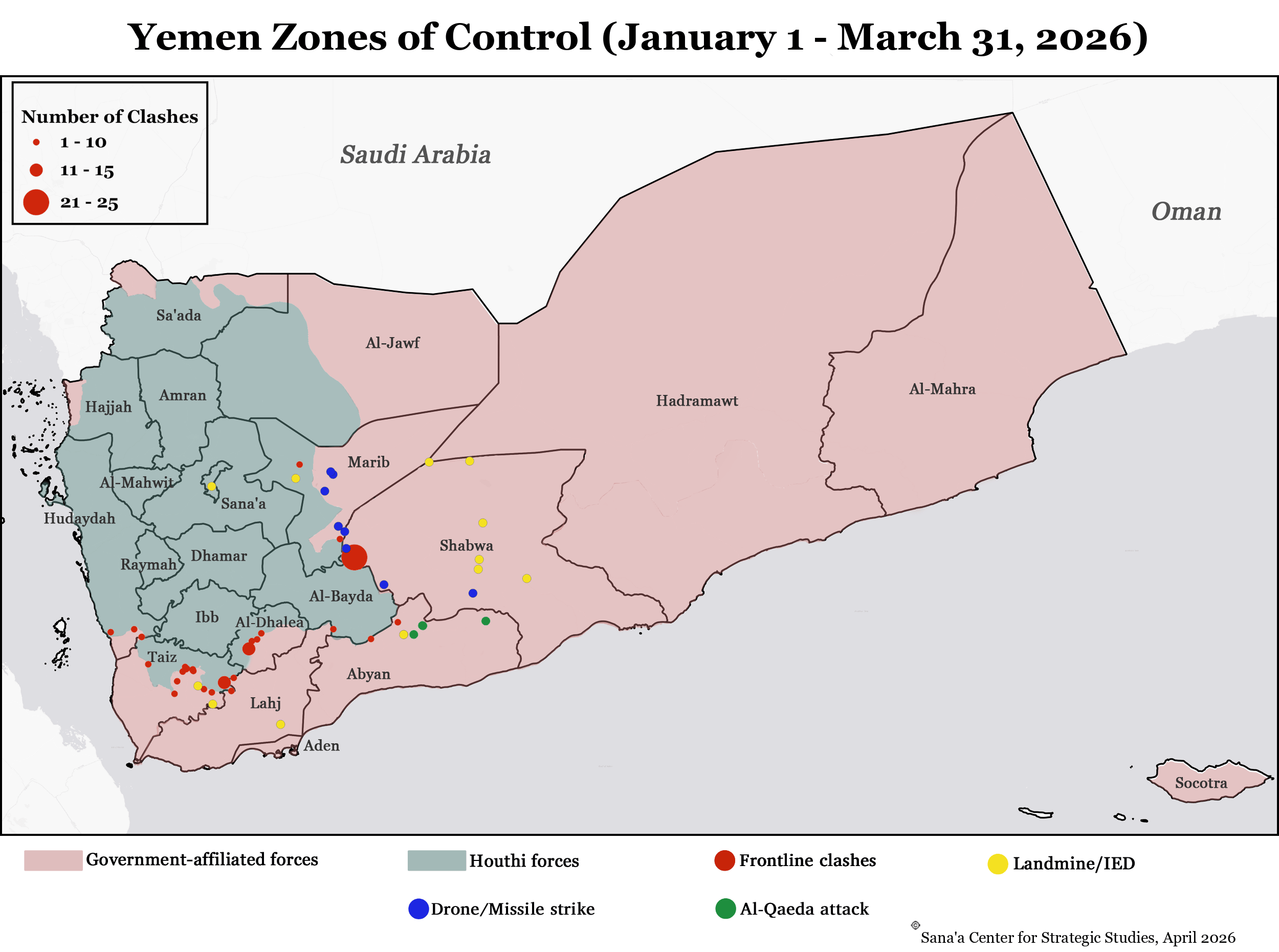
Yemen’s frontlines have largely withstood the sweeping changes to the anti-Houthi coalition’s security landscape, remaining mostly unchanged since the beginning of the year. While the Houthis made a number of probing attacks, particularly on frontlines in Hudaydah, Marib, and Taiz, the group has refrained from exploiting the turbulence on the government side. This is not entirely surprising. The Houthis are still recovering from last year’s devastating US and Israeli airstrikes, are managing a series of internal security crises in Sana’a, and have now become participants in a broader regional conflict.
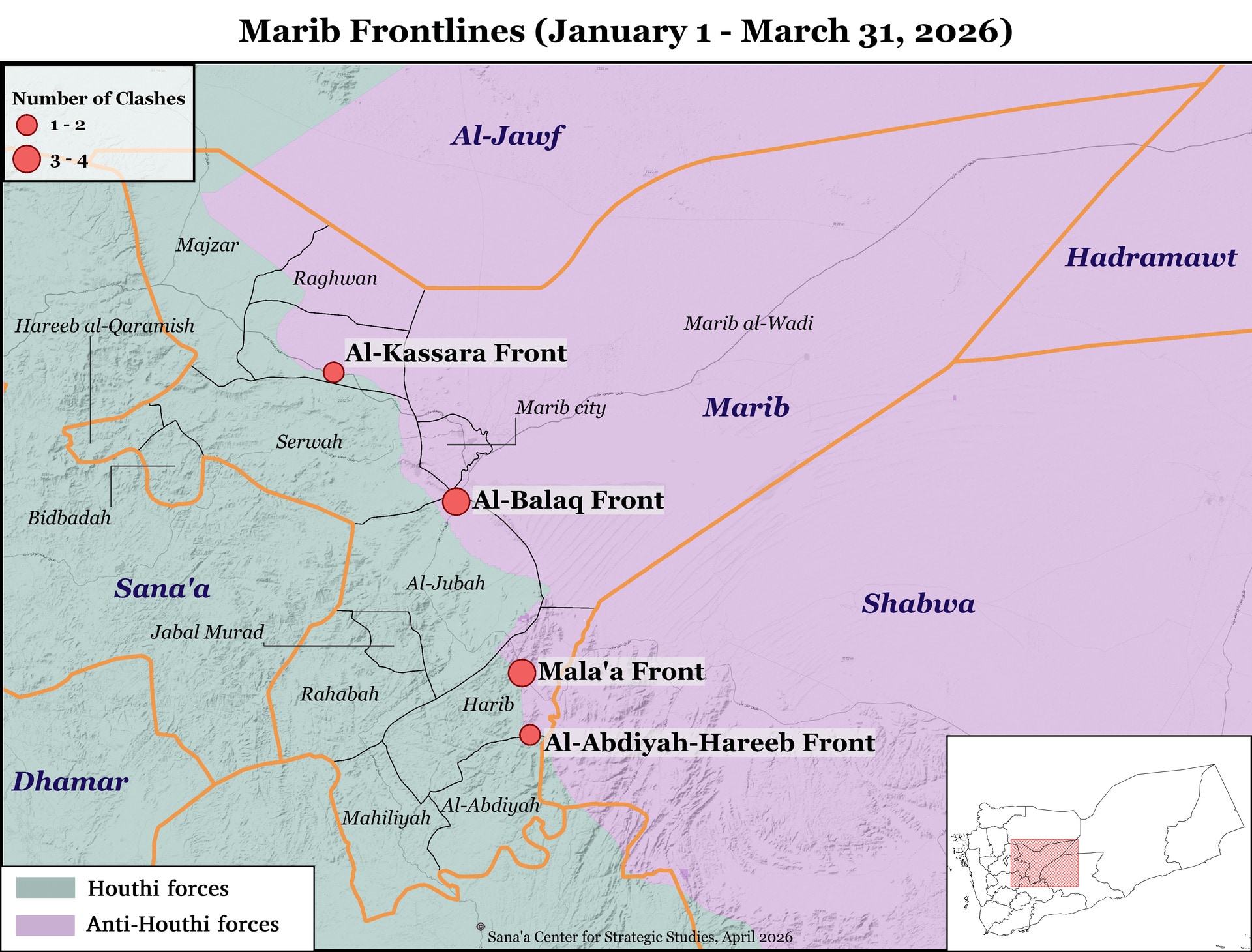
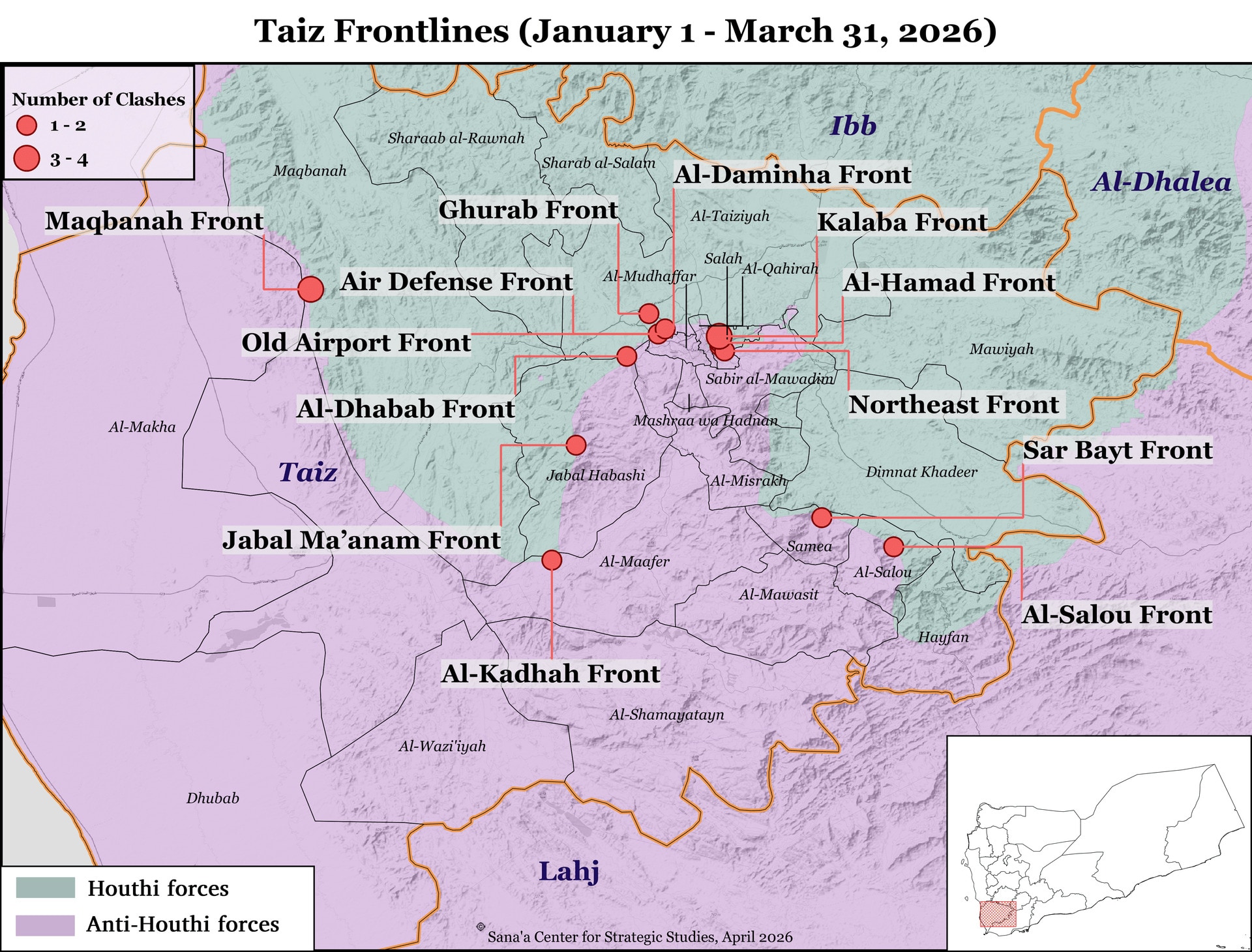
But fighting continues to flare up on several fronts as both sides work to adjust to the evolving security situation, and the Houthis have sent reinforcements to a number of governorates to counter new government deployments. Hudaydah experienced one of the most intense periods of fighting in recent years. Between February 11 and 24, heavy clashes were reported across four frontlines, with 18 soldiers killed and 57 wounded in just one week. The situation has since stabilized, but security sources say the fronts remain heavily fortified. In Marib, clashes continue to erupt along the Mala’a front in the southern Hareeb district, where Houthi forces appear to be testing the capabilities of Shabwa Defense forces, following their recent deployment to replace Giants Brigades forces there. In Taiz, recent weeks have seen increased fighting on fronts to the west of the city, with reports of Houthi troops and heavy equipment arriving from Hajjah in early April. While these flare-ups remain contained for the moment, they are key pressure points for a government already grappling with internal instability. Should the Houthis gain greater operational bandwidth amid a cooldown in the regional escalation, these fronts are likely to emerge as hotspots for any renewed fighting.
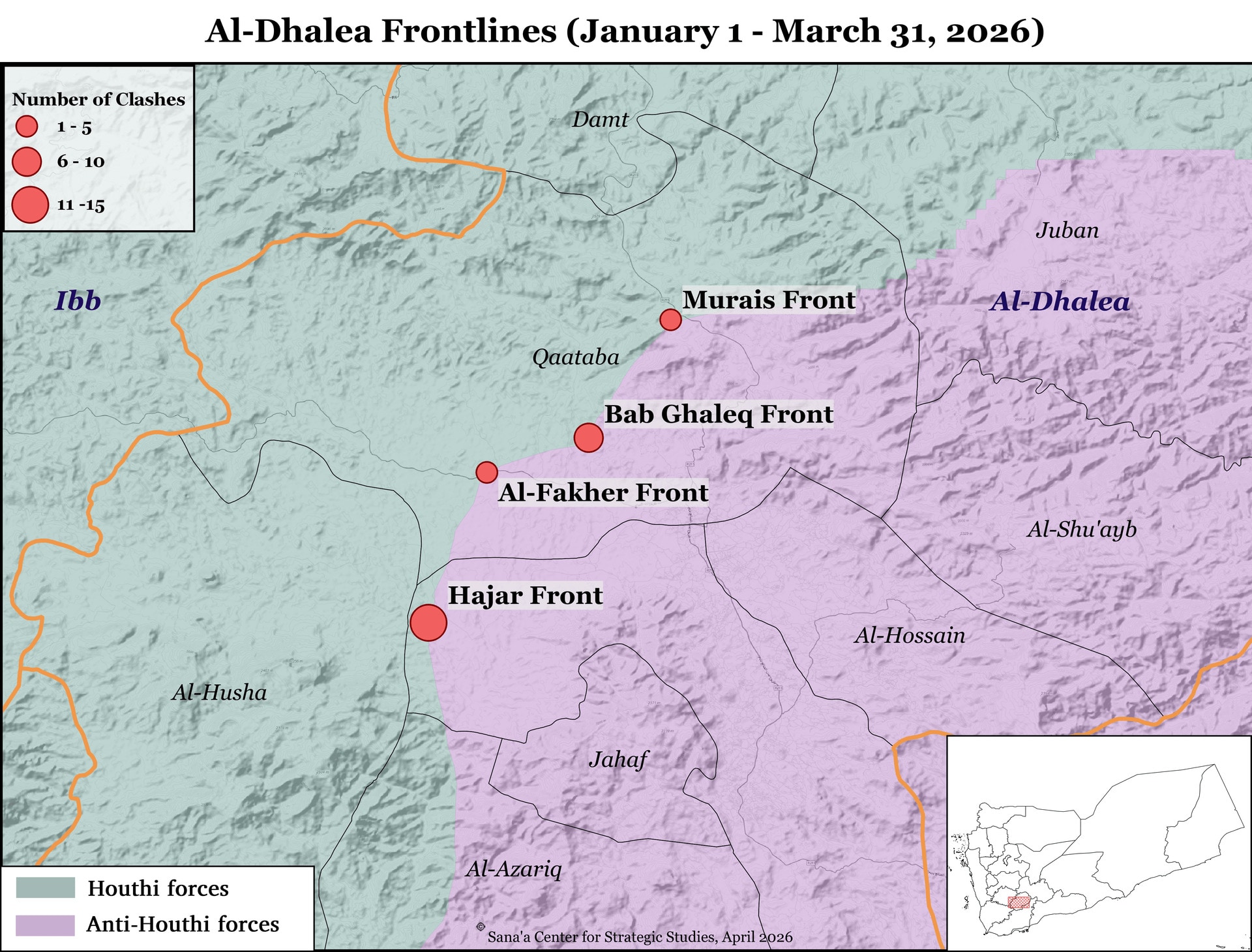
Frontline activity elsewhere has followed existing trends. Lahj, Al-Dhalea, Abyan, and Shabwa all witnessed periodic clashes along established lines of contact, with no significant territorial changes. While Al-Qaeda still maintains a presence in several governorates, most notably in Abyan, there has not been a noticeable rise in operations amid the ongoing reorganization of counterterrorism forces, many of which were previously backed by the UAE. However, local sources in Abyan report that militants affiliated with Al-Qaeda are now operating with greater visibility, including holding meetings in the open.
Other Developments in Brief
February 5-9: The Kamaran Battalion of the Houthi naval forces conducted land and sea maneuvers in areas along the Red Sea Coast, including on Kamaran Island. The simulation included attacks on naval vessels using speedboats, drones, and unidentified objects floating on the sea surface, possibly mines. Fighters also practiced blockading, seizing, and boarding various ship types.
February 16: Al-Qaeda militants attacked several positions held by members of the Arrows of the East counterterrorism campaign in the Omayran Valley in Mudiyah district. The clashes came in the wake of a redeployment of former Security Belt (now National Security) forces from the Omayran Valley to Zinjibar.
March 26: Journalist Samed al-Qadi was fatally shot in the center of Taiz city by unknown gunmen, reflecting the ongoing battle against rampant insecurity in the governorate, now six months after the assassination of government official Iftehan al-Mashhari. The killing is believed to have been committed by individuals connected with informal security forces in the city.
March 31: The final mandate of the United Nations Mission to Support the Hudaydah Agreement (UNMHA) expired. UN Security Council Resolution 2813 terminated the mission in January, seven years after it was created to support the 2018 Hudaydah Agreement. The UN is working with government officials to clarify the transfer of responsibilities to the government and the UN Special Envoy’s office, which are now assuming the mission’s former duties.
April 6: A National Resistance drone mistakenly killed a 20-year-old man, Burhan Ali Taha, on the roof of his home in Al-Waziyah district during a raid related to the hunt for a wanted crime ring leader. The killing of Taha, the son of Ali Taha, one of the leaders of the battles to liberate Al-Waziyah from the Houthis in 2016, sparked outrage in the governorate, with a number of groups calling the strike part of systematic aggression and demanding the withdrawal of National Resistance soldiers from the area. In response, Tareq Saleh personally ordered an investigation into the incident, and following tribal mediation, the National Resistance forces handed over nine individuals involved in the killing, while the Ministry of Interior ordered the arrest of 22 individuals believed to be involved in the aforementioned crime ring.
Former Editor