

The Iran War: Reaction from Sana’a Center Experts
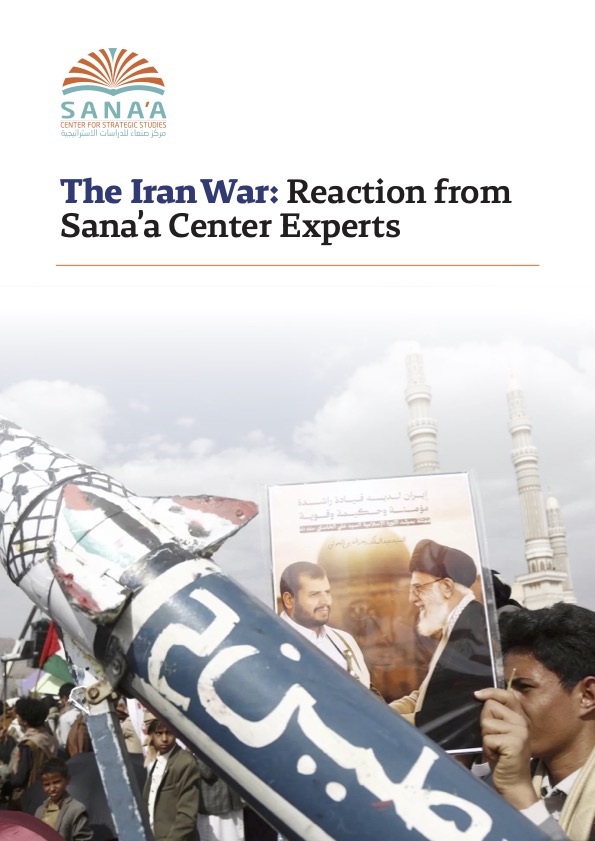
The war against Iran by the US and Israel is unleashing chaos across the region. Since the launch of the joint military offensive in the early hours of February 28, Iran’s death toll has reached the thousands, and its Supreme Leader, Ayatollah Ali Khamenei, has been killed. Tehran’s retaliation continues to widen, with missiles and drones being fired at Israel, American bases, and neighboring Gulf states. Support for Iran from the so-called Axis of Resistance has so far come from Hezbollah and Iraqi militias, but the price for their involvement has been high. Lebanon, in particular, continues to be under heavy Israeli bombardment.
The conflict has, for the time being, spared Yemen. All eyes are on the Houthis, Iran’s most steadfast ally, who have so far shown reticence to join the war militarily. Should they engage in hostilities with the US, Israel, or even the Gulf states, this could spell a very dangerous turn for Yemen. Hope for stability now hangs precariously on the volatile shifts expected in the coming weeks.
Sana’a Center experts react to the recent developments in the Iran War and explore how it is likely to affect Yemen.
The Failure of the Axis of Resistance
The Axis of Resistance, the product of the Islamic Republic of Iran’s patient building of a network of like-minded state and non-state actors in the Middle East, has failed. While the Axis is not defeated and retains some capabilities, it has clearly shown its severe limits. The Axis’s central hub in Iran is now acutely vulnerable, while many of its spokes have suffered losses (Hezbollah in Lebanon), in some cases severe losses (Hamas in the Palestinian Territories), and one of them, Bashar al-Assad’s Syria, has disappeared.
The most important factor explaining the Islamic Republic’s doctrine, often referred to as the strategy of forward defense, is its acute awareness of the region’s severe military imbalances. Recognizing its vulnerability in the event of direct, conventional military confrontation, it chose over the decades to invest in a range of asymmetric assets, notably missiles, drones, and armed non-state actors. The goal was not to reach parity but to convincingly threaten to inflict sufficient pain on its adversaries to deter them from directly attacking Iran.
This strategy proved effective for some time. Until October 2023, there existed a perception of a balance of terror, if a fragile and unstable one, between the United States and Israel, on one side, and Iran on the other. Because open warfare would be costly, as leaders on all sides believed, it was better to avoid it and focus on indirect, localized, and calibrated violence. After the October 7 attacks, however, Israel jettisoned this restraint and chose to fully exploit its massive conventional military power advantage.
Israel subsequently inflicted serious losses on Hezbollah and Hamas during campaigns in Gaza and Lebanon. Neither group has been defeated, but in both cases, their ability to retaliate against Israel has been severely curtailed. In April and October 2024, Israel and Iran directly attacked each other for the first time. In both instances, Israel dominated: it inflicted damage on Iran while suffering only limited pain itself. This dynamic was even more acute during the Twelve-Day War in June 2025: Israel achieved near complete air superiority over large parts of Iran, damaging its military infrastructure, including its air defenses, and, with American participation, its nuclear program. The most recent round of violence has only compounded this trend.
What does this latest round of conflict mean for the Axis of Resistance, and specifically for the Houthis? Before 2023, there was speculation about the Axis’s growing institutionalization. Events since, however, have shown a limited commitment on the part of Axis members to collective self-defense; there have been only uneven efforts to come to each other’s rescue in their hour of need. As the Islamic Republic’s survival is in question, Hamas and Hezbollah, long seen as the vanguard of the Axis, are too weak and constrained to jump into the fight decisively. Iran-backed militias in Iraq are more concerned with preserving their local interests, notably financial, in a fragile Iraq. The Houthis are the one success story in the Axis in recent years; unlike most other members, they are now stronger than they were three years ago. Yet, they too fear American and Israeli retaliation should they join the fight. They also have domestic interests to manage.
The future is bleak for the Axis. If the Islamic Republic survives the war, it will be weaker and therefore more reliant on remnants of the Axis, especially the Houthis, to contribute to its security. Tehran will need to staunch the bleeding to maintain a minimum level of deterrence. To do so, it will need to rebuild trust within the Axis and continue arming its members. However, the Islamic Republic will likely remain choked by sanctions, paralyzed by internal regime infighting, severely weakened militarily, and inward-looking and excessively fearful of a resentful and exhausted population.
The longer the US-Israeli war on Iran continues, the greater the probability that the Islamic Republic collapses. Among Axis members, the Houthis would likely be best positioned to adapt to a post-Islamic Republic world. They have local sources of power and revenue and continue to benefit from the weakness of the anti-Houthi coalition. They have also expended significant energy in recent years to diversify their partnerships, notably with China, Russia, and in the Horn of Africa. Nevertheless, the Houthis, like all other Axis members, would also suffer major setbacks. For one, their missile and drone program, so central to their leverage against Saudi Arabia, the UAE, and maritime shipping in the Red Sea, would likely not be sustainable absent Iranian support.
A Delicate Decision for the Houthis
Regional escalation has forced the Houthis into a dilemma. While their alignment with Tehran and the Axis of Resistance points toward the possibility of direct involvement in the war, their reticence suggests that, unlike past instances, the group may be wary of overextension. Such wariness is shaped both by the fragility of Yemen’s domestic balance and the evolving nature of American and Israeli deterrence. In the past year, US and Israeli strikes in Yemen have shifted towards a more aggressive pattern — from targeting Houthi military assets to strikes against Houthi leadership and civilian infrastructure. The losses have been heavy, including several senior military figures, not least Chief of Staff Mohammed al-Ghamari.
At the onset of the joint Israeli-US attack on Iran, the Axis of Resistance, including the Houthis, likely viewed the escalation as a coercive diplomatic tool designed to force Tehran’s hand at the negotiating table. They showed little appetite for a broader war that offered no clear benefits beyond widening regional conflict. Hezbollah was still struggling to recover from continuous Israeli strikes, while the Houthis were recalibrating their priorities and returning to discussions on the roadmap and mutual understandings with Saudi Arabia. In Iraq, militia factions were busy seeking American acceptance of Nouri al-Maliki’s potential return to power.
But with the assassination of Iran’s Supreme Leader and prominent Iranian military commanders, alongside the spread of missile strikes across the region, and Hezbollah’s entry into the war, the Houthis have been forced to reconsider their position. Iran’s demonstrated ability to retain strategic initiative may encourage the group to lean further into the conflict, especially if it evolves into a prolonged war of attrition. This environment aligns with the Houthis’ military style and operational behavior.
Several factors could further encourage Houthi engagement. These include the group’s ability to threaten the Bab al-Mandab Strait and the reach of its missiles and drones toward potential targets, including Israel and US bases in the Gulf. One major constraint is the Omani-mediated understanding with the US that halted direct hostilities last year. Entering the war would shatter this agreement, removing Washington’s restraint and inviting a lethal, sustained campaign against the group’s leadership and infrastructure.
Should the Iranian regime’s survival be at stake, the cost of intervention for the Houthis would likely outweigh any potential gains. Domestically, the Houthis also fear that the war could trigger a shift in Saudi and US support toward their domestic adversaries in Yemen, possibly leading to a large-scale offensive against the group. Ultimately, whether the Houthis engage or abstain, they have entered a definitive test of political survival where the agency and the consequences rest squarely in their own hands.
Beyond the Houthis, the Iran War is a Litmus Test for Yemen’s Internationally Recognized Government
The escalating war on Iran has triggered widespread speculation regarding Houthi intervention. Yet, for Yemen, the most consequential questions may lie elsewhere. Beyond the strategic calculus of the Houthis, the unfolding regional escalation serves as a critical test for Yemen’s internationally recognized government in terms of its strategic readiness, institutional coherence, and capacity for independent action.
On March 4, Presidential Leadership Council (PLC) head Rashad al-Alimi convened a meeting with the government’s Crisis Management Committee, marking the first emergency-level meeting of its kind since the Twelve-Day War last June. Prior to that, there had been little visible indication of scenario planning or coordinated preparation for prolonged regional escalation. Given the potential for maritime disruption, energy shocks, or cross-border retaliation that could directly affect Yemen, the need for clear strategic signaling from Aden is at an all-time high for the Yemeni people.
Government planning is significant because this escalation will affect Yemen regardless of whether the Houthis formally enter the conflict. Even limited involvement by the group could spur responses that further militarize the Red Sea and increase pressure on Yemeni territory and its people. In a more serious scenario, if Gulf states were directly targeted by the Houthis, Yemen could become deeply entangled in this war.
In the coming weeks, it will become increasingly clear whether the Yemeni government is merely observing events or actively pursuing defined objectives – positioning itself to capitalize on potential shifts on the ground and demonstrating readiness for different escalation scenarios. This could include plans to address potential governance vacuums, maintain service delivery, and instill institutional authority, if the balance of power changes.
At present, the government faces two structural weaknesses. The first is institutional fragility. Security management in Aden continues to exhaust political attention and hinder forward-looking planning. Second, the government is almost wholly dependent on Saudi Arabia. While Saudi backing remains essential for the government’s survival, overreliance reduces its ability to act independently or proactively influence events. If Riyadh recalibrates its priorities in response to regional war, the government risks being relegated to a secondary instrument of foreign policy rather than an independent sovereign actor.
The government formed earlier this year is more internally cohesive than its predecessors, where the ministerial weight of the UAE-backed Southern Transitional Council (STC) often served as an obstacle to policy. This relative unity narrows the scope for internal vetoes, thereby stripping the government of its ability to cite fragmentation as a justification for inaction. A more unified cabinet thus raises expectations among both domestic constituencies and external partners. If regional escalation produces a moment of opportunity, whether through Houthi distraction or shifting Gulf alignments, particularly a growing convergence between Saudi Arabia and Oman on Yemen, the burden of initiative will rest more squarely on the government than before.
In early 2025, during the US air campaign against the Houthis, there was a debate on whether government-aligned forces could capitalize on the military pressure to reclaim key territories, particularly around Hudaydah. That moment passed without any strategic movement, partly due to regional divergences over a renewed offensive against Houthi-held areas. While the current environment has shifted in an important way — marked by a more cohesive cabinet but deeper regional rifts — it remains unclear whether the government’s decision-making culture has evolved in parallel.
Ultimately, this regional escalation challenges Yemen’s government to move beyond internal management and proactively assert national interests via sustained diplomatic engagement amid exceptional regional volatility. Key diplomatic posts, however, remain inactive: the Yemeni ambassador to Washington submitted his resignation in December, while the embassy in Riyadh has lacked an ambassador since March 2024. Meanwhile, Prime Minister Shayea al-Zindani, who also serves as foreign minister, is based in Aden and is likely burdened by pressing domestic priorities despite the urgent need for high-level international engagement. Taken together, these gaps risk weakening the government’s ability to shape its own narrative and actively engage diplomatic arenas to communicate Yemen’s positions, needs, and concerns as regional tensions intensify.
The US Will Win the War and Lose the Peace, Again
The opening phase of the Israeli-instigated US war on Iran is being celebrated by some as a master stroke of military planning. That may or may not be true, but virtually all US foreign military forays over the past few decades were brilliant in tactics but dismal in strategy. The war on Iran will, in all likelihood, be a repeat of its misadventure in Iraq, where a multi-year occupation only helped instill Iranian influence in the country.
A possible scenario is as follows: Iran is weakened and forced to compromise on its nuclear file and support for Axis of Resistance allies across the region. Israel emerges as the unchallenged regional hegemon, working to implement a plan for a Greater Israel stretching from the Euphrates to the Nile. This idea has been openly expressed by officials from both Israel and the US.
Already, the next move has been put on the table by former Israeli Prime Minister Neftali Bennet, who declared that Turkey is emerging as a threat to the state of Israel, and warned of a “new Sunni axis that includes Turkey, Saudi Arabia, Qatar, and Pakistan.” Meanwhile, countries in the region, having seen the codes of international law trampled by Israel, the US, and most Western democracies over the past three years, will see that the only option to restore stability is to resort to the good old balance of power game, building a broad alliance to counter an Israel-India-UAE axis, with the US firmly behind it. When the dust settles, the US will find many regional allies having taken a step away from the US and a step closer to China and Russia. This alliance will also likely include Iran, which will have abandoned its regional proxies and become less threatening to its neighbors.
The outcome of this war could potentially bode well for Yemen. The Iranian regime is likely to emerge intact, but much weaker. One of the three conditions set by the US for ending the conflict is an end to Iranian support for its proxies. Without Iran’s support, the Houthis will finally come to the negotiation table with more modest demands than previously, when they insisted that they were the legitimate government of Yemen and refused to negotiate with the internationally recognized government. Serious peace negotiations that lead to a durable and balanced peace might finally become possible.
This analysis is part of a series of publications produced by the Sana’a Center and funded by the government of the Kingdom of the Netherlands. The series explores issues within economic, political, and environmental themes, aiming to inform discussion and policymaking related to Yemen that foster sustainable peace. Any views expressed within should not be construed as representing the Sana’a Center or the Dutch government.
Non-resident Fellow
Communications Officer
Research manager
Senior Researcher