

Feature
‘Our Land Smelled Beautiful’: Stories from IDPs in Yemen
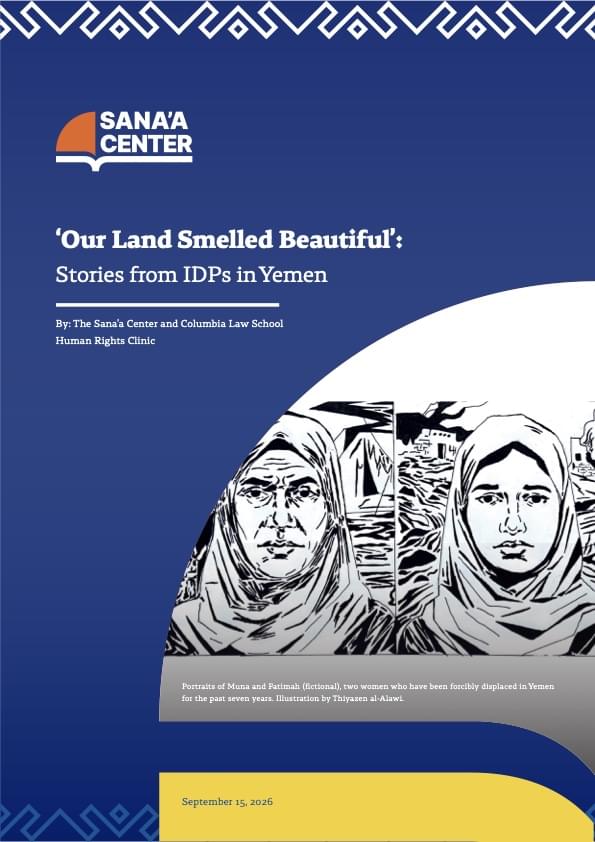
Editor’s Note: This feature was developed through a collaborative effort between the Sana’a Center, the Human Rights Clinic at Columbia Law School, and Bushra Alleswas, a senior development practitioner and humanitarian. Two women agreed to share their stories and their experiences of displacement. Their names have been changed to protect their identities. We express our deepest gratitude to both of them for their candor, courage, and willingness to communicate the urgency of Yemen’s ongoing internally displaced persons (IDP) crisis.
In Spring 2025, Maya Ghazi (a pseudonym) led the conceptualization, research design, and writing of this piece, with support from Theodosia Catisapis and Safia Southey. In Spring 2026, Kimi Nasiri, Paola Ripoll, Grace Tully, and Charlotte Birsh contributed to the research and writing of various drafts. The research design was supervised by Smith Family Human Rights Clinic Professor Sarah Knuckey, while the piece was co-authored and supervised by Associate Research Scholar and Supervising Staff Attorney Luna Borges.
Illustrations for this report were created by Thiyazen al-Alawi, a Yemen-based artist, who learned about these stories through collaboration with the authors. His artwork portrays the challenges faced by young Yemenis affected by conflict, displacement, violence, poverty, and shelling, and highlights new narratives to amplify the lived experiences of both war and non-violent responses to conflict.
In a roofless house in Aden, Muna cooks the evening meal over a fire in the main room. The smoke has nowhere to go, filling the space where her four children sleep and eat; the smell makes them sick.
Not far away, in a courtyard shared with 63 other displaced families, Fatimah watches her ninth and youngest child grow weaker in the heat. His skin is inflamed, he cannot breastfeed, and her family cannot afford to leave the tent for better, cooler shelter.
Internal displacement in Yemen has reached a devastating scale, with around 4.8 million Yemenis currently living in displacement across the country.[1] Women and children,[2] who make up the majority (80 percent) of the displaced population,[3] are particularly at risk of malnutrition, disease, violence, and exploitation.
Internal displacement occurs when people are uprooted from their habitual residence, land, community, or home.[4] Displacement can be caused by armed conflict, violence, natural or human-made disasters, climate change and environmental impacts, and other human rights violations. By definition, internally displaced persons (IDPs) don’t cross international borders, in contrast to refugees, who leave their own countries to seek refuge elsewhere. The stories of IDPs are nonetheless marked by severe hardships, including lack of access to food,[5] clean water,[6] healthcare,[7] and education.[8]
This narrative piece is grounded in the stories of two women, Muna and Fatimah, who were interviewed in Aden, but it also tells the larger story of the lived realities of thousands of Yemeni families. Through an experienced local researcher, women described what it has meant to lose their home, their communities, and their sense of safety and comfort. The testimonies below provide insight into experiences that often remain undocumented due to years of conflict and the absence of safe spaces where victims and survivors can share their stories. The stories, accompanied by illustrations that visually represent their experiences, help us share the realities faced by women and children at risk. They highlight patterns of displacement and vividly illustrate the complex connections between prolonged conflict, inequality, environmental degradation, and climate change.
Two Women’s Journeys Through Ongoing Displacement and Precarity
Fatimah: A Mother’s Flight from Forced Recruitment
Fatimah is a 43-year-old woman from the Asifra area of Taiz city’s Al-Qahira district, who has been displaced twice since 2018. She is married with nine children: five daughters and four sons.
The armed conflict’s encroachment on her home is what initially forced Fatimah and her family to flee their neighborhood in Taiz. After a nearby gas station was hit by mortar fire and her neighbor was killed by shrapnel, Fatimah packed her things and left. “We just fled to save our children’s lives,” she said. “I grabbed what was important, especially our personal documents.”
Her whole family is now settled in the Al-Sha’ab area of Aden’s Al-Buraiqa district, living in a courtyard with 63 other families. Fatimah’s family initially wanted to stay in Taiz, relatively close to home, as long as it remained safe. After their first displacement in 2018, the family settled inside the school where Fatimah enrolled her children, which was housing IDPs during the administrative break. Eventually, they were asked to vacate for the start of the school year and moved into tents outside the school grounds.
Just before the children’s final exams that year, Fatimah was visited by the school principal. He informed her he was under extreme pressure from leaders of the Houthi group (Ansar Allah) to submit names of students of eligible age for recruitment to their military forces. “I told him, ‘I fled with my children from death, only to send them to their death?’,” said Fatimah. She forbade her children from attending school, stating that she would rather they lose a whole school year than be forcibly recruited. Despite her efforts, the neighborhood supervisor (aqil) informed her that her sons’ names had been submitted, and that he was willing to strike a bargain to send just her husband and eldest son to the Houthi forces while her third son, who was in middle school at the time, would be spared in exchange for 150,000 Yemeni rials (approximately US$280). “That was the decisive moment for me, my husband, and my children,” said Fatimah. “We decided right then to flee and seek refuge in a safer area. This time, we chose Aden.”
Fatimah’s decision to pull her sons from school to keep them out of the recruiter’s reach illustrates a broader pattern across Yemen. More than 2.5 million children are out of school, and 8.6 million school-aged children need education assistance.[9] Children account for half of the IDPs in Yemen, and thousands of them were born in displacement.[10]
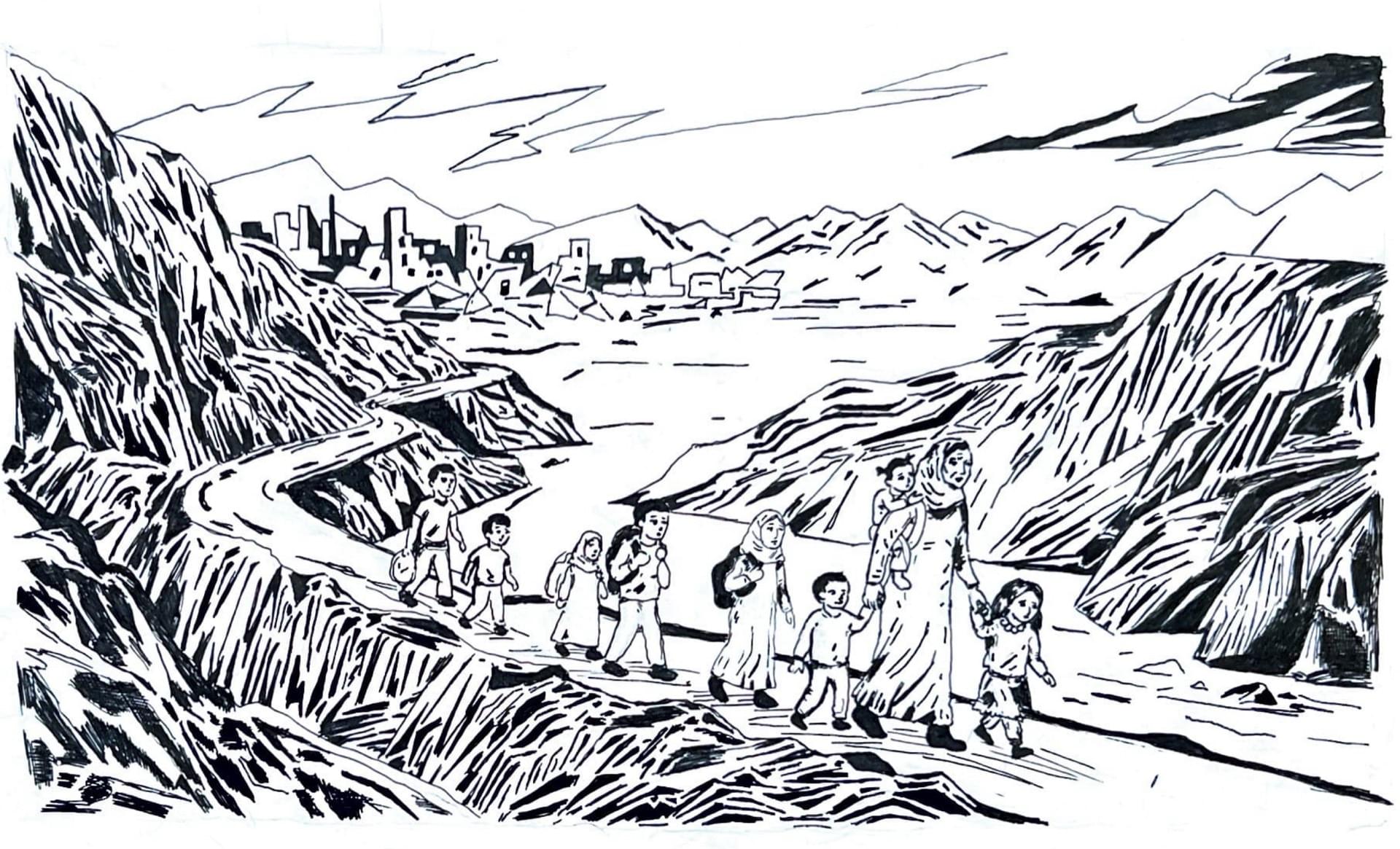
“In my second displacement, I didn’t take time to think because my children’s safety was the most important thing,” said Fatimah. “Despite reassurances that my sons would be stationed at nearby military checkpoints in Taiz, I knew in my heart that was just the beginning, and that soon after, my children would be sent to the frontlines and could disappear. So I fled quickly, before they could take my sons.”
The family left on foot. “Our journey took three days,” said Fatimah. “We slept on the ground in the valleys when we were exhausted and resumed our journey the next day. We walked for three days until we reached an area near Al-Rahidah, on the Taiz-Lahj border, trekking through villages, mountains, and valleys.”
After receiving information that IDP camps had been set up in the Al-Sha’ab area of Aden, the family sold their mobile phone to pay for a car to take them there. Upon arrival, the coordinator wouldn’t accept them without a letter from the police confirming they were displaced and stating where they had come from. Fatimah’s husband obtained the necessary permit from the police station, and the family was admitted. However, Fatimah’s family was among the more fortunate: Yemen still has no comprehensive government IDP registry, which means the people most harmed are also the hardest to count, protect, and connect to some form of social benefit.
Many IDPs in Yemen lack the documentation needed to verify their identity and property claims from prior to displacement. Displaced families overwhelmingly lack secure tenure, and forced evictions from managed IDP sites have increased, particularly in Marib governorate.[11] Lack of documentation also inhibits IDPs from seeking employment to improve their situations. IDPs who cannot prove their identity are prevented from registering births, accessing formal banking, claiming inheritance rights, proving property claims, and enrolling their children in school.
Fatimah’s family was not provided any form of shelter, so they used what they could find – blankets, tarps, cardboard boxes – to cover themselves. “We were out in the sun without a tent to protect us, sleeping on the hot ground because we had no mattresses,” said Fatimah. “We had no kitchen utensils, not even water containers, and no money … We lived like this for two years.”
Along with the lack of shelter, the family faced significant financial and food insecurity. “For the first time in my life, I had to ask people for food at their homes,” said Fatimah. “One woman I asked told me I didn’t look like a beggar asking for help. I told her, ‘If it were just for myself, I would never go out and ask for anything, but for my children, I have to. If my son tells me he’s hungry, I have no other choice but to find food for him and his siblings.’” More than seven years since her arrival in Aden, Fatimah and her family still face serious food insecurity, despite the temporary work she and her husband have been able to find. Prices continue to rise as the cost of living increases, and Fatimah and her husband struggle to make ends meet. “I buy a kilo of rice, but it’s not enough,” said Fatimah. “When one of my children asks if there’s more because he’s still hungry, I make him drink a lot of water to fill his stomach.” Food insecurity affects approximately 18 million Yemenis – more than half of the population – with IDPs consistently ranking within the highest risk tiers.[12]
Displacement strips families of land, livestock, and income. The temporary work that Fatimah and her husband have pieced together does not close the gap. Women in similar circumstances reported unstable incomes ranging from US$1.5 to US$10 per week, which does not keep pace with the rising prices. Economic collapse in the country has made roughly half the population aid-dependent.[13]
“I feel safe here, but I feel my dignity has been violated,” said Fatimah. “If a displaced person is wronged, they find no one to give them justice. Livelihoods are poor, and we cannot improve our own lives. Life is hard because of the heat. There is no electricity, especially since we are in a tent and only have a small battery and a solar panel that doesn’t last all night, leaving us in the dark with the heat and mosquitoes … Now, fevers and diarrhea have spread throughout the school courtyard … I feel my health is exhausted, not like it was in the village [where I grew up].”
The extremely hot climate in Aden also creates hardships for Fatimah and her family. At one point, her youngest child became ill from the heat. He had a fever and refused to breastfeed, becoming dehydrated. The doctor advised moving into a house rather than the tent they were staying in, but Fatimah could not find affordable accommodation.
While they have access to clinical care, many displaced families cannot access the necessary life-saving interventions prescribed by medical professionals. Fewer than half of Yemen’s health facilities provide basic emergency obstetric and newborn care, and 453 facilities have faced partial or imminent closure since January 2025.[14] Internal displacement is a compounding crisis that affects health, education, and prospects for a “normal” life, with repeated displacement associated with higher risks of mental disorders.[15]
It is the village where Fatimah spent her childhood that she spoke of most fondly. Fatimah grew up in a family of 12 children in a village where they relied on farming and herding sheep for their income. “I love my village so much,” said Fatimah. “I love the smell of the earth after the rain. I loved it so much that I would bring handfuls of clay home with me, and my mother would get angry.”
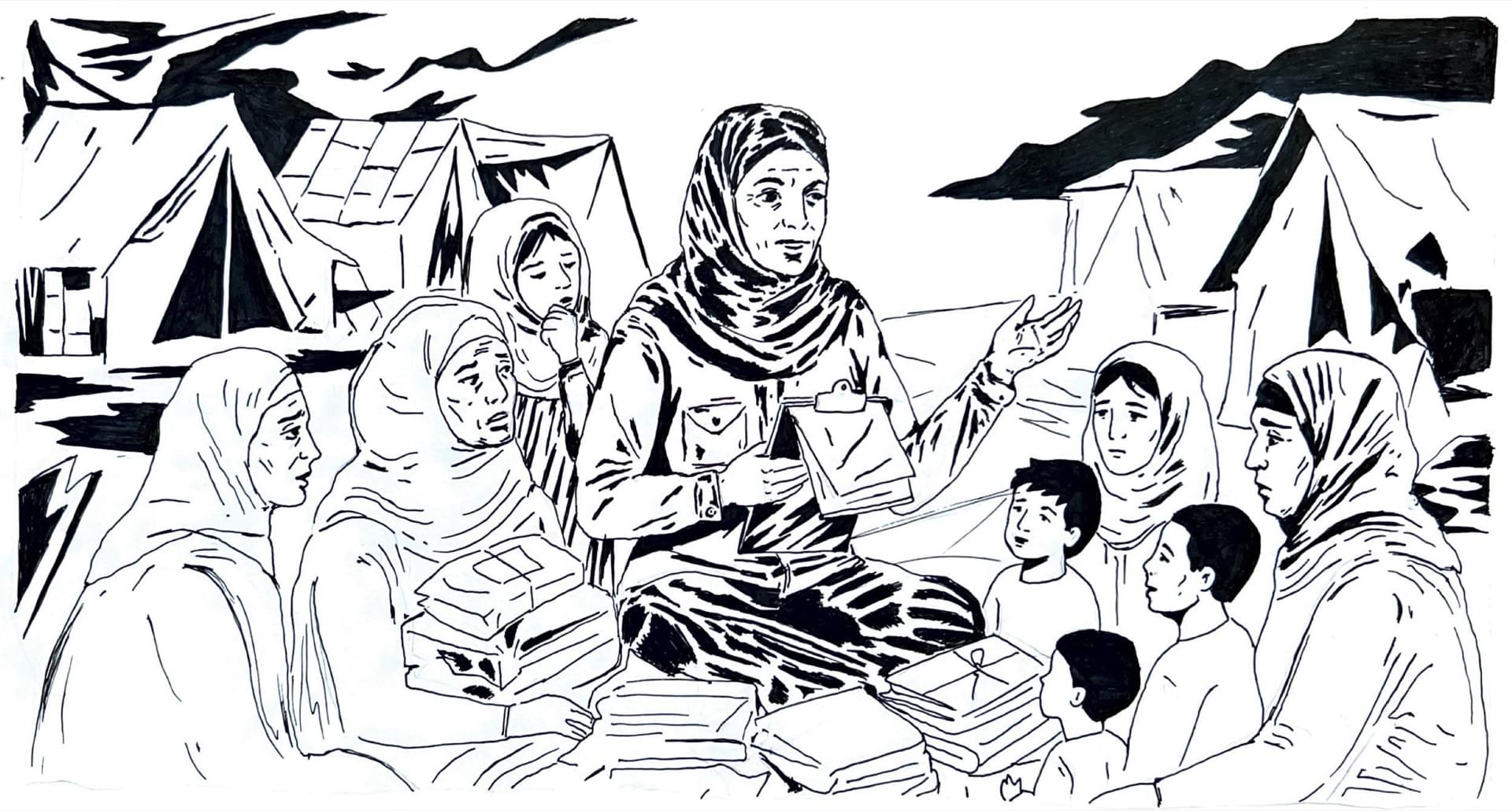
The stark difference between Fatimah’s life as a young girl in the village and her current reality as a displaced woman, wife, and mother reveals the profound losses endured through displacement. Knowing intimately what these losses feel like, Fatimah now volunteers with many organizations to advocate for displaced people. “I have become a voice for families who cannot speak for themselves,” she said. Her hope is that additional support will come in the form of helping displaced youths create livelihoods and generate income. “Don’t give me a fish, but teach me how to fish,” she said.
“To the fighters, I would say: Yemen is one country. What you are doing is like cutting off parts of your own living body. You are harming yourselves before you harm others. Take care of your homeland, the homeland of your ancestors, and stop the fighting.”
Muna: A Family Uprooted by Floods
Muna, a woman in her twenties from Hudaydah’s Bayt al-Faqih district, has been displaced twice, along with her husband and four small children. When speaking about her life before displacement, she emphasized the simple dignity of being able to work, eat, and afford basic necessities. “We were at peace, and then suddenly, everything was gone.” Muna’s family’s farms were damaged, grazing became difficult because of the fighting, and work began to disappear. Still, the family stayed as long as they could. “We were settled and secure in our land and didn’t want to leave,” she said. “What forced us out of our home was the rain and the floods.”
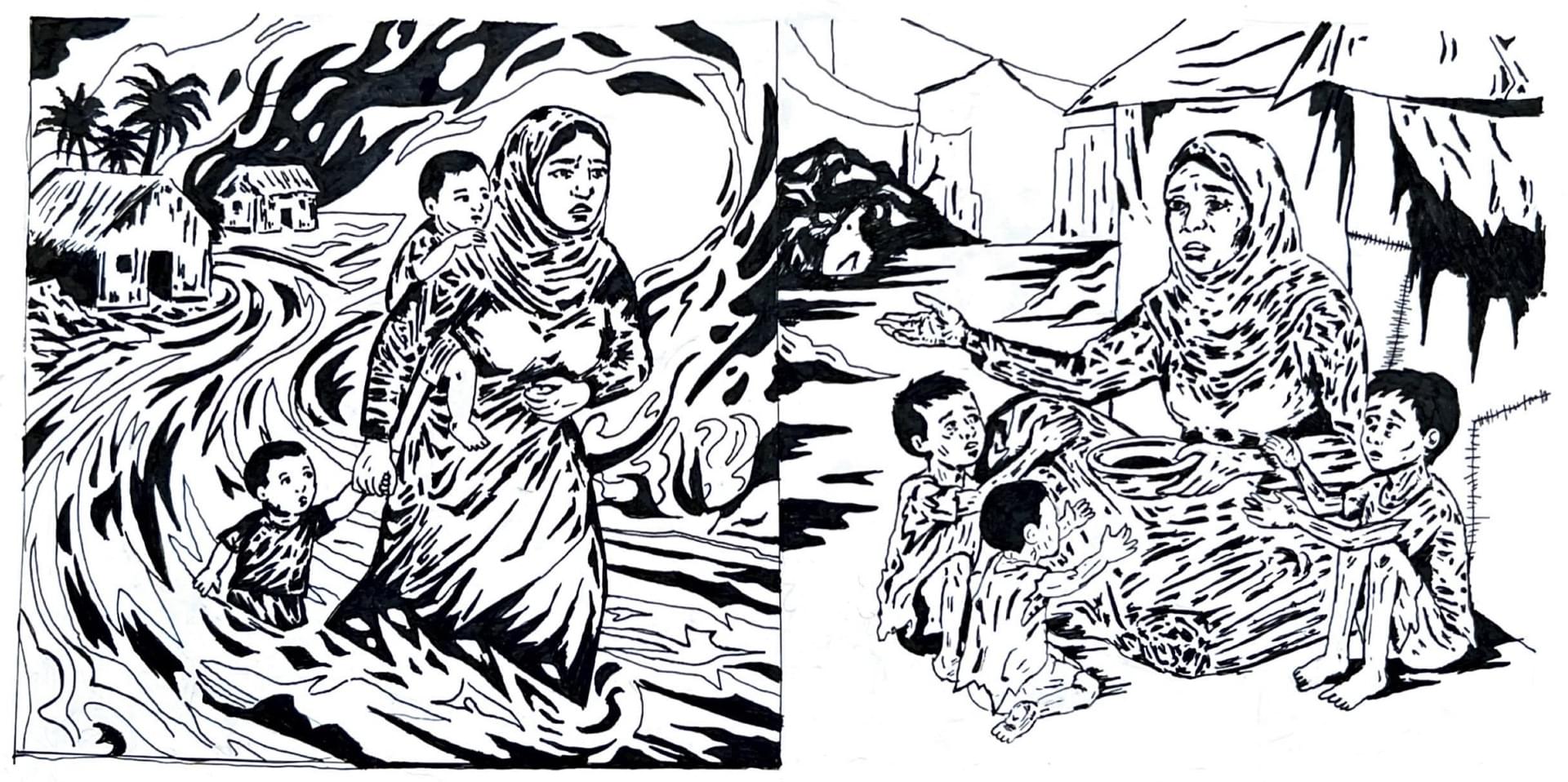
Displacement also results in, or is the result of, the simultaneous loss of land, livestock, income, and regular aid. In Muna’s case, the outbreak of war destroyed her family’s farms, making it difficult to harvest crops or graze livestock.
When the floodwaters from heavy rain came in 2024, they took everything in their path. Their huts were gone. Their children were left without clothes and without bedding. The family remained for a week after the flood, trying to salvage what they could. But life eventually became too difficult to continue in this way, so they left for Hudaydah city. What they found was no work, no source of income, and no housing, not even for rent. For two months, the family lived under tarps and blankets set up like tents in the street. Muna said she would relieve herself inside the tent in plastic bags, tying them shut until her husband returned late at night and could throw them somewhere far away. Like Muna, thousands of IDPs suffer from similar sanitation crises, which are largely undocumented.[16]
Hudaydah, she said, did not suit them. There was no proper shelter, no work, and not enough food for the children. Beyond physical destruction, flooding also poses administrative challenges by damaging documentation and intellectual property. In Hudaydah governorate alone, flooding destroyed more than 440 legal documents critical for establishing identity and property in 2024.[17] Environmental risks do not stop after families have been displaced. As many as 40 percent of IDP sites are located in areas of high or critical flood risk.[18] Flooding also relocates landmines and unexploded ordnance and contaminates water, helping drive disease outbreaks.[19] The 2024 rainy season alone produced flooding across 20 of Yemen’s 22 governorates, killing at least 240 people[20] and displacing an estimated 500,000 people.[21]
For Muna, leaving again meant further separation from the place where she had been raised, married, and lived her life. After two months in Hudaydah city, she traveled to Aden with a large family group, including her husband, their children, her husband’s parents, and other relatives. More than anything, she remembers the sadness of leaving. She did not want to depart from the place that had formed her life, even after all that had happened there.
In Aden, the extended family initially lived together in a single house. Muna described it as unbearable and rented a place for her immediate family for YR60,000 (approximately US$112). The house has no roof, no electricity, and no bathroom. She washes the children inside. For bathing and using the toilet, they share the neighbors’ bathroom, which also has no roof. She said she goes only once a day and feels ashamed each time she has to use it. After sunset, the house goes completely dark. Her children cry from fear, and the family lights scraps of grass and cardboard or relies on a battery lamp.
Cooking is done in the main room over firewood. The house fills with smoke, and the smell makes the children sick. To cook, the family gathers firewood from the areas between their home and the sea. Facing this humanitarian crisis, Muna’s needs are simple, but urgent: a simple house with a gas stove so she does not have to cook in smoke, an electric lamp, and basic human dignity. She needs clothes for her children and food in the house. When she speaks about comfort, she defines it simply: that her husband works and she works too.
Like Muna, many displaced Yemenis are exposed to unsanitary living conditions and fragile arrangements. They lack legal protection for their right to adequate housing, and the limited availability of poorly equipped homes means renting offers no real safeguard. Even three months after her second forced displacement, Muna says she still feels like a stranger in Aden. When the women who were displaced with her gather together, they remember their homeland and the life they once had. Muna still describes Bayt al-Faqih as beautiful: a place of farming and livestock, where work and food were tied to the land. “Our land smelled beautiful,” she said. If the country were to return to the way it was, she would go back and live there. She wishes for what she calls the return of the days of comfort.
If Muna could speak to public officials and to the warring parties, she would tell them that the family is exhausted by the war and that the floods took their homes and their clothes. What grieves her most is how little stands between her children and the small things she cannot provide. Sometimes, she said, a child asks her for some money to buy juice, and she cannot give it to them. Often, their father is afraid to enter the house while the children are awake, for fear they will ask for something he cannot bring them. “I wish my children could have the childhood I had. I wish they could go to school,” said Muna. “I wish for the war to stop and for our country to go back to the way it was.”
A Future Towards Justice
A large number of internally displaced persons remain in extended displacement, unable to return home due to ongoing violence, damaged infrastructure, or a lack of livelihood opportunities. As seen in the stories of Fatimah and Muna, this repeated displacement progressively pushes households to more precarious locations with lower-quality shelter and scarce access to basic needs. In light of this reality, the call for action is both urgent and future-looking.
Humanitarian support for IDPs is shrinking, with a 40 percent reduction in interventions in 2025, closing 54 health facilities and 10 safe spaces, where women and girls receive life-saving support even in remote areas, and cutting off nearly two million women and girls from services they once had access to before displacement.[22] It is imperative to coordinate with and provide funding for local and international organizations to roll out programs for interim reparative measures to provide more urgent relief to IDP communities.
Yemeni civil society and victims have been calling for victim-centered transitional justice for years, since long before the current conflict.[23] One crucial aspect of a victim-centered approach towards transitional justice is the ability to listen directly to victims of the conflict and interconnected harms,[24] such as climate change and environmental impacts.[25] Unfortunately, IDPs are also hard to reach. Connecting with women IDPs, specifically, often presents unique challenges related to safety, mobility, trust, and cultural norms. Many displaced women may commonly feel safer moving in groups or with male companions.
In this context, coordination with and support for local organizations (e.g., the Yemeni Women’s Union) can maximize the impact of humanitarian aid for IDPs and further develop a more systematic process for gathering information on IDPs’ conflict-related needs and harms in Yemen. Both immediate and long-term actions are urgently needed to address the impacts of protracted conflict. These efforts must be grounded in participatory, community-based approaches that encourage the meaningful participation of women, children, and other systemically marginalized groups.
- “Yemen: UNHCR Operational Update, January – October 2025,” Reliefweb, December 4, 2025, https://reliefweb.int/report/yemen/yemen-unhcr-operational-update-january-october-2025 “Yemen: UNHCR Operational Update, January – October 2025,” Reliefweb, December 4, 2025, https://reliefweb.int/report/yemen/yemen-unhcr-operational-update-january-october-2025
- Manal Ghanem, “In Endless Pursuit of Refuge: The Struggle of Yemen’s Internally Displaced Persons in Marib,” Sana’a Center, December 23, 2021, https://sanaacenter.org/publications/analysis/16121
- “A Humanitarian Response in Yemen 2024,” UNFPA, March 26, 2024, https://yemen.unfpa.org/en/publications/unfpa-humanitarian-response-yemen-2024 “A Humanitarian Response in Yemen 2024,” UNFPA, March 26, 2024, https://yemen.unfpa.org/en/publications/unfpa-humanitarian-response-yemen-2024
- According to the Guiding Principles on Internal Displacement, internally displaced persons are “persons or groups of persons who have been forced or obliged to flee or to leave their homes or places of habitual residence, in particular as a result of or in order to avoid the effects of armed conflict, situations of generalized violence, violations of human rights or natural or human-made disasters, and who have not crossed an internationally recognized State border.” See: “Guiding Principles on Internal Displacement,” UNHCR, April 17, 1998, https://www.unhcr.org/us/media/guiding-principles-internal-displacement
- “Yemen,” World Food Programme USA, https://wfpusa.org/place/yemen/
- “Being the Change in Yemen: Improving Integrated Water Resources Management for Food Security,” UN Yemen, March 23, 2023, https://yemen.un.org/en/224345-being-change-yemen-improving-integrated-water-resources-management-food-security#:~:text=About 14.5 million people in,large populations at high risk
- “Internal Displacement’s Impacts on Health in Yemen,” Internal Displacement Monitoring Centre (IDMC), June 16, 2021, https://api.internal-displacement.org/sites/default/files/publications/documents/IDMC_ImpactsonHealthinYemen.pdf
- “Yemen: Conflict Leaves Millions of Children Without Proper Education,” International Committee of the Red Cross (ICRC),October 13, 2022, https://www.icrc.org/en/document/yemen-conflict-leaves-millions-children-without-proper-education
- “Yemen Crisis Explained,” USA for UNHCR, https://www.unrefugees.org/news/yemen-crisis-explained/, accessed June 10, 2026.
- “Yemen Humanitarian Situation Report: January–December 2021,” ReliefWeb, March 16, 2022, https://reliefweb.int/report/yemen/unicef-yemen-humanitarian-situation-report-january-december-2021-enar
- “Forced Eviction Analysis in Managed IDP Sites: A Focus on Marib Governorate- January to June 2024,” NRC, 2024, https://www.nrc.no/globalassets/pdf/reports/forced-eviction-analysis-in-managed-idp-sites/forced-eviction-analysis-in-managed-idp-sites—a-focus-on-marib-governorates—jan-jun-2024.pdf
- “Integrated Food Security Phase Classification (IPC),” WFP IPC assessments, January 27, 2025 https://www.ipcinfo.org/ipc-country-analysis/details-map/en/c/1159662/?iso3=YEM ; “UNHCR Yemen Protection Brief 2025,” January 6, 2026, https://reliefweb.int/report/yemen/unhcr-yemen-protection-brief-2025
- “Starving in Silence: Surging Food Insecurity in Yemen,” International Rescue Committee (IRC), January 19, 2026, https://www.rescue.org/report/starving-silence-surging-food-insecurity-yemen; “Global Report on Internal Displacement 2025 (GRID 2025),” Internal Displacement Monitoring Center (IDMC), https://www.internal-displacement.org/global-report/grid2025/
- “Yemen Situation Report, October–December 2025,” UNFPA, 2025, https://www.unfpa.org/resources/situation-report-crisis-yemen-october-–-december-2025
- Manal Ghanem, “In Endless Pursuit of Refuge: The Struggle of Yemen’s Internally Displaced Persons in Marib,” Sana’a Center, December 23, 2021, https://sanaacenter.org/publications/analysis/16121
- Suprenant, M.P.; Hussein, R.; Al Dheeb, N.; Basaleem, H.; Zaman, M.; Yasukawa, L., “Internal Displacement’s Impacts on Mental Health in Yemen,” Internal Displacement Monitoring Center (IDMC), January 2020, https://api.internal-displacement.org/sites/default/files/publications/documents/IDMC_ImpactsonHealthinYemen.pdf
- “Yemen: Impact of 2024 Heavy Rains,” ACAPS, August 29, 2024, https://www.acaps.org/fileadmin/Data_Product/Main_media/20240829_ACAPS_Middle_East_Hub_Impacts_of_2024_heavy_rains_in_Yemen.pdf ; “Conflict and Climate: The Need for Green Transitional Justice in Yemen,” Sana’a Center and Columbia Law School Human Rights Clinic, February 17, 2025 https://sanaacenter.org/files/Conflict_and_Climate_The_Need_for_Green_Transitional_Justice_in_Yemen_en.pdf.
- “Yemen: CCCM IDP Site Flood Hazard Exposure Analysis – IDP Sites in Marib Governorate,” Camp Coordination and Camp Management (CCCM) Cluster, International Organization for Migration and REACH Initiative, May 2024, https://reliefweb.int/report/yemen/yemen-cccm-idp-site-flood-hazard-exposure-analysis-idp-sites-marib-governorate-report-may-2024; “The Crisis in Yemen, Explained,” Concern Worldwide, January 9, 2026, https://concernusa.org/news/yemen-crisis-explained/
- “Yemen Flood Operation Update #1,” Yemen Red Crescent Society, November 13, 2024, https://reliefweb.int/report/yemen/yemen-flood-operation-update-1-mdrye014
- “Yemen Flood Operation Update #1,” Yemen Red Crescent Society, November 13, 2024, https://reliefweb.int/report/yemen/yemen-flood-operation-update-1-mdrye014; “Yemen: Impact of 2024 Heavy Rains,” ACAPS, August 29, 2024, https://www.acaps.org/fileadmin/Data_Product/Main_media/20240829_ACAPS_Middle_East_Hub_Impacts_of_2024_heavy_rains_in_Yemen.pdf
- Yemen Red Crescent Society, “Yemen Flood Operation Update #1,” November 13, 2024, https://reliefweb.int/report/yemen/yemen-flood-operation-update-1-mdrye014
- “Situation Report#2: Humanitarian Crisis in Yemen,” UNFPA, July 2025 https://www.unfpa.org/sites/default/files/resource-pdf/Yemen Sitrep April – June 2025.pdf “Situation Report#2: Humanitarian Crisis in Yemen,” UNFPA, July 2025 https://www.unfpa.org/sites/default/files/resource-pdf/Yemen Sitrep April – June 2025.pdf
- Rana Cheaito, “Breaking the Cycle: Towards a Victim-Centered Justice in Yemen,” August 30, 2023, https://www.opensocietyfoundations.org/voices/breaking-the-cycle-towards-a-victim-centered-justice-in-yemen ;
- Marta Mendes and Yazeed Al-Jeddawy, “Engaging Victims in Peace-Making and Transitional Justice in Yemen,” Sana’a Center, March 24, 2024, https://sanaacenter.org/publications/main-publications/22094
- “Conflict and Climate: The Need for Green Transitional Justice in Yemen,” Sana’a Center and Columbia Law School Human Rights Clinic, February 17, 2025,https://sanaacenter.org/publications/policy-research/24246