

The Economy
Blackouts in Aden and Hadramawt
Power outages lasting up to 18 hours have plagued the cities of Aden and Hadramawt, compounding residents’ suffering during the hot summer months, when temperatures exceed 40 degrees. In May, Saudi Arabia sent US$150 million in emergency fuel supplies, but this offered only temporary respite. The assistance followed US$81.2 million in support to pay for 339 million liters of diesel and mazut from the Petromasila fields in Hadramawt to supply fuel to over 70 power plants across Yemen earlier in the year.
While Saudi fuel grants have provided some breathing room, the sector’s long-term stability is hampered by aging infrastructure, inefficient distribution networks, and deep-seated institutional deficiencies. During July and August, Riyadh even shipped generators as part of an emergency support package to boost the electrical grid’s efficiency and alleviate power outages. In early July, Hadramawt received the first batch of generators, with a combined capacity of 200 megawatts, to address energy demand in Mukalla and Seyoun. In mid-August, the Ministry of Electricity and Energy announced that the first shipment of equipment for a new 100-megawatt emergency power plant had arrived to address Aden’s electricity shortage. The project is funded by the Saudi Development and Reconstruction Program for Yemen (SDRPY), and the Gulf International Energy Company is undertaking the installation of the generators and their connection to the grid under a Build-Operate-Transfer (BOT) model.
As of this writing, the generators have not come online. Establishing new mazut-fueled power plants requires extensive engineering and construction, including site preparation and the installation of fuel tanks, cooling systems, transformers, and transmission and grid-connection networks, alongside comprehensive infrastructure.
Rial Stays Relatively Stable Amid Mounting Fiscal Pressures
The price of new rials remained stable, trading at YR1,562 per US$1 for most of the reporting period. It depreciated slightly by 1 percent, to YR1,580 per US$1, over the course of September, following the military escalation on the West Coast, which has complicated the monetary and economic landscape. In Houthi-controlled areas, the old rial remained almost flat, trading at YR533 per US$1.
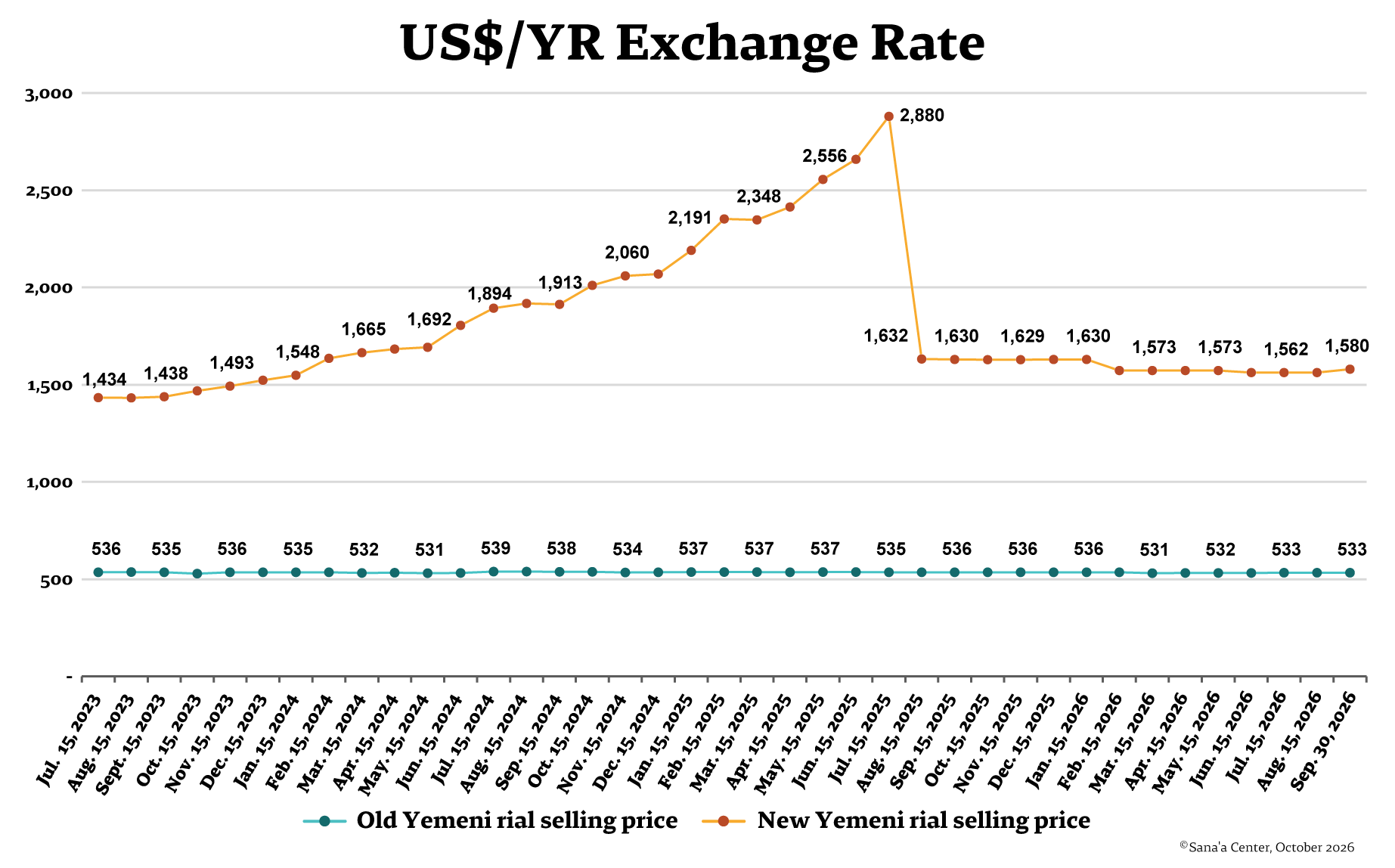
A major source of the new rial’s stability can be attributed to the collective efforts of the National Committee for Regulating and Financing Imports and the government-controlled Central Bank of Yemen in Aden (CBY-Aden). In mid-September, the committee reported that the total value of import requests processed since the beginning of the year exceeded US$5 billion, led by basic and essential goods – chiefly food, medicine, fuel, and production inputs. In a country that imports up to 90 percent of its basic necessities, the value of the local currency depends heavily on the central bank’s capacity to finance foreign trade. The scale of funds allocated for this purpose in recent months points to CBY-Aden’s effectiveness in regulating the foreign exchange market and containing pressures that destabilize the currency.
Saudi support has been a secondary contributor to currency stabilization. On September 3, the SDRPY announced new support for the CBY-Aden. The SDRPY did not disclose the transfer amount or its intended use, but a source said it totaled US$42 million and is intended to replenish CBY-Aden’s foreign exchange reserves. Despite the limited scale of this financial aid, it comes as the government faces numerous challenges, including a crippling financial crisis that has undermined its ability to pay public sector salaries and provide essential services.
The revenue shortage stems from the continued suspension of oil exports, once the state’s main source of income. The government’s financial woes have been further exacerbated by the escalation in fighting by the Houthis, which launched military attacks on multiple fronts in Hudaydah, Taiz, and other areas. The renewed fighting adds pressure to the government’s already strained finances, as it must now pay to sustain military operations across various fronts.
On July 20, the government’s National Defense Council issued a decision to resume oil exports, though it could take between six months and a year to prepare the infrastructure, and it is unclear how the Houthis would respond. Years of war have affected wells, pipelines, and refineries, and thinned the ranks of the skilled workers who keep them running. Neglect of infrastructure maintenance would make any future recovery time-consuming and expensive. Further, the government has not specified when exports would actually resume, which terminals would be used, or what security arrangements would be put in place in oil-producing governorates such as Hadramawt, Shabwa, and Marib. Neither has it laid out plans for managing the threat from Houthis.
Oil production has been halted since October 2022, when Houthi drone attacks targeted export infrastructure, severely undermining state finances and foreign exchange reserves. In 2022, oil generated YR1.11 trillion – 54 percent of total state revenues – easily covering that year’s YR856 billion wage bill. Resuming exports would replenish vital government funds, allowing the state to meet urgent spending needs such as public sector salaries and electricity subsidies.
The deteriorating political and security situation in government-controlled areas threatens the currency’s relative stability. Without a strategy to resume crude oil exports or mobilize other revenues, there is likely to be persistent downward pressure on the rial.
Aden Remains Plagued by Gas Crisis
Aden continued to suffer from a severe cooking gas shortage, which has persisted since the end of last year, pushing living conditions to a breaking point. The supply deficit extends far beyond home kitchens – it has also paralyzed public transportation. Numerous buses and other vehicles have been converted to run on cooking gas to offset high imported fuel prices. Restaurants, bakeries, and commercial outlets have faced imminent shutdown. The shortage has spread to neighboring governorates, leaving regions like Abyan in a similar situation.
Scheduled summer maintenance at Marib’s Safer production facility—the sole domestic supplier of cooking gas – led to a further reduction in supply. According to the Yemen Gas Company (YGC), the maintenance reduced Aden’s daily allocation from 14 tankers to seven. While the YGC announced the completion of maintenance on August 23, it has been insufficient to ameliorate broader structural problems.
The abrupt suspension for maintenance, at a time when stocks were already insufficient, reflects a systemic failure. The scarcity of gas is hardly new: shortages have continued for over a year and stem from problems across the supply chain. These issues are compounded by breakdowns in security. Tankers from Marib have been repeatedly interdicted by tribal groups as they transit through Shabwa and Abyan. In early August, armed tribal groups in Marib seized a number of tankers, preventing them from proceeding to market.
Scarcity is also driven by rising demand for cooking gas as an alternative to higher-priced imported petrol and diesel. In particular, Aden has seen a significant surge in demand, as an estimated 80 percent of private vehicles and taxis in the transport sector now operate on gas. A field survey conducted between May and June 2025 indicated that 36 large-scale establishments—including hotels, commercial centers, restaurants, and factories—have also begun relying on gas. During the same period, approximately 1,800 vehicles were converted to run on cooking gas, while an additional 775 new gas-powered vehicles entered the city. This puts further pressure on inadequate supplies.
The government lacks effective monitoring tools along distribution routes; even when supplies are technically sufficient, distribution is hampered by a lack of security and oversight. Deep-seated imbalances within the distribution system—particularly between different governorates —incentivize smuggling. Some stations have also deliberately withheld stock to maximize their profits. A 20-liter gas cylinder currently costs YR18,000 on the black market, more than double its official price of YR8,500. Cooking gas has become unaffordable for most poorer households, and the shortage has paralyzed local transit and disrupted business activities.
Yemen’s Economy Buckles Under Regional and Domestic Escalation
The relative military calm that had persisted since the 2022 truce broke down completely mid-year due to direct military actions between pro-government forces and the Houthis. This triggered rapid effects on domestic trade. The operational space for humanitarian organizations also contracted further, compounded by severe international funding shortfalls. On September 3, OCHA reported that the 2026 Humanitarian Needs and Response Plan had received only 20.2 percent of the requested funding: US$437.9 million of the US$2.16 billion needed to effectively assist the country’s most vulnerable populations.
Military operations escalated further on September 3, when Houthi forces launched a major offensive across Yemen’s West Coast and parts of Taiz and Hudaydah governorates, establishing control over critical coastal centers, including Al-Makha, Al-Khawkhah, Dhubab, and Hays. As of late September, the fighting has displaced more than 145,000 individuals across eight governorates since conflict escalated on the West Coast in June, according to the International Organization for Migration. These displaced persons often lack adequate shelter and require urgent humanitarian assistance. Their influx into overcrowded cities like Aden places immense strain on fragile infrastructure — health, education, water, and electricity services are already on the verge of collapse.
During the offensive, Houthi attacks targeted the strategic Red Sea port of Al-Makha, causing an estimated US$79 million in damage. The port’s closure halted commercial trade supply chains across western Yemen, directly affecting the livelihoods of 1,500 dock workers and thousands of affiliated transport operators.
Immediately following the capture of West Coast municipalities, Houthi authorities imposed the old rial. They banned all new rial banknotes issued by CBY-Aden, compelling citizens, financial institutions, and the commercial sector to exchange them for the old currency. During the first week of Houthi control, the Houthi-affiliated Central Bank of Yemen in Sana’a (CBY-Sana’a) received requests from financial entities on the West Coast to convert over YR60 billion in new rial banknotes into old rials—demand Sana’a struggled to meet due to an acute shortage of physical currency. Territories absorbed by the Houthis were immediately subject to their public finance regulations. Regular public sector salaries paid by the government were replaced by irregular allowance schedules, while customs tariffs and secondary taxes were applied at new internal checkpoints. This drove capital flight, reduced local private sector investment, and increased the final retail cost of staple commodities.
The humanitarian situation remains dire. According to the World Food Programme (WFP) Food Security Update, severe food deprivation across Yemen expanded from 31 percent of households in April to 36 percent in May 2026. Sixty-two percent of households struggled to meet their minimum food needs, surpassing the “very high” threshold of 40 percent in all governorates, with the highest rates concentrated in southern and eastern governorates such as Lahj, Shabwa, Hadramawt, Al-Dhalea, and Abyan. Around 10 percent of households in Houthi-controlled areas and 8 percent in government areas reported that at least one member went an entire day and night without eating.
Fuel prices in government-controlled areas increased by up to 30 percent in September compared to February 2026, reaching their highest level since August 2025 and raising the risk of further deterioration in food security through inflationary pressure. Hikes in domestic fuel prices are primarily due to surging global crude oil prices and maritime insurance costs. Local fuel prices surged by 40 to 44 percent year-on-year in US dollar terms, highlighting how little the local currency’s appreciation has translated into relief for domestic markets.
In mid-September, the Houthis increased the price of a liter of gasoline by 10.5 percent, from YR475 to YR525, bringing the cost of a 20-liter jerrycan to YR10,500. The price of diesel rose by 21 percent, from YR475 to YR575, with a 20-liter jerrycan now selling at YR11,500. They attributed the price hike to higher global fuel prices driven by regional tensions, as well as increased transportation costs. However, the Houthi price hikes cannot be explained by global trends and shipping costs alone. Global fuel prices began climbing immediately after the outbreak of the US-Israeli war against Iran in late February. In response, the group adopted a strategy of projecting resilience and stability in both pricing and supply, in contrast to the government, which experienced critical shortages and was ultimately forced to raise prices. Over the first five months, fuel imports via the Houthi-controlled ports of Hudaydah dropped by 73 percent compared to the same period in 2025; imports to government-controlled ports fell by 60 percent over the same period. Houthi-controlled areas have reported an increase in low-quality fuel at fuel stations, adversely affecting vehicles, water pumps, power plants, and livelihoods. To keep prices down, the Houthis released a significant amount of their strategic fuel reserves to meet market demand. As a result, cities under Houthi control reported a rise in low-quality and contaminated fuel, which caused extensive damage to vehicles, irrigation pumps, factories, and workshops.
While fuel imports through Houthi-held Red Sea ports significantly declined, the group relied on cross-border networks and shadow tankers for importing fuel, stockpiling it at facilities in the Al-Sabah area in the west of Sana’a city, in anticipation of shortages. OCHA has reported that “these areas are fully import-dependent for fuel – mainly from Gulf countries – with a substantial portion of Iranian imports arriving at Red Sea ports on shadow tankers.”
Despite these logistical disruptions, imported food has continued to arrive in sufficient volumes, with imports via all Yemeni seaports rising by 21 percent during January-May compared to the same period last year. However, food security deteriorated sharply due to an acute erosion of household purchasing power. The cost of the minimum food basket in government areas increased by 3 percent from February to May 2026, with vegetable oil recording a 7 percent rise, while key food prices in Sana’a surged by 13 percent.
Central Bank Pushes Unified Electronic Payment Infrastructure
The CBY-Aden has adopted a series of reforms aimed at developing a national digital financial infrastructure. On August 3, the bank launched the Payments and Clearing Company, which is designed to play a critical role in clearing, settlement, and payment operations; foster financial inclusion; and support the transition toward digital financial services. The company is part of the Yemen Financial Market Infrastructure and Inclusion Project (FMIIP), a five-year initiative funded by the World Bank, which has been implemented by the United Nations Development Programme (UNDP) since the second half of last year. It aims to facilitate and accelerate financial transactions, enhance the efficiency of interbank clearing and settlement processes, expand the use of electronic payment methods, reduce transaction costs, and provide faster, more reliable financial services to individuals and businesses.
The move came only days after the CBY-Aden restructured the Unified Financial Network Company, expanding the company’s shareholder base to include all Yemeni banks and injecting additional capital. Previously, the company relied exclusively on money exchange companies and money transfer channels—a poorly regulated environment prone to illicit activity. Moving past the fragmented regulatory environment is critical for formalizing digital financial services, deepening financial inclusion, and expanding access to capital.
There have been other reforms too. On August 5, the CBY-Aden launched a registry of defaulting customers, intended to help mitigate credit risks, protect depositors’ funds, enhance the soundness of the banking system, and support financial stability. The next day, the CBY-Aden signed a memorandum of understanding with the UNDP to enhance cooperation in the fields of financial technology and digital innovation. This will allow the central bank to develop and test innovative financial solutions and technologies, as well as to establish further regulatory and supervisory frameworks for the banking sector.
Govt Expands Starlink Service
On September 19, the government-run Ministry of Telecommunications and Information Technology in Aden announced the expansion of the high-speed satellite internet service Starlink to new areas. It plans to extend internet coverage to the governorates of Taiz, Marib, and Hudaydah, as well as Al-Makha. The ministry said the new phase of its plan also includes expanding coverage and boosting capacity in areas where the service currently operates, with the aim of improving internet services.
The initiative is part of the ministry’s broader strategy to improve the sector’s infrastructure, free it from the Houthis’ grip, and reclaim one of the state’s most vital revenue streams. In late August, the Ministry proposed a package of reforms for the Yemen International Telecommunications Company (TeleYemen), including leadership changes, as part of a restructuring plan to enhance the company’s technical, administrative, and financial efficiency and boost state revenues. But these reforms have yet to be implemented, and the Houthis continue to dominate the sector.
The government officially announced the introduction of the Starlink satellite internet service in Aden two years ago, making Yemen the first country in the Middle East to offer the service. The Ministry envisions a nationwide project encompassing all regions of Yemen, including those under Houthi control. However, uptake has remained limited even in government-controlled areas, as the high cost of Starlink devices puts them beyond the financial reach of many citizens. Despite the dire state of internet services provided by Aden Net and the Houthi-run Yemen Net, which rely on aging undersea cables, the government has been unable to build modern telecommunications infrastructure capable of providing secure and reliable mobile service and internet access.
Import Committee Bans Iranian Goods, Eases Other Restrictions
The government-run National Committee for Regulating and Financing Imports held its seventh meeting of the year on September 13, where it announced a ban on the import and circulation of Iranian goods and products. The committee also reported that the total value of import requests processed since the beginning of the year exceeded US$5 billion, led by basic and essential goods – chiefly food, medicine, fuel, and production inputs.
The Houthis have boycotted or banned imports from states they consider hostile, while redirecting the commodity market toward goods from more friendly countries such as Iran and China. Official statistics show that Yemen’s imports from Iran totaled US$10.67 million in 2024, with cereals, flour, and milk products accounting for 57 percent of the total. While this figure is marginal compared to import volumes from other countries, actual levels likely far exceed the officially reported figures. Substantial Iranian fuel shipments to the Houthis are not officially documented, as they arrive at Red Sea ports aboard shadow tankers. The US Treasury Department estimates that the Houthis generate more than US$2 billion annually from oil sales, relying on a combination of free energy shipments from Iran and highly organized black-market distribution networks.
Media outlets have reported that the group has systematically restructured Yemen’s consumer goods market to favor Iranian-origin products while suppressing competition from other traders. Companies and import agencies tied to the Houthi leadership enjoy preferential treatment, allowing them to dominate the market and flood it with Iranian goods. In May 2023, the group banned domestically produced gas from the Safer liquefaction station in government-controlled Marib, even though it was far less expensive than the imported gas sold by Houthi companies.
To implement its new ban effectively, the government needs to develop a clear strategic plan for the strict monitoring of goods flowing through Yemen’s border crossings and sea and air ports, in order to curb the smuggling of illicit Iranian goods into Houthi-controlled markets—a task that will be difficult to achieve given the institutional divisions across its factions.
Houthis Cut Port Fees, Raise Taxes Elsewhere
In a move calculated to draw shipping traffic—and the revenue it brings—the Houthi-affiliated Red Sea Ports Authority and Tax and Customs Authority announced reductions of up to 50 percent on vessel and container fees and port taxes, effective October 1. The group said the cuts are intended to counter what they described as exorbitant fees at government-controlled ports and encouraged importers to take advantage of established facilities in Hudaydah.
The tax cut is part of a broader Houthi strategy that leaves commercial importers with a stark choice: pay customs tariffs twice, or reroute shipments through Hudaydah. Over the course of the conflict, the group has adopted a taxation scheme whereby goods arriving from government-controlled areas are subject to customs tariffs when they enter Houthi-controlled markets. It began in mid-2017, following the split of the Central Bank, when the Supreme Political Council in Sana’a established inland customs centers, such as at Al-Rahadah in Taiz and Afar in Al-Bayda, to collect a 30 percent tariff on all commercial trucks arriving from government-controlled ports. Then, in March 2021, the Houthi Ministry of Finance issued an official circular raising the inland customs collection rate from 30 to 50 percent, explicitly targeting non-essential commercial items arriving overland from the port of Aden. Finally, in early September 2022, the group imposed a 100 percent levy on all items imported through government-controlled ports. The Houthi Ministry of Finance made it clear that when they arrived at Houthi checkpoints, any products imported through government-controlled ports or border crossings would be subject to the same tax and customs fees as those imported through Hudaydah.
The new policy of reducing fees at ports under Houthi control is not a spur-of-the-moment decision; rather, it is a calculated move to capitalize on its recent capture of Yemen’s entire West Coast—including the Bab al-Mandab and the strategic port of Al-Makha—and further incentivize importers to use Houthi-controlled ports.
Medicine Shortage in Houthi-Controlled Areas
Houthi-controlled areas are suffering from a severe shortage of medicines and medical supplies. Yemen imports over 90 percent of its pharmaceuticals, but with supply chains disrupted, a healthcare disaster could be looming, threatening hundreds of thousands of patients suffering from chronic diseases.
On July 26, the National Oncology Center in Sana’a warned of the deteriorating situation during a press conference, stating that some 120,000 cancer patients are currently facing a severe lack of medical care, while more than 10,000 require travel abroad for urgent treatment. There is also a critical shortage of life-saving medications, including medicines for diabetes and other health conditions. The health sector is experiencing shortages of 60 percent of its essential medicines, along with a total absence of 10 to 15 key types of oncology drugs.
The closure of Sana’a Airport has reportedly contributed to the scarcity of medicine and the withdrawal of international companies from Yemen. The departure of these companies from the market has, according to official estimates, contributed to approximately 28,000 deaths in recent years due to the inability of patients to access appropriate care and the difficulty of traveling abroad for treatment.
The airport was first knocked out of service after Houthi escalation in the Red Sea provoked Israeli airstrikes. Its closure coincided with a reduction in relief operations by the WFP and other UN agencies in Houthi-controlled areas, driven by funding gaps and the arrest and detention of humanitarian staff. Last November, the World Health Organization (WHO) and UNICEF officially suspended health and humanitarian aid in most Houthi-controlled areas. Throughout the conflict, the health sector in Houthi-controlled areas has relied almost entirely on external support, owing to the collapse of government funding and the destruction of infrastructure.
Compounding the crisis is the Houthis’ aggressive nationalization of medicine and pharmaceutical production to favor businessmen loyal to the group. In early April, the Sana’a-based Ministry of Economy, Industry, and Trade revoked the licenses of 4,225 established commercial agencies, which serve as the legal local representatives for foreign companies. This included 1,900 pharmaceutical companies, many of which are facing significant hurdles in renewing licenses due to administrative complexities and exorbitant fees. Many had already had their operations suspended by the Houthis before their licenses were revoked.
Chief Economist