

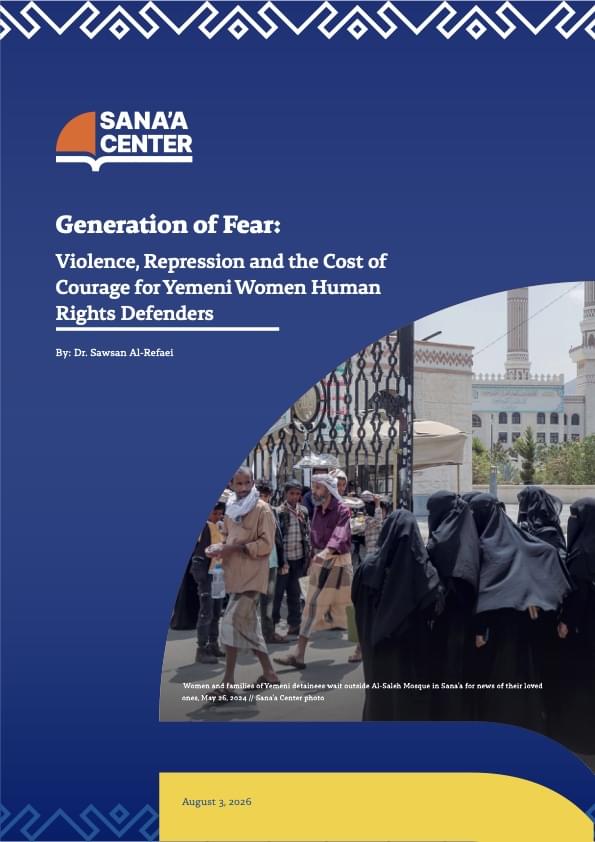
Generation of Fear: Violence, Repression and the Cost of Courage for Yemeni Women Human Rights Defenders
Executive Summary
We are certain that no one has our back. Our blood can be shed in the streets, and there will be zero accountability. [1]
Yemeni women human rights defenders (WHRDs)[2] are today operating under increasingly dangerous conditions shaped by ongoing conflict, rising fundamentalism, and the erosion of social and institutional protections. Discrimination against them is rife, as violations are perpetrated by multiple actors, including state and de facto authorities, armed groups, local powerholders, and online networks. Violations include arbitrary detention, enforced disappearance, intimidation at checkpoints, document confiscation, coercion to act as informants, and death threats. Gendered disinformation, online harassment, and the use of religious rhetoric to incite hostility against women, meanwhile, are on the rise, further exposing women to stigma, reputational harm, and threats of violence across both local and diaspora contexts.
Against this backdrop, this study explores the lived realities of Yemeni women leaders, challenging prevailing narratives that emphasize “resilience” while downplaying risk. It argues that such framings risk obscuring the severity of the threats endured by WHRDs, limiting recognition of the urgent protection measures required. Drawing on qualitative, in-depth interviews, the study captures the experiences of 22 Yemeni women leaders active in human rights work, hailing from various regions of Yemen and in the diaspora. It highlights the cumulative physical, psychological, social, and economic impacts of their advocacy work.
The findings reveal a profound and multidimensional toll on women leaders. Many reported experiencing chronic physical ailments such as hypertension, diabetes, autoimmune diseases, and fatigue, largely attributed to prolonged stress and unsafe working conditions. Eating disorders, sleep disturbances, and weakened immunity are widespread. Psychologically, all participants reported high levels of distress, including anxiety, depression, panic attacks, and symptoms consistent with post-traumatic stress disorder. Repeated exposure to violence, threats, and traumatic experiences, both direct and secondary, has resulted in hypervigilance, emotional numbness, and, in some cases, suicidal ideation. Despite these conditions, women continue working under extreme pressure, often overworking as a coping mechanism, leading to burnout and declining productivity.
Women interviewed shared stories of defamation, hyper-surveillance, and heightened scrutiny by authorities and their communities. To reduce risk, many have withdrawn from public engagement, media, and even family interactions. The impact extends to their children and families, who are also affected by stigma, intimidation, and social exclusion. In the diaspora community, although physical safety may improve, women continue to live in fear for themselves in their new countries of residence, as well as for their families in Yemen. Many reported facing significant economic challenges due to displacement, difficulties in integrating into new environments, and ongoing isolation.
These personal and familial hardships expose a broader structural crisis: the near-complete absence of effective protection mechanisms, accountability systems, and enforcement of laws, leaving Yemeni women at the frontlines of risk dangerously exposed. The protection of women defenders is rarely integrated into program design, while international and national organizations often fail to uphold duty of care obligations. Psychosocial support is limited, poorly tailored, and often inaccessible, while digital security gaps expose women to surveillance, blackmail, and reputational attacks.
Beyond affecting their personal well-being, these conditions have profound implications for the sustainability of the women’s movement in Yemen. Burnout, fear, and a lack of protection are driving many experienced women leaders to withdraw from public life, creating generational gaps and reducing opportunities to mentor younger leaders. Trust in the Yemeni government and international actors has eroded due to perceived inaction and lack of accountability. As a result, women’s participation in civic and political spaces is declining, threatening progress in gender equality, peacebuilding, and human rights advocacy.
The severe risks outlined in this research underscore the urgent need for concrete measures to protect Yemeni women human rights defenders. The Yemeni government, as the prime duty-bearer, must strengthen accountability by enforcing protection measures for women human rights defenders, accelerating investigations into violations, and prosecuting perpetrators of violence, harassment, and illegal detention. At the same time, rapid response protection systems should be established as life-saving interventions, including safe relocation, emergency financial support, secure housing, and confidential case management that minimizes re-traumatization.
International organizations and donors must institutionalize the duty of care through safeguarding frameworks, emergency protocols, and equitable access to healthcare and legal support for all WHRDs, including those contracted. Flexible and adequate funding is essential to cover the high costs of safe work, including mobility, housing, and sustained protection, while prioritizing survivors of detention, torture, or active threats for relocation and asylum pathways.
At the systemic level, protection must be reinforced through advocacy and accountability mechanisms that pressure armed actors to adopt and uphold non-targeting commitments toward women civilians and WHRDs. Strengthening WHRDs networks, mentorship structures, and safe coordination spaces is critical for movement sustainability, alongside investing in documentation and data collection to increase visibility, inform policy, and counter stigma. Community-based strategies must be used, including male allyship and engagement of influential leaders, to challenge harmful narratives and strengthen collective protection.
This policy brief is part of a series of publications produced by the Sana’a Center and funded by the government of the Kingdom of the Netherlands. The series explores issues within economic, political, and environmental themes, aiming to inform discussion and policymaking related to Yemen that foster sustainable peace.
- Interview with a woman journalist and human rights activist in Taiz, October 17, 2025.
- According to the UN Office of the High Commissioner for Human Rights (OHCHR), Women Human Rights Defenders (WHRDs) include “all women and girls working on any human rights issue … and people of all genders who work to promote women’s rights and rights related to gender equality.” The definition also encompasses civil society actors who may not self-identify as human rights defenders, including journalists, health workers, environmental activists, peacebuilders, and humanitarian and development actors among others. See: https://www.ohchr.org/en/women/women-human-rights-defenders
Author