

Weaponizing Slander: The Dark Side of Defamation Campaigns Against Yemeni Women Leaders
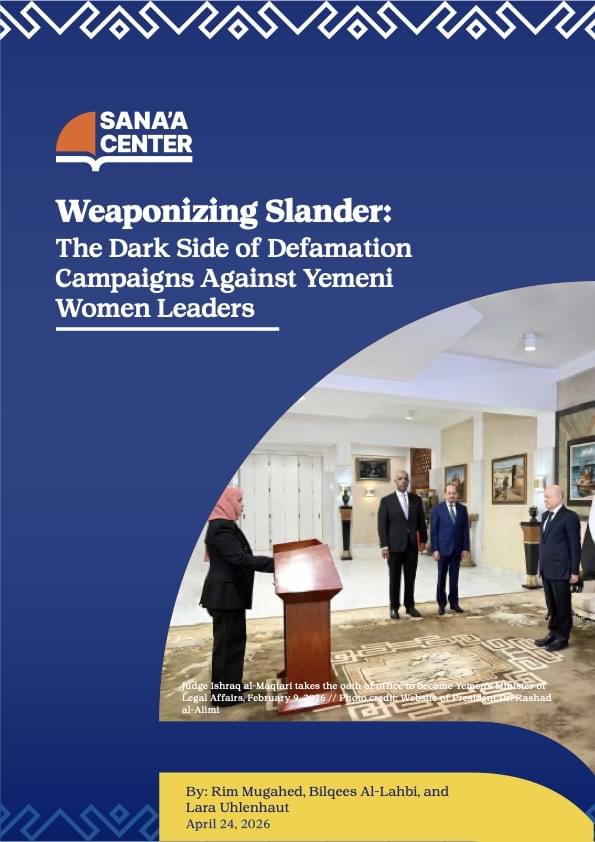
The beginning of the year brought good news for Yemeni women: after six years of total absence from government, three women were appointed to the new cabinet formed in early February, followed by the historic naming of Yemen’s first female ambassador to the United States in April.
Yemen’s new administration emerged from a year of profound turbulence, shaped not only by the sweeping events reshaping the political landscape at the beginning of the year, but also by the tragic assassination of Iftehan al-Mashhari last September. Iftehan, a civil servant, was murdered in broad daylight, shot twenty times by gunmen linked to powerful local political factions in Taiz. The targeted assassination of a woman, unprecedented in Yemen’s history, marked a new turning point in political violence in the country, rupturing long-standing informal “red lines” protecting women from physical harm and highlighting the growing risks faced by Yemeni women in leadership.
Last month’s online targeting of high-profile women — from newly-appointed members of government to grassroots advocates — overshadowed the brief spell of optimism that greeted the new cabinet. Malicious, unsubstantiated, and thriving on an atmosphere of impunity, these defamation campaigns were deliberately launched, amplified with ease, and carried out with no personal cost to those behind them. Finding fertile ground in pre-existing social biases and rising discriminatory practices, the attacks required little proof to gain traction. To those watching, they served as a stark reminder of the heavy costs involved for women trying to enter an increasingly hostile public sphere.
Three Women, Three Patterns of Defamation
In late March, social media platforms were flooded with an incitement campaign targeting Misk al-Maqrami, the Director General of the Taiz Cooperative Park,[1] a government-run recreational facility. What began as a dispute over a group of local residents entering the park without tickets became a case that exposed multiple layers of social inequality. Chief among them was racism, evident in the fact that Misk is a member of the muhammasheen, one of the most marginalized communities in Yemen, whose women are increasingly facing well-documented heightened risks since the war. Derogatory comments against Misk went viral on social media, with posts that alluded to or explicitly insulted her background. “It was both inhumane and terrifying,” said Misk, in an exchange with one of the authors. “If this is what is said to my face while I am in a position of authority, what is being said to our daughters in schools?”[2]
Other factors were at play, not least impunity and the absence of law and governance. Taiz’s Cooperative Park is a revenue-generating scheme in a governorate where many resources are controlled by armed political factions, making its administration a point of contention among competing interests. Misk faced accusations of management failures and of deteriorating park conditions that, in reality, stemmed from broader governance failures.
As AI-manipulated images of Misk—depicting rats crawling all over her body—circulated across various social media platforms, leaks about Jamila Ali Raja’s appointment as ambassador to the US also surfaced, prompting a wave of online vitriol. Across social media platforms, she was described as unsuitable for an ambassadorship due to alleged associations with the Houthis, a well-rehearsed tactic often used to discredit candidates in a politically charged environment, regardless of gender. But scrutiny of Ali Raja extended beyond that. Both in the digital sphere and within private homes, her credentials were questioned with exacting, if selective scrutiny. Her age, credibility, familial ties, and professional competence were all called into question by segments of the public, despite her prominent position on the Consultation and Reconciliation Committee (CRC) and a distinguished career spanning decades.
Such targeting was not spontaneous. As regional dynamics shift and the “Yemen file” reaches a critical crossroads, the appointment of a woman to the US ambassadorship —one of the country’s most consequential diplomatic posts—follows six years of complete absence of women from government and unprecedented political marginalization. Landmark legal victories against defamers, won by Dr. Olfat al-Daba’i, a fellow member of the CRC and herself a victim of a defamatory online campaign, could help redefine the landscape of accountability by demonstrating that unhinged defamation campaigns carry legal consequences. Yet, instead of deterring perpetrators, attackers have resorted to the old playbook. Accusing individuals of serving local or regional agendas, a “ready-made” charge, is effective because it bypasses nuance and poisons public perception.
Not spared by the wave of hostile online commentary was Judge Ishraq al-Maqtari, the newly appointed Minister of Legal Affairs. The scrutiny she faced followed a more familiar path for Yemeni women. After taking the constitutional oath, observers took to social media to comment on her appearance and attire, reflecting a broader pattern in which women in the public eye are judged on their appearance to discredit them or question their moral character. In this framing, attire is no longer treated as a personal choice but as evidence of “depravity,” “deviation from values,” or “association with foreign entities,” familiar tropes women have become accustomed to. The female body itself becomes an alternative arena through which judgment is produced. It can simultaneously be used as a powerful tool of defamation, as the discussion immediately shifts to: “Is this woman—morally—qualified to hold this position?”
Beyond these inherent social and political dynamics, these campaigns gain exceptional momentum from one fact: these leaders are women. Their gender is fundamental to the intensity and nature of the backlash they face. Numerous reports and surveys highlight that Yemeni women are disproportionately targeted online, in a local context where reputational damage carries far-reaching consequences, impacting both physical and mental well-being. In Misk’s case, her story represents a complex intersection of historical marginalization, racism, and gender-based violence. For all three candidates and hundreds more before them, criticism and scrutiny come with a hyper-focused lens reserved for women stepping into positions of power, against the backdrop of a decline in women’s rights within an increasingly polarized social and political climate.
A Silver Lining: When Bystanders Become Allies
More often than not, women fight these battles alone, receiving none of the support of political, partisan, or tribal entities that a man of the same background or position would. This leaves them navigating a maze of tensions that stretches from the private home to the street and ultimately into the public eye. Unquestionably, the digital space in Yemen has become a primary site for harassment of women, yet it has also introduced a powerful new variable: in response to unprecedented digital violence and defamation, spontaneous, unorganized avenues of support have started to slowly emerge, mostly led by other women.
This support—bridging identity, political orientation, and generations—has drawn in young Yemeni women and men, who share the same values: rejecting inequality, violence, incitement, and racism. Support for the women subjected to these attacks has come from official political representatives, including the Yemeni Socialist Party Secretariat in Taiz, among others, and official institutions such as the National Committee for Women. These acts of vocal solidarity and resistance, however small, may lay the groundwork for a more organized movement capable of establishing accountability and checking the rise of defamation campaigns in Yemen. Broader civic actors, however, must be prepared to assume greater responsibility for supporting women.
Such support takes on renewed importance in a context where incitement can lead to tragedy; recent events have shown us with chilling clarity how unchecked rhetoric can become a prelude to deadly violence. The consequences of targeted violence against women in public life—regardless of rank or form— extend far beyond the harm done to the individual targeted. Such violence steadily shrinks the already deteriorated public space in which women move, day by day. It dims the ambitions of others who have not yet arrived. More worryingly, it emboldens those who face no accountability, whether shielded by arms and influence or by the anonymity and impunity afforded by social media.
This publication was produced as part of the second phase of the Yemen Peace Forum (YPF), a Sana’a Center initiative that seeks to empower the next generation of Yemeni youth and civil society activists to engage in critical national issues. The YPF is funded by the Government of the Kingdom of the Netherlands.
- The Taiz Cooperative park includes a swimming pool, a restaurant, recreation spaces, and halls for entertainment events and meetings.While some amenities, such as the swimming pool and event halls, require an entrance fee, other recreational spaces are freely accessible to visitors.
- WhatsApp exchange between one of the authors and Misk al-Maqrami, March 24, 2026.
Program Manager and Researcher
Gender and Civil Society Advisor
Editor and Researcher