

Oil Spills in Shabwa: Residents Bear the Heavy Cost Alone
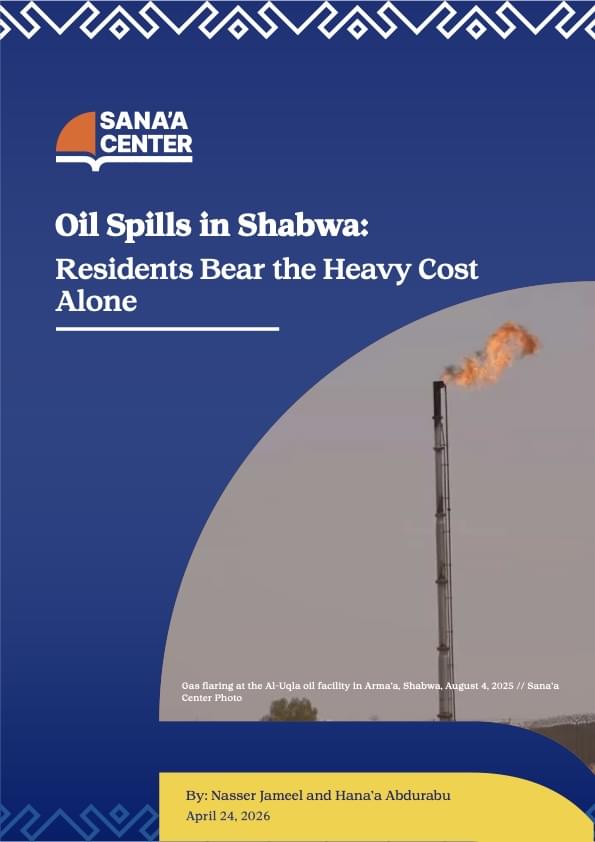
The governorate of Shabwa possesses a unique geography, ranging from fertile plains to long coastlines, mountain highlands, and vast deserts. It also holds rich natural resources, such as oil and gas. This natural wealth made it the site of the largest investment project in Yemen: the Balhaf liquefied natural gas (LNG) terminal.
However, Balhaf and other hydrocarbon projects in the governorate have affected both the environment and the population without sufficient consideration of long-term consequences. Oil spills and pollution from the poorly regulated sector have caused damage to residents’ health, killed livestock, and contaminated farmland. In recent years, residents have reported an increase in cases of cancer and kidney disease in Al-Rawda and Mayfa’a districts in eastern Shabwa.[1]
Amid growing community concern about a potential link between these cases and oil spills in the area, the governorate’s oncology center has neither officially confirmed nor denied the fears. Emerging studies, however, have begun to shed light on the effects of oil spills in Yemen, including recent research focusing on Shabwa. Yet the current level of attention is nowhere near adequate. Residents of affected areas are calling for urgent and sustained government intervention to address the mounting threat to their lives and livelihoods.
The Decay of Shabwa’s Oil Infrastructure
Oil was discovered in Shabwa more than 38 years ago, in 1987, when a Soviet company, Technoexport,[2] found the first reserves west of Block 4 (Ayad). Discoveries then continued across four main blocks, managed by local and foreign companies. These discoveries represented a significant economic turning point, opening the door to extensive investment in oil infrastructure in the governorate, but they fell short of providing adequate risk-management regulations.
The expansion of investment in Shabwa’s oil sector has brought with it significant challenges. Sector governance remains weak and is largely oriented toward the interests of foreign companies and the central government, with limited consideration for local communities, environmental impacts, or regulatory oversight. This exclusion has fueled tribal sabotage, as residents see no tangible benefits, such as jobs or infrastructure, further exacerbating underlying tensions between local communities on the one hand and the government and operating companies on the other hand.
Local residents have complained of widespread oil leaks that have impacted large areas of agricultural land and contaminated water wells. There are several underlying causes, mainly the deterioration of the supply line infrastructure due to technical and security failures, and the lack of replacements for aging pipelines. These systemic failures have led to a contaminated landscape and a local population that navigates this contamination on its own.
According to a statement from the Shabwa Branch of the General Authority for Environmental Protection Agency, the pipeline extending from the Ayad facility to the port of Al-Nushayma has not undergone maintenance since its construction in 1987, but it remains operational despite repeated sabotage from local tribesmen who feel they are not benefiting from the oil in their lands. Without maintenance, oil leaks have become a permanent condition, creating chronic pollution in the districts through which the pipeline passes. Oil spills originate in the Lahya area of Habban district, pass through the Azzan area of Mayfa’a district, and reach areas in Al-Rawda district, such as Ghayl al-Sa’idi and Qarn Bamahraz. The leaks pollute agricultural lands, wadis, and the water sources upon which residents rely.
Prompted by the hardship faced by local residents, an agricultural association in the Ghurair area of the Al-Rawda district appealed in December 2025 to the local authority and operating companies to maintain the pipeline, clean up oil spills, and remove contaminated soil. Yet, no substantial action has been taken; visits by specialized committees have been limited to assessing the problem and performing emergency repairs, without addressing the root causes.
An Extended Impact
Adel Bamahriz, a resident of Qarn Bamahriz in Al-Rawdah district, noted that persistent oil leaks have had wide-ranging impacts on local life, affecting water sources, soil quality, vegetation, and public health.[3] According to him, leaks have contaminated the community’s primary water sources and caused significant damage to crops and arable land.
Abdelsalam bin Samaa,[4] the Executive Director of the Al-Ata Foundation, a local initiative for environmental protection, notes that agricultural output has declined significantly. In the Ghayl Al Sa’idi area, local farms, once full of palms, mangoes, and fodder, a primary source of livelihood for local families in the area, have been lost, along with Al Thaqba trees (Thespesia populnea) extending from the Al Rawda junction to the Lamatar area. Livestock have also been affected, poisoned by consuming oil-contaminated water. Even worse, residents’ health has been directly impacted, with local reports of extensive skin and respiratory problems among residents, in addition to an increase in cases of cancer and kidney disease.[5] A study published in March assessing soil pollution near the crude oil pipeline in Shabwa confirmed soil contamination with hazardous substances, including polycyclic aromatic hydrocarbons (PAHs). These compounds persist in the soil for extended periods and are notoriously associated with genetic mutations and cancer, posing a significant threat to both human health and the environment.
Turning a Blind Eye
There are clear fundamental problems in the management of the country’s oil sector, and the government’s policy of turning a blind eye to the crisis in Shabwa demonstrates the prioritization of economic interests over residents’ safety. This violates Yemeni law, specifically Articles 35 and 36 of Law No. (26) of 1995 concerning Environmental Protection, which outlines accountability for damage in such cases. The persistent disregard for communities’ safety also undermines trust in official authorities, further complicating efforts to address the damage and threatening local stability.
In response, notable local initiatives have emerged. These include efforts to document the damage caused by oil leakage, the formation of local committees to follow up on the issue with the governorate’s local authorities and the relevant ministry, and the organization of local campaigns to raise residents’ awareness of the impact of oil leakages. Despite limited resources, communities in Shabwa have shown incredible self-reliance in their efforts to mitigate the effects of this pollution. But oil spills in Shabwa can no longer be treated as accidental or emergency events. Instead, they must be analyzed as a problem within the structural framework of oil sector management. Both the government and locally operating oil companies must comply with national and international laws and safety standards to protect the environment, the health and livelihoods of affected communities, and the sustainability of natural resources.
This publication was produced as part of the second phase of the Yemen Peace Forum (YPF), a Sana’a Center initiative that seeks to empower the next generation of Yemeni youth and civil society activists to engage in critical national issues. The YPF is funded by the Government of the Kingdom of the Netherlands.
- Interview with Adel Bamahriz, resident of Qarn Bamahriz, Al-Rawdah district, September 1, 2025; and Head of the Agricultural Development and Rehabilitation Association in Ghurair, Al-Rawdah district, December 7, 2025.
- “A brief history of oil exploration in Yemen,” Ministry of Oil and Minerals website: www.mom-ye.com/site-ar/نبـذة-تاريخـيةinterestson/
- Interview with Adel Bamahriz, resident of Qarn Bamahriz, Al-Rawdah district, September 1, 2025.
- Interview with Abdelsalam bin Samaa, Executive Director of the Al-Ata Foundation and a resident of Al-Rawdah district, December 6, 2025.
- Unpublished report submitted to the Shabwa local authority and the Ministry of Water and Environment. The report was written by a local environmental team formed in Shabwa on March 2, 2020, to assess the environmental impacts of oil leakages in the areas of Ghurair in Al-Rawdah and Lahiya in Habban district.
Author
Author