

Politics and Diplomacy
Saudi Arabia Takes Control
The December incursion of the Southern Transitional Council (STC) into eastern Yemen appeared at first to be a resounding success for the UAE-backed secessionist movement. It was accompanied by triumphal pronouncements in southern media about the imminent resurrection of a southern state. But the rapid advance into the oil-rich hinterland, displacing pro-government and tribal forces, quickly unraveled in the face of Saudi pressure and local mobilization.
Forces affiliated with the STC were pushed out of Hadramawt and Al-Mahra in early January by Saudi airstrikes, Saudi-backed troops, and local tribal forces. STC leader and Presidential Leadership Council (PLC) member Aiderous al-Zubaidi reportedly fled into exile – first by boat to Somaliland, then by plane to the UAE. The government has since charged him with treason.
Abu Dhabi, whose sponsorship of some of the most experienced and effective armed groups in Yemen appeared to give it the whip hand, quickly backed down. Under immense pressure from Riyadh, all Emirati soldiers have now left the country, the STC has been officially dissolved, and other UAE-backed forces are being brought into the Saudi fold. Through a broad political and military restructuring, Riyadh is now seeking to remake the balance of power in the government-held Yemen, where it holds unrivaled sway for the first time since the war began.
The STC’s offensive appears to have been an enormous miscalculation by both the group’s leadership and its Emirati backers. There are several reasons why they might have misread the scale of Riyadh’s response. Chief among these was Saudi Arabia’s long-standing reticence to act quickly or forcefully in Yemen, both during operations against the Houthis and in past rounds of fighting between STC and government forces. After its initial intervention in Yemen in 2015, the Kingdom’s administration of the war progressed slowly, with general dithering over financial support, political appointments, and military aid. The rapid deployment of Saudi air power, which had been dormant since 2022, seemed unlikely, and the speed of the STC’s advance cast doubt on the capabilities and loyalties of the local forces Riyadh supported, namely the Nation’s Shield forces, Yemen Emergency forces, and local Hadrami tribesmen. The STC and UAE also underestimated Riyadh’s sensitivity to developments in the governorates of Hadramawt and Al-Mahra, which the Kingdom views differently from its involvement elsewhere in Yemen. Hadramawt’s direct access to the open sea makes it a locus of Saudi attention for economic reasons, including a long-mooted pipeline that could bypass the Strait of Hormuz, but the vast, shared border and historical social ties with the governorate were probably even more consequential.
Much has also been made of the timing of the STC’s offensive, which came on the heels of a trip to Washington by Saudi Crown Prince Mohammed bin Salman. Another arena of Saudi-Emirati competition – Sudan – was reportedly on the agenda, and Saudi officials allegedly asked for sanctions against the rebel Emirati-backed Rapid Support Forces, and perhaps even against the UAE itself. Abu Dhabi may have seen Yemen as a venue for retaliation or rebalancing, anticipating diminished influence elsewhere. Israel’s near-simultaneous recognition of Somaliland was also highly conspicuous. From Egypt and Turkey to Qatar and Oman, there was significant concern about what appeared to be a rapid, coordinated reconfiguration of the regional order and an expansion of Emirati and Israeli influence across the southern Red Sea. The UAE’s normalization with Israel may have won it friends in Washington, but in the region, its stance became increasingly unpopular during the war in Gaza. The STC’s own reported olive branch to Israel was likely a bid to secure American support, but it cast the group as part of a broader rebalancing of regional power.
Finally, the UAE might simply have overestimated the local power and influence of the STC. The group had repeatedly demonstrated that it was the leading movement in the anti-Houthi coalition, with a distinct political project and substantial military capabilities. It had previously fought pro-government forces successfully in Aden in 2019 and in Shabwa in 2022. But its appeal and power were largely untested outside its traditional strongholds. Wadi Hadramawt has been politically contested by local groups seeking greater autonomy, pro-government forces with connections to the Islah party, and local tribal organizations, none of which subscribed to the STC’s secessionist ideology. The STC’s political organization and agitation in Seyoun had gained local traction, but also significant pushback.
Ultimately, the STC’s military capabilities and local appeal were simply insufficient. When the airstrikes came, the governorate’s topography provided little cover. Widespread looting in Wadi Hadramawt turned locals against STC soldiers. As they were quickly pushed out of Seyoun by tribal and Saudi-backed forces, the STC appeared to lose the confidence of the UAE, which began winding down its support. The few remaining Emirati soldiers still in Yemen were evacuated, abandoning the Hadramawt coast, the liquified natural gas facility at Balhaf, and the Socotra archipelago.
Saudi Arabia has been left as the sole sponsor of Yemen’s anti-Houthi alliance, and has sought to reorganize the political and security administration across the South to empower loyal forces, bring Emirati proxies under its wing, and diminish and dilute support for the STC and its remaining supporters, who continue to protest the group’s official dissolution and a government ban on its political activities (see Military and Security)
New Government Unveiled
The downfall of the STC precipitated a massive reorganization of Yemen’s political landscape, with the internationally recognized government now under the sole suzerainty of Saudi Arabia. A new cabinet was announced on February 6, following weeks of contentious horse-trading over its composition. Riyadh exerted pressure for a breakthrough amid widespread demonstrations by STC supporters. At one protest in Seyoun, demonstrators reportedly chanted slogans condemning Saudi Arabia and tore up photos of Crown Prince Mohammed bin Salman, before being violently suppressed by security forces.
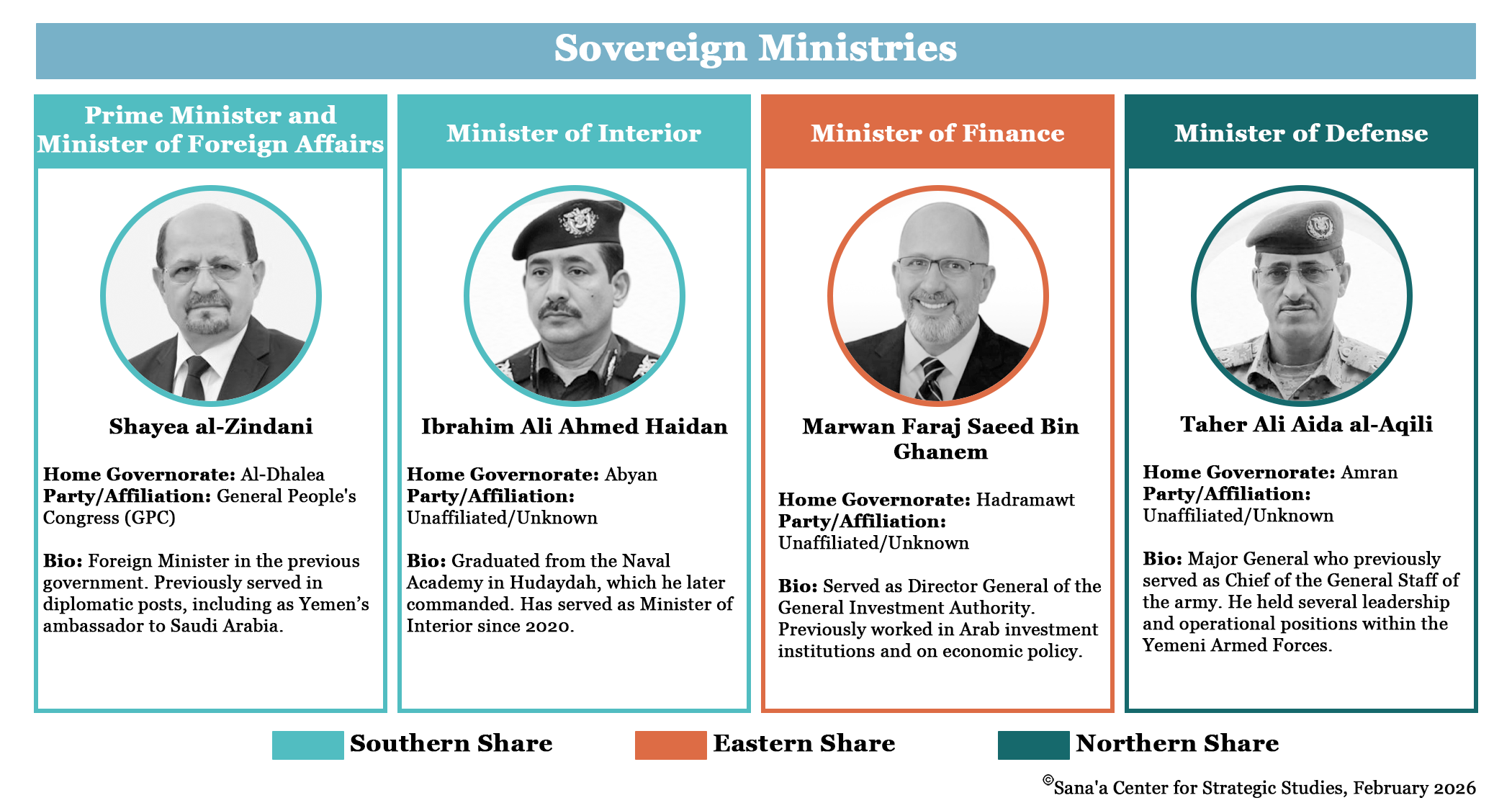
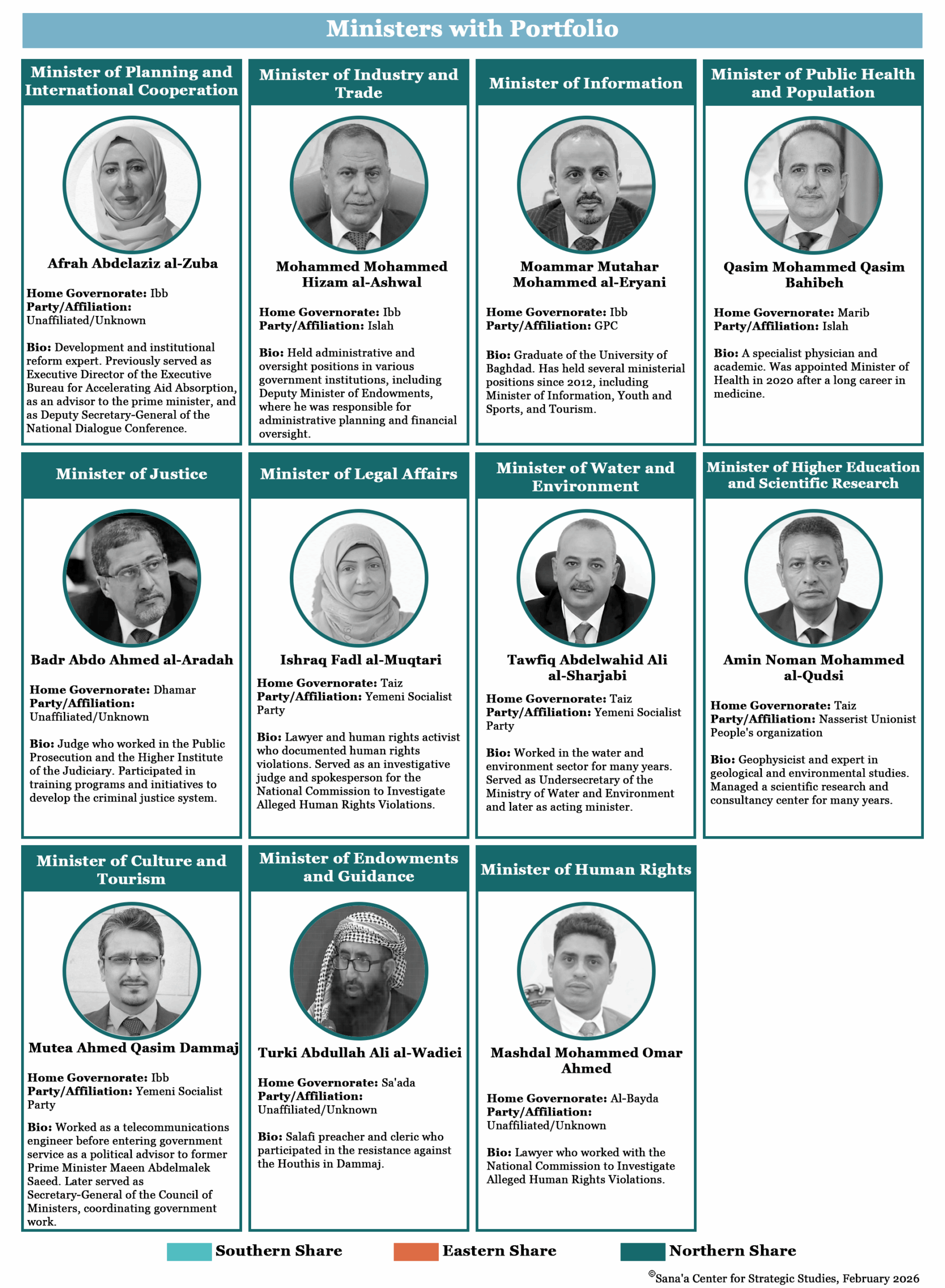
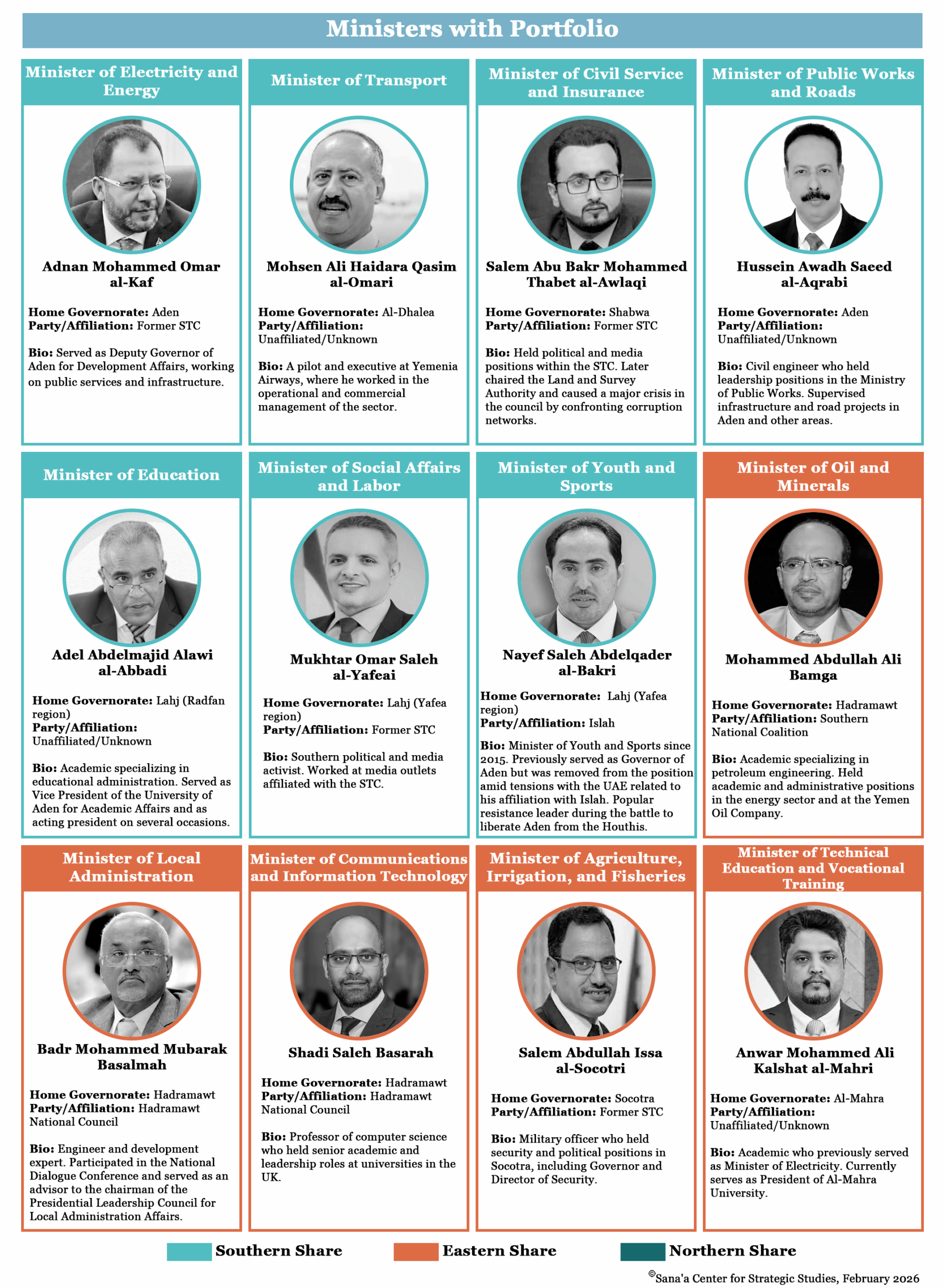
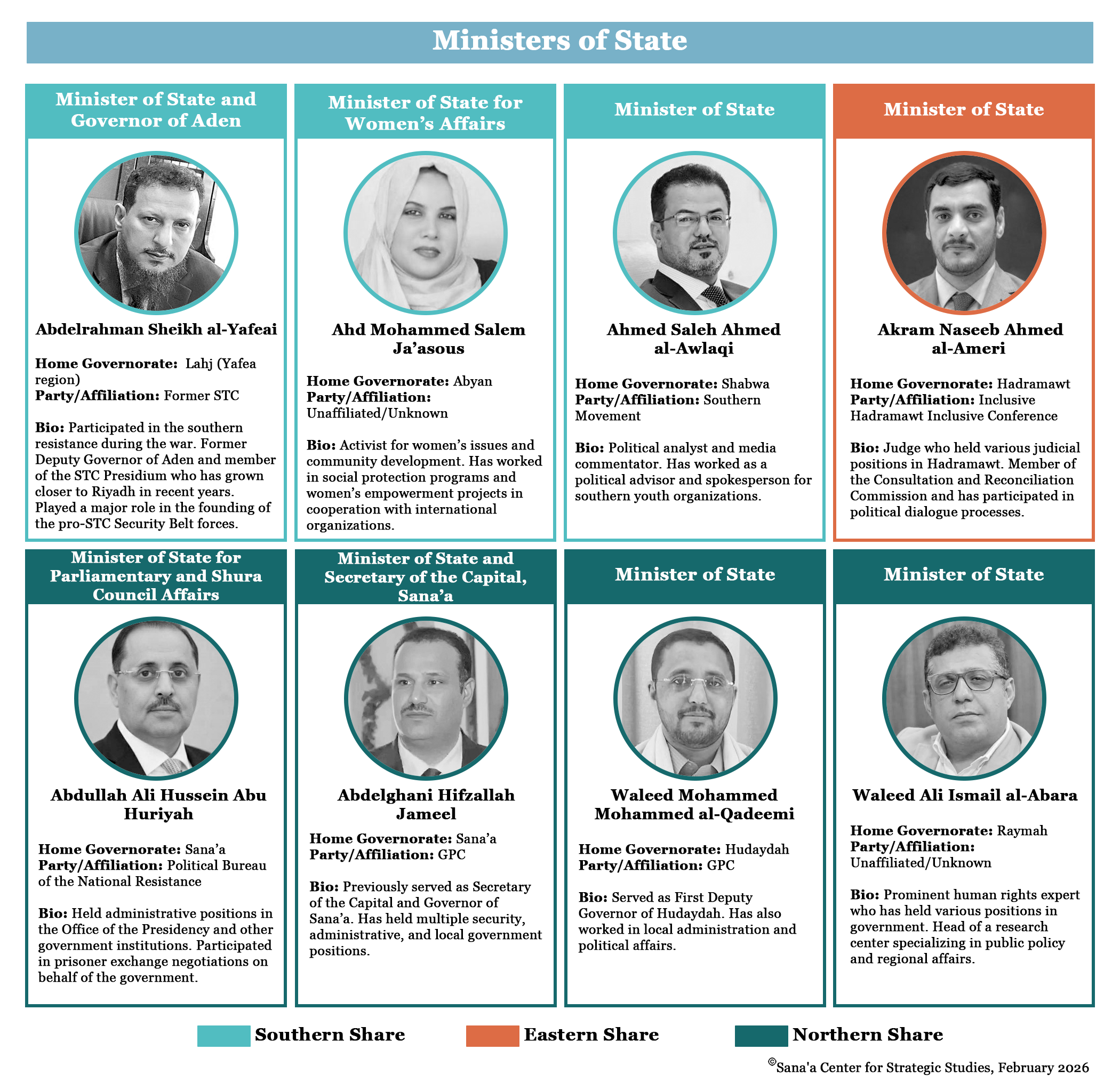
Appointments to the cabinet were contested between PLC chief Rashad al-Alimi and fellow PLC member Abdullah al-Alimi, who has attempted to position himself as the primary representative of the South following the proscription of the STC. Alongside Riyadh, the pair seem to have been the primary decision-makers regarding who would join the government. An agreement was eventually reached for a 35-member cabinet, with portfolios distributed between the north and the south, as well as the inclusion of specific seats for eastern Yemen, underscoring its importance and recently elevated relevance to Riyadh. The geographic allocations also reinforced the waning influence of Yemen’s political parties, which had been pushing for party quotas instead.
Representatives from southern Yemen were given two of the four sovereign ministries, leaving one for the north and one for the east. Ibrahim Haidan retained the post of Interior Minister, while Taher al-Aqili, a former army chief of staff, was named Defense Minister. Recently appointed Prime Minister Shayea al-Zindani retained the post of Foreign Minister for himself. One surprise came at the Finance Ministry, with Marwan bin Ghanem named to the top job. Bin Ghanam, who has little government experience, is the son of Faraj bin Ghanem, a well-respected figure from Hadramawt who served as prime minister in the 1990s.
The appointment of three women to the cabinet represented a positive shift, reversing a trend of total exclusion that began with the government formed in late 2020. Afrah al-Zuba, a development professional, was named Minister of Planning and International Cooperation; Ishraq al-Muqtari, an investigator and spokesperson for the National Commission to Investigate Alleged Violations of Human Rights, was selected as Minister of Legal Affairs; and Ahd Ja’asous, a human rights activist and UNICEF coordinator at the Social Welfare Fund in Aden, was named Minister of State for Women’s Affairs.
Several officials formerly affiliated with the STC were included in the new government, part of Saudi efforts to peel southern leaders away from the group and its Emirati backers. These included Civil Service Minister Salem Thabet, Social Affairs and Labor Minister Mukhtar al-Yafii, Electricity and Energy Minister Adnan al-Kaff, Agriculture, Irrigation, and Fisheries Minister Abdullah al-Socotri, and Minister of State Abdelrahman Sheikh, who was also appointed Governor of Aden in January.
The government was sworn in on February 9 at the Yemeni embassy in Riyadh, still unable to return to Aden due to the volatile security situation. Its first meeting in the interim capital was not held until February 19, when a crowd of protestors reportedly linked to the STC attempted to storm the presidential palace, resulting in deadly clashes with the security forces (see Military and Security). Government ministers have since observed a curfew in Aden.
As part of the government overhaul, PLC chief Al-Alimi appointed three new governors to southern governorates on March 13. During individual meetings with new Lahj Governor Murad al-Halimi, Abyan Governor Mukhtar al-Rabbash, and Al-Dhalea Governor General Ahmed al-Qubba, Al-Alimi framed their mandates explicitly in state-building terms, emphasizing the need to remove illegal checkpoints, unify decision-making on security issues, and improve service delivery. Al-Halimi, a former transport minister and member of the STC presidium, is viewed as a pragmatic figure who could help stem pushback from STC loyalists. Al-Rabbash previously served as a Deputy Minister for Religious Endowments and was a military commander in the Southern Resistance during the Houthi invasion of Aden. A well-respected Salafi, his perceived independence from both the Islah party and controversial Salafi networks may give him more room to maneuver politically and confront security challenges. In Al-Dhalea, the appointment of Al-Qubba, the governorate’s security director, a commander in the National Security forces (formerly the STC-affiliated Security Belt forces), and head of the Al-Dhalea Military Axis, indicates that Saudi priorities there are dominated by security concerns. Al-Dhalea is the heartland of the STC and the ancestral home of its now-fugitive leader, Aiderous al-Zubaidi, and has several frontlines facing Houthi forces.

Southern Dialogue Postponed
Riyadh’s plan for the political and military reorganization of the south was to be accompanied by a grand southern dialogue, in apparent, belated recognition of long-festering grievances. The marginalization of the South after unification created strong currents of resentment. Grievances range from land appropriation to political representation and remain the primary mobilizing factor for many southern Yemenis, fueling the emergence and popularity of the broader Southern Movement (Al-Hirak) and the STC. Reportedly at the request of PLC chief Al-Alimi, the Saudi Foreign Ministry announced it would host a dialogue in Riyadh to bring together southern factions and develop “fair solutions that meet the legitimate aspirations of the people of the South.” The announcement received international backing, support from governors across southern Yemen, and was even welcomed by the STC.
Initial proposals for the dialogue envisioned delegates from across the south gathering in Riyadh during Ramadan for comprehensive talks on reconciliation, sparking immediate speculation about who would take part. PLC member Abdullah al-Alimi angled for a leading role in selecting delegates and managing the process, as did PLC head Rashad al-Alimi. Riyadh reportedly intended to host a wide spectrum of prominent southern and eastern figures, even including former STC members.
But plans for the dialogue were scaled back and then postponed. Rather than the in-depth deliberations previously anticipated, Riyadh narrowed its ambitions, recasting the talks as part of its ongoing efforts to stabilize the situation in southern Yemen and reorganize UAE-backed forces under the umbrella of the government. It is now unclear when the dialogue will take place and in what format. Riyadh, with its attention no doubt elsewhere due to the US-Iran war, is seemingly content with the political progress achieved through the reorganization of forces. While still a serious security concern, pressure from the STC has so far failed to prevent the government from exercising its functions. The thinking was that Riyadh would be able to absorb or head off any dissatisfaction and disillusionment through increased service provision – a Saudi fuel derivatives grant had improved the once moribund electricity supply in Aden, and military forces were receiving their salaries on time.
But the Kingdom may rue its decision to postpone talks and the chance to address issues of southern resentment and division. Saudi Arabia now has a full plate with the damage and disruption caused by the US-Iran war and the closure of the Strait of Hormuz. Electricity provision in Aden has again begun to decline, and the city has endured a shortage of cooking gas since the beginning of the year. After a lull during Ramadan, STC demonstrations have resumed in earnest, and the group is reorganizing politically and reopening its offices across the south.
The government is struggling to respond and is now threatened not only by a resurgent STC but by fragmentation and competition among the local political actors seeking to replace it. Further violence at STC demonstrations could undermine the government’s fragile claims to legitimacy and provoke wider unrest. The political and military reorganization of the south would be difficult even with full Saudi support and attention, facilitated dialogue, and institutional coordination. None of these conditions is in place, and with international attention elsewhere, the political crisis of December and January could fester and metastasize into further instability.
US-Iran War Clouds Road to Peace
One month into the US and Israel’s war on Iran, the Houthis belatedly joined the hostilities, claiming to have fired a barrage of missiles at Israeli military sites on March 28. Israel later confirmed it had intercepted a missile fired from Yemen. Limited attacks were announced on April 1, 2, 4, and 6, but the Houthis’ apparent restraint raised fresh questions about the group’s intent, and what the response might be from the United States, which concluded a ceasefire with the Houthis after a bombing campaign last year, and Israel, which targeted Houthi military and political leaders and civilian infrastructure in response to a Houthi missile and drone campaign last summer and fall.
The group’s apparent hesitance can be attributed to a range of strategic calculations, including conserving the capabilities of the Axis of Resistance, preserving its relationship with Saudi Arabia, or simply timing the operation for maximum effect. Still, there were early signs that the Houthis were preparing to act. In Hudaydah, sources reported that the Houthis had been activating military positions, including missile platforms and mobile radar vehicles, along the Red Sea coast as early as late February. On March 14, a popular Houthi radio channel concluded a fundraising campaign collecting more than YR317 million (US$598,000) to support Houthi military operations.
The Houthis’ decision to target Israel weeks into the conflict has fueled speculation over the degree of coordination with its Iranian benefactors. As the conflict progressed, Houthi rhetoric increasingly aligned with Tehran’s, with the group openly framing itself as part of the “unity of battlefields” that make up the Axis of Resistance. To this end, both Iranian and Houthi officials repeatedly threatened to close the Bab al-Mandab, which would amplify the economic cost of Iran’s blockade of the Strait of Hormuz. The status of Hormuz has emerged as the key element in talks to end the conflict. The Houthi attack may have served as military signaling, strengthening Iran’s hand in negotiations and reminding the US that it still has options for escalation. The additional leverage would be particularly useful if Iran seeks a broader deal that includes Lebanon’s Hezbollah.
But the choice to attack Israel rather than maritime shipping reflects the Houthis’ own careful strategic calculations. The situation in Palestine, the stated cause of the Houthis’ previous campaign against Israel, is a far more resonant issue in Yemen than the plight of Iran. While it added weight to Iranian economic threats, attacking Israel also serves the Houthis’ domestic propaganda. The group’s domestic power largely derives from its ideological cohesiveness, and such rhetorical campaigns have been a key component in maintaining it.
The Houthis have not launched any further attacks since April 8, when the US and Iran agreed to a ceasefire to halt hostilities, but the agreement quickly faltered over disputed interpretations of its scope. Talks are still ongoing, but with the Strait of Hormuz still closed, the resumption of Houthi attacks in the Bab al-Mandab still looks like an important card, multiplying disruptions to shipping and shocks to energy prices, and helping Iran exact a high toll for any future US and Israeli attacks. But there are different considerations than when the group launched its Red Sea campaign in 2023. Renewed attacks would put further pressure on oil prices and the Gulf economies, but would also bring the Houthis into direct conflict with Saudi Arabia, which has diverted oil shipments to its west coast ports for export.
The conflict will not last indefinitely, and when it is over, the Houthis will still be in dire financial straits. Under the weight of sanctions and aid cuts, the economic situation in the north continues to deteriorate (see The Economy).
The Houthis may be holding out hope that a version of the UN-backed Saudi peace plan could ultimately be revived, which envisioned payouts to public-sector workers – including Houthi military forces – in exchange for peace. In an Eid speech, the head of the Houthi Supreme Political Council, Mahdi al-Mashat, criticized the US and Saudi Arabia for stalling the peace process and preventing the implementation of the so-called “roadmap.” If the Houthis impose a blockade in the Bab al-Mandab or otherwise harm Saudi economic interests, the plan could be scrapped entirely.
Most consequentially for Yemen’s civilian population will be an Israeli military response to the strikes, which seems all but inevitable. Israel could move to target the Houthi leadership, as it has in the past, or seek to degrade the group’s military capabilities through a similar campaign as the one the US waged last spring. In either scenario, civilian infrastructure, such as ports, airports, power plants, and factories, could be targeted. Israel has undertaken such strikes before.
The prospect of Israeli airstrikes appears to have the Houthis worried. The environment in Sana’a remains tense, and Houthi leaders remain on high alert for potential airstrikes. Wary of public unrest and espionage, the group has divided the capital into security districts and launched a security campaign with dozens of civilian detentions. Both the scale of the campaign and the number of arrests make it clear that the group is targeting anyone it suspects could play a role in political mobilization.
Editor and Researcher