

Al-Wadea Crossing: A Critical Corridor in Disarray
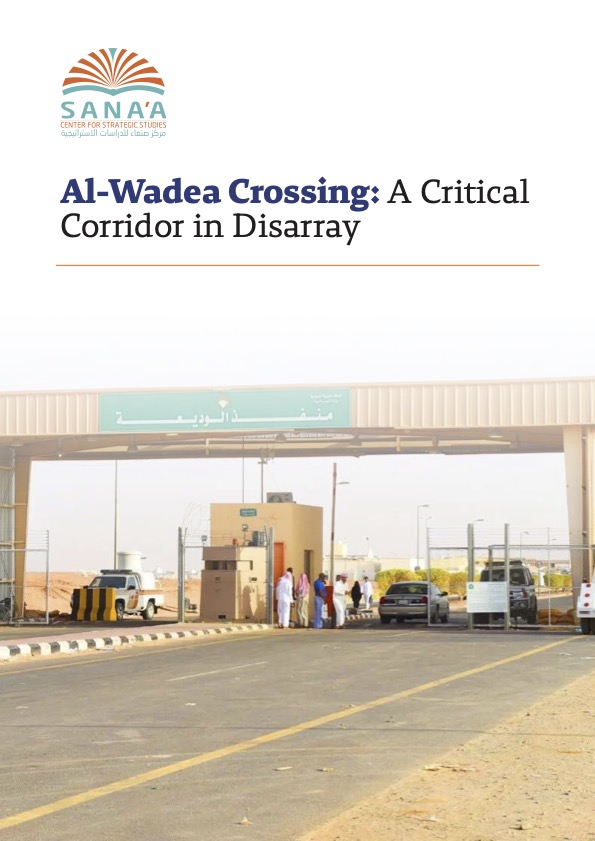
The Al-Wadea border crossing between Yemen and Saudi Arabia was established in September 2003, coinciding with efforts by both countries to enhance coordination and cooperation amid the security challenges posed by terrorism. Before the war, the crossing was used for the movement of Yemeni travelers to and from Saudi Arabia, but its activity remained limited due to the existence of other points of entry, such as the Al-Tuwal crossing in Hajjah and the Al-Buqa’ and Alab crossings in Sa’ada. Al-Tuwal and Al-Buqa’ were more convenient options for entry to and exit from Saudi Arabia because of their proximity to population centers, in contrast to Al-Wadea, which is located in the northeast of Yemen in Hadramawt.
Since 2015, however, the Al-Tuwal crossing has been closed following the transformation of the city into a military confrontation zone between government forces and the Houthi group (Ansar Allah), who turned the area into a military base used to target cities in southern Saudi Arabia. The war has also forced the closure of other crossings as well, and for the past decade, Al-Wadea has served as the only remaining land connection between Yemen and Saudi Arabia. The crossing’s importance has therefore increased, evolving into a primary hub for commercial traffic, the entry of humanitarian aid into Yemen, and the movement of travelers and pilgrims, particularly between Yemen’s eastern governorates and Saudi Arabia. The importance of the Al-Wadea crossing is further amplified by the large Yemeni community in Saudi Arabia, which remains the primary destination for Yemeni expatriation.
Today, the crossing has become a site plagued by chronic congestion, corruption, and inefficiency, driven by fragmented control, weak institutional capacity, and increased traffic. Frequent changes in authority, the absence of effective management systems, and unsuccessful reform attempts—such as the poorly implemented Obour application—have further strained operations, making the crossing a burden for Yemenis. To ease these challenges, comprehensive and accountable oversight has become imperative.
A Vital Passage Caught in Chaos
Data from Yemen’s Ministry of Foreign Affairs and Expatriates Affairs indicate that approximately 1.5 million Yemenis reside in Saudi Arabia. Despite its limited infrastructure and weak capacity, the Al-Wadea crossing receives thousands of Yemenis daily, including expatriates returning home, laborers seeking opportunities abroad, and patients who rely on it as a critical gateway for medical treatment. Al-Wadea accounts for approximately two-thirds of total passenger movement to and from the country. In 2024, it received roughly 2.3 million passengers out of the 3.3 million who crossed Yemen’s land, sea, and air borders. The crossing is also a primary conduit for the flow of goods into Yemen.
In recent years, the surge in the number of travelers, combined with a lack of institutional development, has transformed Al-Wadea into a daily scene of severe congestion and protracted queues. Amid persistent administrative challenges and organizational chaos faced by Yemeni authorities, the crossing has become more than a mere transit point; it now serves as a mirror reflecting Yemen’s fragmented reality and the government’s inability to provide services commensurate with the crossing’s strategic, economic, and humanitarian significance. Chronic structural and administrative shortcomings include the absence of a reliable electronic system for managing and documenting cross-border movement and the failure to separate commercial and humanitarian truck traffic from other vehicles, thereby exacerbating daily congestion.
Official data shows that revenues from the crossing exceeded 100 billion Yemeni rials in 2024, making it one of the state’s most significant sources of income. Despite, or perhaps because of the substantial revenues it generates, multiple testimonies and reports indicate the crossing has remained a theater for illegal levies and the exploitation of influence by various military and administrative leaders who have vied for control throughout the years of the war. These include both civilian and military actors, represented by the border administration and the forces tasked with securing the crossing. The primary military unit operating at the crossing is the 2nd Battalion, also known as the Border Crossing Protection Battalion, which falls under the 141st Infantry Brigade. The brigade is part of the government’s 6th Military Region based in Marib, with operational theaters in Al-Jawf, Amran, and Sa’adah. Another force operating at the crossing consists of military units affiliated with the Saudi-backed Nation’s Shield forces, under the command of Presidential Leadership Council head Rashad al-Alimi. Civilian actors have also been implicated in the imposition of illegal tolls and extortion, including the former director of the crossing, Mutlaq al-Sa’iri. Following widespread reports of corruption at the crossing, then-Vice President Ali Mohsen al-Ahmar formed an official committee in 2016 to investigate the matter. However, the findings of this investigation have never been publicly disclosed, and Al-Sa’iri remained in his position until 2024.
Ongoing structural imbalances have maintained a fertile ground for extortion and corruption, turning the crossing into a passage that is both psychologically and financially taxing for Yemenis. In response, the authorities marketed Obour, an electronic transit application, as an organizational solution, but it has quickly become part of the problem, exacerbating border issues.
The Obour App
In late January 2025, the Land Transport Authority announced the launch of the Obour application, a move described at the time as an attempt to organize traffic and entry through Al-Wadea and to reduce the lengthy wait times endured by Yemenis. The application offered several features, including advance booking, emergency case processing, and reservation verification.
However, a significant gap between its stated goals and its practical implementation quickly became apparent. According to testimonies from travelers and drivers,[1] Obour suffered from persistent technical glitches, including frozen requests, delays in booking approvals, applications remaining “pending,” and problems in rebooking after a cancellation. Furthermore, the application was not supported on iPhones.[2] Reviews on the Google Play Store reflected deep frustration with these failures, which placed many in precarious situations,[3] particularly those whose visas were nearing expiration or whose travel dates were tied to employment contracts.
Testimonies suggest that conditions at the border and the app’s failure have given rise to a parallel system: paying for passage. Travelers reported paying between 500 and 800 Saudi riyals (roughly between 130 to just over 200 USD) to brokers and intermediaries at the crossing to allow their vehicles to bypass the long queues.[4] Many travelers assert that this has become the only way to avoid waiting a week or more at the crossing.[5] Sometimes payment is mandatory. One driver recounted being asked for 500 Saudi riyals to “cross into Saudi territory” after the system repeatedly rejected his booking.[6] These accounts align with internal reports from the crossing confirming “clear brokerage” at the entry gates, especially during peak seasons such as the Hajj.[7]
Consequently, rather than improving wait times and facilitating transit, the Obour app has created additional bottlenecks that entrench extortion and impose new financial burdens on travelers.
Power Struggles
Throughout the war, the crossing has been a major source of revenue, making its control a focal point of political and economic competition. In recent years, Al-Wadea has seen frequent changes in its protection and supervisory arrangements, reflecting intense competition among Yemeni factions over one of the country’s few remaining sources of revenue. Until mid-2024, the crossing was under the supervision of the 141st Brigade, affiliated with the government’s 6th Military Region. But in August of that year, control shifted to the Saudi-funded Nation’s Shield forces, which assumed responsibility for passports, customs, and the central gate. This transition followed popular and tribal demands in Hadramawt to hand over management to locals; the move to the Nation’s Shield forces achieved this, as most of its personnel are from Hadramawt. But despite the transfer of supervision, the crossing continues to face the same structural issues of corruption and a lack of oversight.
Although the crossing’s management announced the abolition of passport fees (previously 10 Saudi riyals) in November 2024, the move failed to stop illicit financial practices. Fees soon reappeared under new names and through different methods, indicating that the problem lies not in the fees themselves but in the absence of institutional accountability. This prompted government directives in October 2025 that emphasized the need to halt revenue collection outside legal frameworks. The Ministry of Transport was legally responsible for enforcement, with a focus on collecting revenues through official channels and remitting them to the central bank.
An Urgent Need for Administrative Oversight
The experience with the Obour app and other reform attempts demonstrates that the core issue is not a lack of technical tools, but the absence of an administrative and regulatory system capable of managing such a sensitive facility. Every attempt at change is met by a corrupt system capable of circumventing new rulesand reproducing itself in new forms.
Improving processes at Al-Wadea requires a genuine commitment from official authorities to reform the administrative system, decouple military influence from civilian management, and hold accountable those involved in financial extortion and exploitation.
Financial and administrative oversight must be strengthened to ensure that all revenues are deposited into the treasury in accordance with the law, and that illegal financial practices are abolished. Activating the roles of regulatory bodies, including the Ministry of Transport and relevant government agencies, is vital to ensuring compliance and penalizing those who exploit travelers. This oversight should be continuous and multi-layered, involving field inspections, regular audits of financial records, and technical reviews of the application process to ensure transparency at every stage of a traveler’s journey.
Technically, the Obour application requires updating to provide effective booking mechanisms and technical support for travelers. These measures must be overseen by independent regulatory bodies to ensure the application is not used as a vehicle for further financial extortion.
This analysis is part of a series of publications produced by the Sana’a Center and funded by the government of the Kingdom of the Netherlands. The series explores issues within economic, political, and environmental themes, aiming to inform discussion and policymaking related to Yemen that foster sustainable peace. Any views expressed within should not be construed as representing the Sana’a Center or the Dutch government.
- Interview with driver transporting passengers to and from Saudi Arabia, November 29, 2025.
- Interview with a driver and a traveler, October 15, 2025.
- Review by the author of comments on the Google Play Store, November 25, 2025.
- Interview with an expatriate laborer, September 3, 2025.
- Interview with an expatriate, September 3, 2025.
- Interview with an expatriate, September 3, 2025.
- Interview with an expatriate, September 3, 2025.
Author
Author
Author