

Military and Security
Saudi Arabia Counterattacks After STC Offensive
The UAE-backed Southern Transitional Council (STC)’s lightning push into Hadramawt and Al-Mahra in early December marked one of the most abrupt and consequential shifts in Yemen’s security landscape in recent decades. Within weeks, STC-affiliated forces surged into the eastern governorates, were rapidly pushed back, and were ultimately forced to retreat to Aden and then cede control of the interim capital. The episode culminated in the end of more than a decade of Emirati troop presence in Yemen, the expulsion of STC leader Aiderous al-Zubiaidi from the Presidential Leadership Council (PLC), and sweeping changes to the southern security architecture.
For years, the secessionist STC had been laying the groundwork for a potential expansion eastward, and had steadily increased its military presence in Hadramawt through the Hadrami Elite and 2nd Military Region forces based in Mukalla.[1] Since 2022, Saudi Arabia has worked to counter the STC’s growing presence in Hadramawt by building up the Nation’s Shield forces, a unit of predominantly Salafi-leaning soldiers trained and funded by the Kingdom and placed under the direct command of Presidential Leadership Council (PLC) chief Rashad al-Alimi. The Nation’s Shield, along with Yemen Emergency forces based along the northern border in Sa’ada and Al-Jawf, 1st Military Region soldiers based in Seyoun, and national army forces in Marib, make up the bulk of the pro-Saudi military network in Yemen. Earlier this year, Saudi Arabia also began cultivating ties with Hadrami tribal leader Amr bin Habrish, who had established his own fighting group, the Hadramawt Protection forces, outside government control.
Hadramawt occupies a distinct place in Riyadh’s eyes and strategic mindset, owing both to the deep tribal and social ties shared between Hadramis and Saudis and the long border with Saudi territory. To this end, Riyadh has repeatedly made clear that Hadramawt is a matter of national security, not simply of ordinary interest. Despite these warnings, the STC likely believed it was facing a closing window of opportunity in Hadramawt. Summer protests over chronic electricity shortages had eroded public confidence in the STC’s leadership in the governorate, while simultaneously fueling the meteoric rise of tribal leader Amr bin Habrish, whose growing influence caught the eye of Saudi Defense Minister Khalid bin Salman, the penholder of the Yemen file in Riyadh. For months, STC leaders and affiliated media hurled increasingly pointed warnings at Bin Habrish, whose calls for an independent Hadrami project posed a direct challenge to the STC’s goal of recreating a southern state encompassing all of the former South Yemen. Tensions steadily escalated throughout the autumn, as reports emerged of tribal military training camps forming in and around Bin Habrish’s stronghold in Ghayl bin Yameen district.
The tipping point came on November 23, when the head of the STC-affiliated Security Support forces, Saleh bin al-Sheikh Abu Bakr, known locally as Abu Ali al-Hadrami, began agitating against Bin Habrish, calling his forces “illegitimate” and vowing to sever their supply lines from the coast. Using explicitly secessionist language, he referred to STC-affiliated forces as the “Army of the Arabian South,” while southern media parroted the narrative as a “final warning” to Bin Habrish. STC forces began mobilizing the following day, with units from Lahj, Aden, Abyan, and Shabwa heading toward Mukalla on the Hadrami coast, ostensibly in support of Abu Ali al-Hadrami and to “combat terrorism.”
Limited clashes soon broke out between STC-affiliated forces and Bin Habrish’s tribal fighters at the gates of the PetroMasila facilities, where the latter were holed up after preemptively occupying the oil fields days earlier. Although the fighting was brief and possibly staged to prevent major casualties, it marked the first armed clashes in Hadramawt since Al-Qaeda in the Arabian Peninsula (AQAP) was expelled from Mukalla in 2016. To the northwest, STC forces advanced toward Seyoun, entering the city on December 2. While local sources say at least 30 people were killed in the fighting for Seyoun, resistance was limited: 1st Military Region forces handed over the city with only minimal fighting before making their orderly withdrawal toward Marib.

At the oil fields, emergency mediation efforts quickly collapsed, and renewed clashes broke out between the Hadrami Elite forces and tribal fighters. Bin Habrish, eventually overrun, fled to Saudi Arabia, where he called on his forces to disband and return to their homes. In Shabwa, a simultaneous surprise attack from UAE-backed forces dispelled any doubts that a coordinated maneuver was underway. Shabwa Defense forces raided the Al-Areen Camp in the desert region near the border with Marib, expelling Islah-affiliated Ataq Military Axis forces and effectively removing Islah’s last foothold in Shabwa after the force’s expulsion from Ataq in 2022. The subsequent handover of the Al-Aqla oil facilities in Shabwa to UAE-backed forces and the uncontested march of STC-affiliated forces into Al-Mahra painted a clear picture: the STC had taken the east.

It is possible that Saudi Arabia tacitly allowed the STC to push out the Islah-affiliated 1st Military Region in Hadramawt, perhaps with the understanding that they would subsequently be replaced by the Nation’s Shield forces under the command of PLC chief Al-Alimi. The decision to fold twelve Nation’s Shield brigades into the 1st Military Region command structure only days earlier also points to some sort of coordination – or at least prior knowledge – on Riyadh’s behalf. In the following days, it became increasingly clear that the STC had committed a serious overreach by seizing and holding eastern Yemen. Riyadh immediately shifted into a defensive position, withdrawing its forces from key bases in Aden, Al-Mahra, and Mayoun (Perim) Island on the Red Sea, and redeploying Nation’s Shield units toward the Hadramawt border areas of Al-Abr and Al-Wadea.
The military movements triggered a political crisis between Aden, Abu Dhabi, and Riyadh. Saudi officials were quick to assert that, while a limited STC move on Seyoun may have been tolerated, the takeover of Hadramawt crossed a firm red line. Despite repeated Saudi demands for the STC to stand down, southern units consolidated their positions, while pro-STC protestors took to the streets to demand the declaration of a southern state (see Politics section). Riyadh consequently found itself with little room to maneuver and was compelled to act. Through PLC chief Al-Alimi and Nation’s Shield commander Bashir al-Madrabi, Saudi Arabia pressed ahead with the repositioning of the forces, who announced their complete redeployment on December 19. The sudden return of Amr bin Habrish to Hadramawt from Saudi Arabia, timed to deliver a forceful and rallying speech at the Hadramawt Tribal Alliance (HTA)’s ten-year anniversary, signalled that Riyadh was gearing up for a more forceful response.
Events came to a head on December 25, when Security Support forces led by Abu Ali al-Hadrami advanced on positions held by HTA-affiliated tribal fighters in Ghayl bin Yameen district. In response, Saudi Arabia launched isolated airstrikes in the Hadramawt Valley, intended as a final warning to the STC-affiliated soldiers and their backers in Abu Dhabi. Rather than acquiesce, the UAE sent reinforcements: two ships sailed from Fujairah and docked at Mukalla, and unloaded military vehicles and weapons reportedly destined for the STC. Saudi Arabia responded in force, targeting the Emirati cargo with airstrikes. From Riyadh, Rashad al-Alimi terminated the Joint Defense Agreement with the UAE and formally requested the withdrawal of all Emirati forces from Yemen within 24 hours. Al-Alimi then directed that all Emirati positions be handed over to the Nation’s Shield and ordered the withdrawal of STC forces to their original positions.

Once Riyadh decided to act, it became apparent that the balance of power on the ground was far different from what it first appeared. Hadramawt’s topography provides little cover, and ground forces proved extremely vulnerable to airstrikes. Saudi-backed Nation’s Shield forces were joined by the Yemen Emergency forces, and with local tribesmen and air support, found quick success. Using Al-Abr as a staging point, Saudi-backed forces branched out, taking back Al-Khasha’a, Seyoun, and Al-Qatn, before advancing toward Mukalla. STC-affiliated forces withdrew from Al-Mahra with little fighting. Nation’s Shield forces then moved westward toward Shabwa and Abyan, eventually securing the interim capital and pulling out heavy weaponry there. Saudi airstrikes extended even to Al-Zubaidi’s home governorate of Al-Dhalea following the STC leader’s refusal to attend a summons to Riyadh.
Following reports of Al-Zubaidi’s escape to the UAE via Somaliland, the STC withdrew forces and heavy weaponry from Aden’s Al-Ma’ashiq Palace, and Giants Brigade soldiers under the command of PLC member Abdelrahman al-Muharammi (Abu Zara’a), assumed control of the compound. While Abu Zara’a was directly backed by the UAE and was promoted to overall security director of the STC last year, he appears to have pledged fealty to Riyadh and has been placed in charge of Aden’s security. His political reversal and those of other UAE-backed actors demonstrate the fluidity of the alliances that characterize Yemen’s security sector.
While fighting on the ground has subsided, large changes remain in store for security in the south. Beyond the decision to dissolve the government (see Politics), a number of pro-STC military commanders in Hadramawt and Al-Mahra have been sacked and referred for investigation. This includes the commander of the 2nd Military Region, Talib Saeed Barjash, who was replaced by Mohammed Omar al-Yamani. The government also announced a new Supreme Military Council in an effort to bring all forces under a single umbrella.

But the main question for Saudi Arabia will be what to do with the remaining forces that were on the UAE payroll. While the Kingdom had picked up the bill for some southern security forces following the UAE’s redeployment from Aden in 2019, Abu Dhabi was reportedly still responsible for regular payments to the Giants Brigades, Shabwa Defense forces, and Hadrami Elite forces – not to mention various security units in and around Aden whose salaries the STC had covered on an irregular basis. Even with the Kingdom’s vast wealth, the addition of these new salaries will entail a significant financial outlay and pose a logistical challenge. It also remains unclear how Saudi Arabia plans to ensure the loyalty of former STC fighters, particularly those from Al-Dhalea who share tribal or regional ties with the Al-Zubaidi and are unlikely to accept his defeat.
A related security concern accompanies the withdrawal of Emirati counterterrorism forces, which could create a significant security vacuum. There is serious worry that Al-Qaeda may try to take advantage of this period of instability. Beyond the interim capital, fears of insecurity have been particularly high in Hadramawt, where the snap withdrawal of the STC has led to looting, banditry, and reported weapons stockpiling. While Nation’s Shield forces have conducted a number of security campaigns to prevent Bin Habrish’s fighters and other tribesmen from consolidating too many arms, the Saudis will need to be careful to balance the competing interests in Hadramawt. Elsewhere in the south, protests, prison riots, and clashes over military hardware portend an arduous road ahead for Saudi Arabia, which must secure the interim capital before it sends back Yemen’s new government from its satellite campus in Riyadh.
As the dust settles in Aden and Hadramawt, one thing remains clear: the events of the past months have reiterated the extent of Yemenis’ agency in their own political process. By dissolving the STC and its affiliated forces, leaders in Riyadh have demonstrated their intent to take full control of Yemen’s security sector. While this may unify strategic decision-making in the immediate future, particularly regarding any possible military action against the Houthi group (Ansar Allah), it is unlikely to be tenable in the long run. Tensions over security in Aden have demonstrated that many of the longstanding grievances that have underpinned decades of conflict still exist, and the fact that soldiers’ pay stubs are signed by a new hegemon does little to address that. But this challenge also presents Riyadh with an opportunity: to tackle security risks on the ground in a lasting and sustainable manner, Saudi Arabia must now genuinely empower Yemeni actors, not sideline them.

Shippers Return to Red Sea, Houthis Put Somaliland in Crosshairs
The Houthis have honored their promises to halt attacks on Red Sea shipping, allowing the safe passage of vessels since the announcement of a US-brokered ceasefire in Gaza in early October. The group even released the crew of the Eternity C, who had been held captive since their ship was sunk in mid-July. The crew was transported via plane from Sana’a to Oman along with a delegation of senior Houthi figures for UN-backed prisoner exchange negotiations (see Politics). For now, the Red Sea is calm. Shipping giant Maersk announced a trial return to the Red Sea route. Along with other global shippers, it had diverted its maritime traffic around the Cape of Good Hope since early 2024. The EU’s Operation Aspides announced in late November that it had secured the passage of more than 1,320 commercial vessels since it began operations in the Red Sea in February 2024.
But the risk of a return to Red Sea violence remains a real possibility. Houthi activity in recent months indicates that the group is continuing to mobilize for possible future attacks and building up the arsenal to do so. Reports received by the Sana’a Center indicate that Houthi naval forces conducted amphibious drills along Hudaydah’s Red Sea Coast, including simulated landing operations, naval battles, and site captures. The nature of the simulations could indicate Houthi preparations for coastal advances, possibly on one of the Joint Forces-controlled islands. The withdrawal and redeployment of Saudi and Emirati troops on Red Sea islands in recent weeks has likely strengthened these considerations.
Renewed Houthi activity on the Red Sea front could also be aimed toward Somaliland. Israel’s recognition of the breakaway region, presumably to extend its economic and operational reach in the southern Red Sea, has angered leaders across the Arab world and drawn condemnations from the Houthi leadership. Abdelmalek al-Houthi warned that the group would “not hesitate” to target any Israeli base built there.
The continued import of illicit arms through both official and clandestine ports in Hudaydah indicates that the group probably has the firepower to back up these claims. Since the beginning of October, the Sana’a Center has recorded 11 incidents of illicit arms smuggling along Hudaydah’s coast, while activity has resumed at the ports of Hudaydah and Al-Salif, following their destruction by Israeli airstrikes. Along with arms, the Houthis continue to violate international sanctions, regularly importing smuggled grain, printers, oil, and other goods.
Frontline Stability Threatened by Coalition Reshuffle
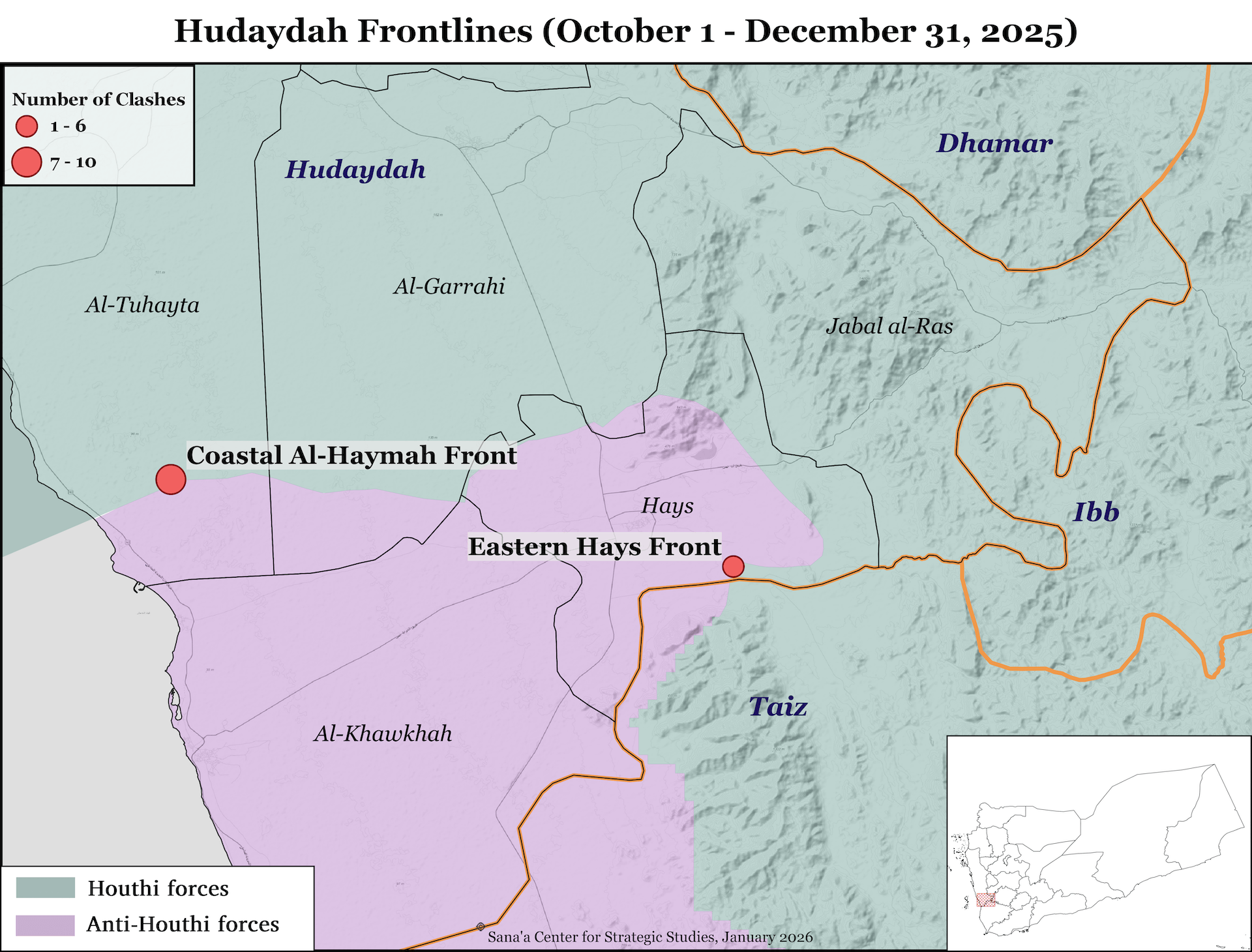
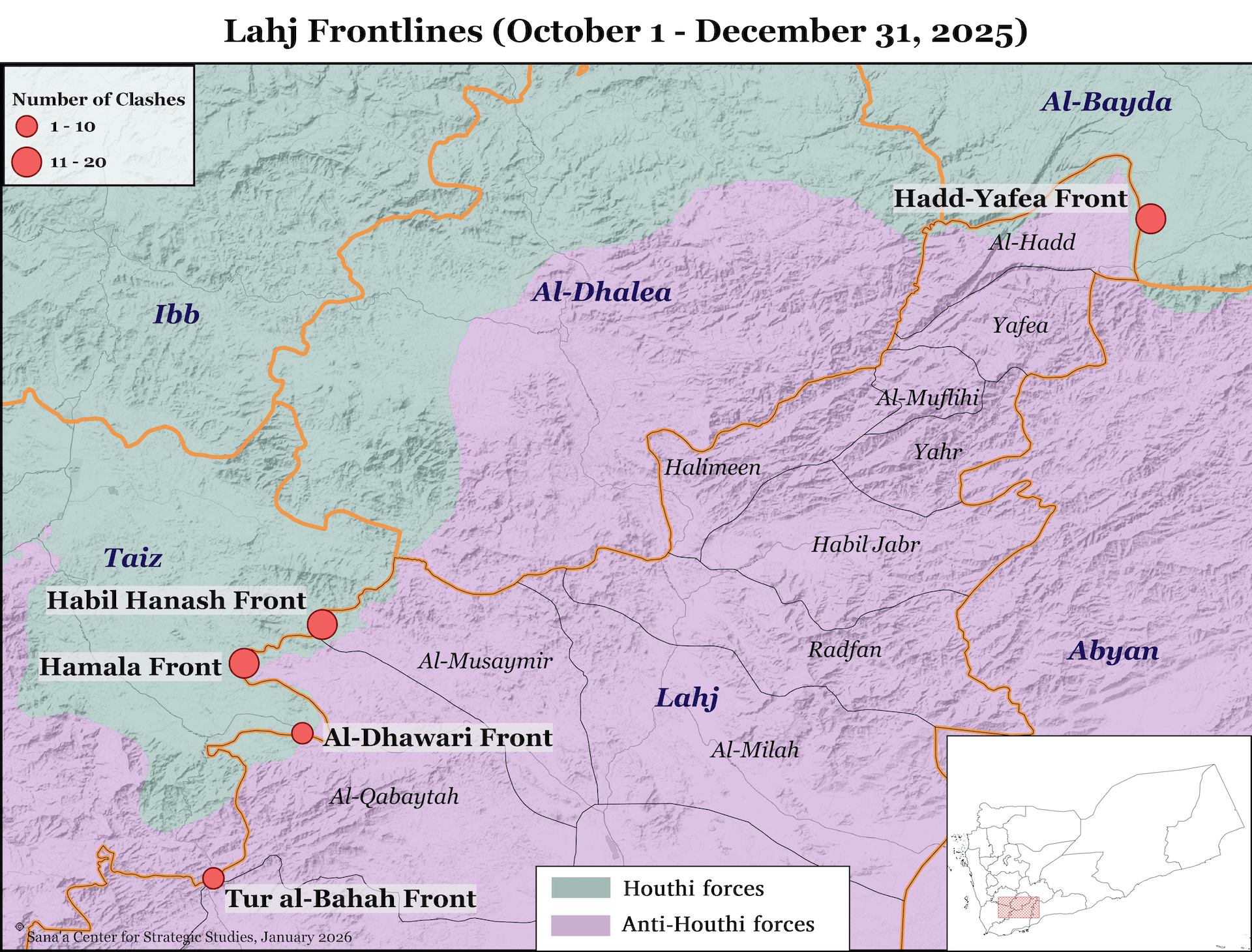
Infighting among the anti-Houthi coalition now threatens the fragile stability of Yemen’s frontlines. Many of the most active frontlines, including those in Lahj, Al-Dhalea, Abyan, and Shabwa, were manned, in part, by STC-affiliated or UAE-backed units. Their transfer to Saudi administration, and the redeployment of Giants Brigade forces from frontlines in Hudaydah to Aden, could create weaknesses in the anti-Houthi defenses.
Despite these changes, the Houthis have made no major advances and appear to be watching to see what happens. Their continued mobilization of tribesmen, particularly in Marib and Hudaydah, suggests they’re not sitting idle. The group is still reeling from losses to both its leadership and arsenal following US and Israeli air campaigns last year, which have caused internal discord and paranoia. Leadership in Sana’a is likely eyeing the possibility of a political détente with Riyadh, and any offensive now could jeopardize a future deal.
In other areas, frontlines remained fragile but stable throughout the autumn, with fighting taking place in Taiz, Lahj, Al-Dhalea, Shabwa, Abyan, and Hudaydah. In Al-Jawf, intermittent clashes were recorded between Houthi fighters and pro-government soldiers throughout November, but did not result in any major territorial changes or casualties. In late December, fighting also broke out for the first time in ten months along the Aqabat Halhal front in Abyan’s Lawdar district, a development which may have been triggered by the redeployment of Nation’s Shield forces.





Other Developments In Brief
October 16: The Houthis announced the death of their military chief of staff, Mohammed Abdelkarim al-Ghamari, from wounds sustained during “various raids launched by the criminal American-Zionist aggression.” It is unclear if Al-Ghamari was injured by a targeted Israeli airstrike in June or Israeli Operation Lucky Drop, which killed a dozen Houthi cabinet members and other officials in late August.
October 20: The Associated Press reported that a new airstrip has been built on Zuqar Island in the Red Sea off the coast of Hudaydah, which is controlled by forces loyal to Tareq Saleh.
November 13: The UN Security Council voted to renew its sanctions regime in Yemen for another year. Thirteen countries voted in favor, with Russia and China abstaining. The vote extends the asset freeze and travel ban on several Houthi officials, and the arms embargo measures that have been in place since 2014.
November 9: Tensions rose among government forces on the West Coast after UAE-backed Giants Brigade commander Hamdi Shukri deployed an additional battalion to coastal areas of Lahj, disgruntling Nation’s Shield forces stationed in the area. The move prompted PLC head Rashad al-Alimi to withdraw the Nation’s Shield forces.
November 24: Clashes erupted between villagers in Lahj and local security forces as Taiz Governor Nabil Shamsan’s convoy passed through the area, sparking concerns of a possible assassination attempt. Although Shamsan’s presence appeared to have been coincidental, the incident underscored the deteriorating relationship between civilians and armed groups in Yemen.
November 29: A US drone strike killed senior Al-Qaeda leader Munir al-Ahdal, also known as Abu al-Haija al-Hadidi, and another individual as they were riding a motorcycle along a dirt road in the Al-Ramsa area of Marib al-Wadi district. Two suspected Al-Qaeda militants were also killed in a drone strike of unclear origin in Marib’s al-Wadi district on December 8.
December 25: Houthi authorities held funerals for five military leaders, some of whom were killed in US and Israeli airstrikes earlier this year. Among the dead was Zakaria Abdullah Hajar, who oversaw the Houthi drone unit and was considered a pioneer in the group’s drone capabilities. His brother, Ahmed Abdullah Hajar, was also killed and was responsible for logistics linked to missile and drone forces.
- Yemen’s anti-Houthi coalition is comprised of a patchwork of forces with various loyalties. The military regions are army operational commands that were reorganized under former president Abdo Rabbu Mansour Hadi in 2012. The 1st Military Region has been historically affiliated with the Islah party, while the 2nd Military Region has been backed by the UAE and allied with the STC.
Former Editor
Editor and Researcher