

Military and Security
Saudi-led Restructuring Tests Southern Military Loyalties
The Saudi-led restructuring of the Yemeni government’s military and security apparatuses, which began in the early months of 2026, has put southern military loyalties to the test in the year’s second quarter. The restructuring has included a broad revamp of commands, personnel systems, and revenue networks once controlled by the secessionist Southern Transitional Council (STC) or formerly under UAE patronage. The restructuring has seen a number of commanders dismissed from their positions, others grow closer to Riyadh, and still others pushed into hiding as Saudi officials and their partners in the Yemeni government work to dismantle and weaken the STC’s remaining military structures. In many regards, the initiative has made great strides. The Yemeni armed forces are on track to become more coordinated than at any point in their recent history, with a more centralized chain of command, unified registration system, and regular salary payments. But despite these changes, Yemen’s army remains far from organized. Clashes have erupted across the South as commanders refuse to yield their positions and their loyalists push back against perceived Saudi strong-arming.
If the year’s first quarter was a story of Saudi Arabia’s consolidation of its authority over Yemen’s armed forces, the second is one of implementation. After spending months reappointing top security officials at the ministerial level and bringing southern armed forces under the nominal administration of the Ministries of Defense and Interior, Riyadh has now begun to shift its focus toward personnel changes on the ground level. One of the most consequential changes made in recent months was the April 30 appointment of 2nd Giants Brigades commander Hamdi Shukri as commander of the 4th Military Region. Shukri’s influential Subaihi tribal roots and military acumen have made him one of the most successful leaders in the formerly UAE-backed Giants Brigades forces, and he will retain his old position in addition to the new appointment. Alongside him, Mahdar al-Sa’adi al-Yafeai now serves as the Region’s chief of staff and Ali Hassan al-Jahouri al-Radfani as chief of operations. The choice of the three men to lead the 4th Military Region – which oversees frontlines and bases in the former STC strongholds of Aden, Lahj, Abyan, Al-Dhalea, and parts of Taiz – is hardly inconsequential. In choosing them, Riyadh has distributed authority across three of the South’s most influential tribal constituencies, working to placate tribesmen and STC supporters while simultaneously assuring the forces’ compliance through the placement of a trusted Salafi commander at the top.
Beyond the appointment of high-ranking commanders, Riyadh is also attempting to redraw the very nature of Yemen’s southern military geography. On April 21, the Joint Operations Authority of the Southern Armed Forces, led by PLC member Abdelrahman al-Muharrami (Abu Zara’a), issued a decree that aims to reorganize the southern forces across three new operational axes headquartered in Abyan, Lahj, and Al-Dhalea. The first of these (the Abyan Operational Axis) incorporates units from the existing Abyan and Yafea Axes, the Shabwa Infantry Brigades, and several other smaller units. The second (the Lahj Operational Axis) groups units from Radfan, the Al-Anad Air Base, and the Karesh, Al-Musaymir, and Tur al-Bahah regions of Lahj, as well as areas near the Bab al-Mandab. The third (the Al-Dhalea Operational Axis) will bring together units along frontlines around the governorate’s districts of Al-Dhalea and Murais.
While the full reasoning for the move is not entirely clear, it may be an attempt to break up what has historically been known as the southern “triangle” of Radfan, Yafea, and Al-Dhalea. This political and military bloc formed the backbone of the early southern resistance movement and remains a major obstacle to Saudi efforts to centralize military authority in Aden and the surrounding governorates. Under the new configuration, Yafea will be linked militarily with Abyan and Shabwa; Radfan will be grouped with Al-Subaiha and the Bab al-Mandab; and Al-Dhalea will be aligned northward toward Murais and the surrounding areas. Each former STC stronghold would thus be incorporated into a wider territorial command.
At the tactical level, the reorganization helps to align commands with actual threats in the face of a potential Houthi offensive. Furthermore, government officials may hope it addresses the fragmentation that has long plagued Yemen’s armed forces, wherein units with competing interests operate under overlapping brigades, axes, and formations with unclear chains of command and political loyalties. Ironically, it may also exacerbate that very problem: the proposed Al-Dhalea Axis contradicts a 2025 PLC decision to establish the 8th Military District, which is headquartered in Al-Dhalea’s Qaataba district and is responsible for various frontlines in the governorate. These moves support the first major redeployment of ground forces in mid-March, after Shabwa Defense forces were sent to Marib’s Harib district and Shabwa’s Bayhan and Ain districts to replace Giants Brigades forces there.
To ensure that all soldiers are fully integrated within the new command structures and appropriate ministries, the government has moved forward with the biometric census initiative proposed earlier this year. The new system is primarily intended to curb corruption by eliminating the practice of employing absent “ghost soldiers” to inflate payrolls and prevent soldiers from “double dipping” by enlisting in more than one outfit – both widespread practices under the old system. More broadly, the initiative also centralizes control of the military payroll system and removes it from the hands of individual commanders. The establishment of a database has been mooted for years, but pushback from commanders and politicians who benefited from the disarray stalled any tangible steps toward realization. In many regards, the census’s implementation has been successful thus far: local sources say soldiers across Aden, Lahj, Al-Dhalea, Abyan, and Taiz have all signed up under the new system. However, protests from a number of soldiers lamenting their exclusion from the new payment system show the registration process is far from perfect. In Lahj’s Radfan district, for example, a dispute over soldiers from the 5th Support and Backup Brigade being allowed to fingerprint left two soldiers and five civilians dead in early April. In Aden, soldiers have staged protests outside the local authority building, claiming that their superiors arbitrarily excluded them from the registration process.
Beyond payroll corruption, the Saudi-led restructuring is also working to curb informal revenue from flowing into the hands of breakaway southern commanders and various other actors. The government has announced coordinated campaigns in Abyan, Lahj, and Al-Dhalea to dismantle unofficial checkpoints collecting illegal levies from civilian travelers and commercial truck drivers. Government officials have tried in vain for years to eradicate the checkpoints, but in many cases, efforts have been cosmetic and intended only for public display. Of the genuine campaigns that have occurred, many faced pushback from commanders who argued that their forces weren’t adequately funded and relied on the levies in order to operate effectively. This time, the government seems motivated in the hopes that removing levies will simultaneously dry up revenue that was flowing into the hands of STC commanders who operate them. But while the campaign has had strong buy-in from local governors, truckers and travelers report that no major changes have yet occurred, and illegal levies remain prevalent from Aden to Taiz. In May, Abyan Governor Mukhtar al-Rabbash personally led security forces in an operation to dismantle a checkpoint near Zinjibar city, which turned violent. Security officials have faced pushback in other areas, too. In Al-Dhalea, National Security forces clashed with armed men who had blocked the Murais section of the Aden-Sana’a road in an attempt to tax qat traders, according to sources in the local authority. Gunmen also opened fire on the governorate’s local authority headquarters after Governor Ahmed al-Qubba ordered the dismantling of 12 STC-aligned checkpoints collecting illegal tolls.
Looking forward, the biggest remaining challenge in the restructuring process is the resistance of certain commanders to step down and peacefully hand over their positions. A number of leaders claim they have been personally targeted by the reappointments, either because of their participation in the December STC offensive or due to personal disputes with senior officials. In Shabwa, the 4th Infantry Brigade of the STC-aligned Southern Armed forces raided the weapons stores of the Al-Khurmah camp in Mayfa’a district before withdrawing after their commander, Asil bin Rashid, refused to surrender the camp to a Giants Brigades commander at the direction of Abu Zara’a. A similar standoff occurred in Abyan after the commander of the Ja’ar Sector of the National Security forces (formerly Security Belt forces) refused to cede control of the October 7th Camp to the 1st Giants Brigade. In Lahj, loyalists of Mukhtar al-Nubi initially refused to hand over their positions in Radfan before later ceding control, according to military sources. Al-Nubi is one of the most influential STC military commanders in the country, and is rumored to have gone into hiding following the STC’s December 2025 military offensive.
Taken together, the efforts made in the past three months represent meaningful progress toward reintegrating Yemen’s fragmented armed forces. The Saudi-backed initiative has made more headway in inventorying and reorganizing the anti-Houthi camp than any previous government effort, and the continuing handover of camps, dismantling of checkpoints, and biometric registration are important steps toward building a more coherent force. But genuine cohesion remains a distant prospect. Riyadh cannot expect to erase the political and military loyalties that have underpinned the STC project for more than a decade through a simple administrative restructuring alone. Looking forward, if Riyadh is to genuinely rebuild Yemen’s fractured armed forces, it will need to do more than redraw command charts and register soldiers on a centralized payroll. Instead, the real test lies in whether Riyadh’s newly appointed commanders will be able to issue orders that soldiers will actually follow. Doing so will require convincing commanders and rank-and-file fighters that they have a place in the new system, and ensuring they can fight alongside one another – and not against their leaders – when it counts most.
Houthi Restraint Gives Way to Renewed Escalation
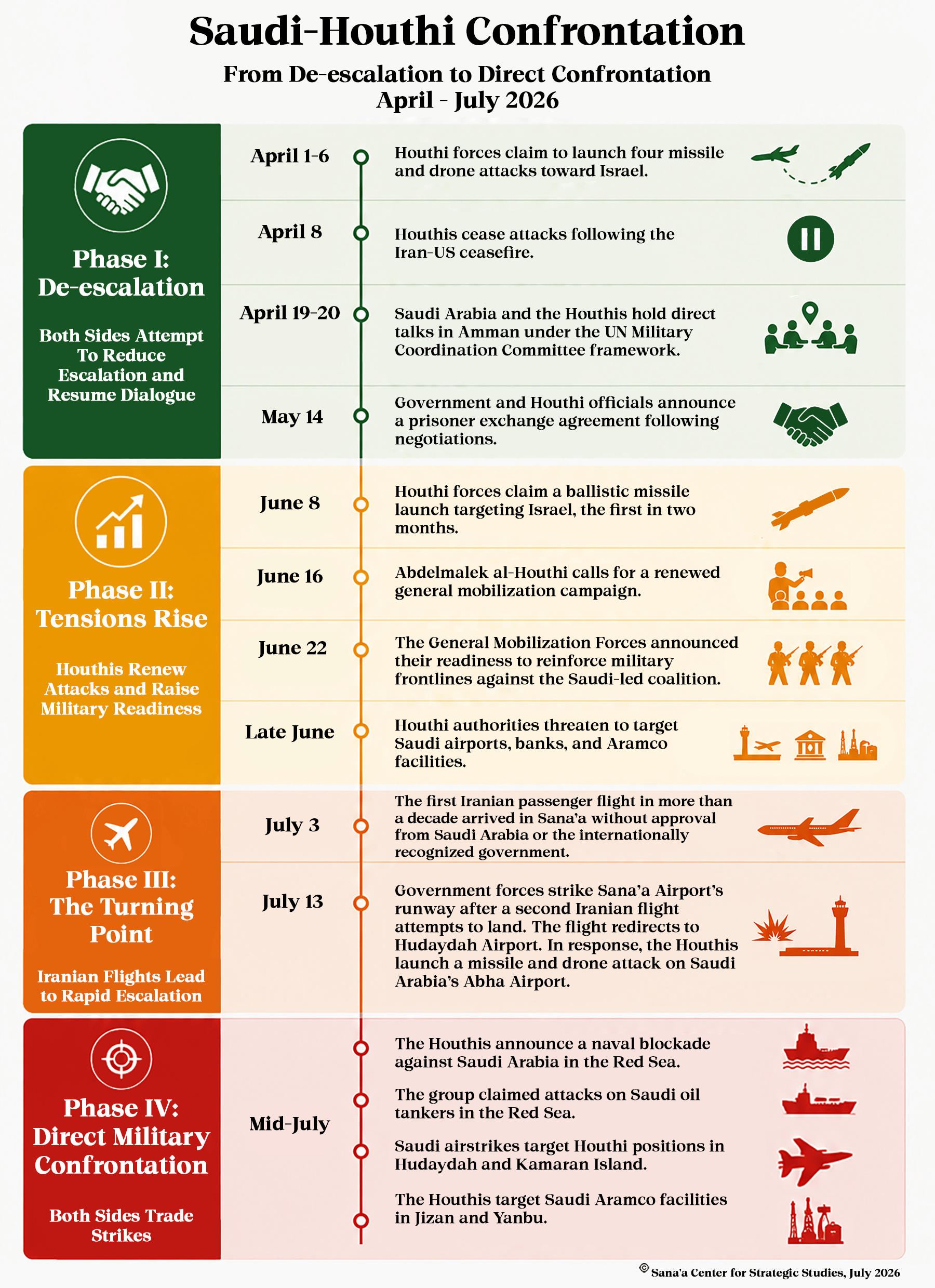
The arrival of two Iranian aircraft in Houthi-held Yemen in early July has triggered a rapidly escalating confrontation, leading to direct Saudi-Houthi exchanges of fire on a scale not seen since the April 2022 truce. In the weeks since, the Houthis have announced a naval blockade against Saudi Arabia, claimed attacks on three ships in the Red Sea, and targeted Saudi airports and oil infrastructure. In response, government forces targeted the runways at Sana’a Airport, while the Kingdom launched its own strikes against Houthi military and telecommunications sites along Hudaydah’s coast.
Prior to this direct confrontation, tensions had been building between the two sides for months. On June 8, a purported Houthi missile attack targeting Israel ended an extended pause in hostilities. For more than two months, the group had limited its involvement in the regional conflict between Iran, Israel, and the United States, opting instead to support Tehran through a carefully constructed rhetorical and media campaign. In the background, Houthi negotiators quietly resumed backchannel talks with Saudi Arabia, hoping to extract concessions ahead of a possible political settlement. But as negotiations stalled and the US-Iran conflict dragged on, relations between Riyadh and Sana’a grew increasingly sour.
The quarter opened with Houthi action against Israel: between April 1 and 6, the Houthis launched four missile and drone attacks toward Israel in what they framed as solidarity with Palestine, Iran, and other actors in the Axis of Resistance. In the weeks that followed, the group increasingly began referring to themselves as an active part of the Axis, in which their duty was to uphold the “unity of battlefields” that defended Palestine through control over the “two straits.” However, following the ceasefire signed by Iran and the United States on April 8, the Houthis once again paused their attacks. Although Houthi officials continued to threaten Israel and warned that any Israeli presence in Somaliland would be considered a target, no attacks against Israel or commercial shipping were recorded for over two months. Instead, the group used its position on the Red Sea as leverage, repeatedly threatening to close the Bab al-Mandab and emphasizing its ability to disrupt global shipping.
This pause in operations opened up space for Saudi-Houthi engagement. Between April 19 and 20, the Houthis and the Saudis met for direct talks in Amman under the UN’s Military Coordination Committee (MCC) framework, without representatives of the internationally recognized government, followed two months later by a meeting with MCC representatives and government officials. The two sides remained in contact following Omani efforts to bring Riyadh and the group together for follow-up talks, which eventually led to the prisoner deal announced in mid-May (see Politics). Throughout these negotiations, the Houthis likely found their forbearance in the Red Sea to be a useful bargaining chip as they worked to extract additional concessions from the Kingdom and push toward a broader political settlement. For Riyadh, however, the threat to the Bab al-Mandab remained real. Since the outbreak of the US-Iran conflict, the Kingdom has redirected oil shipments to its western ports to bypass the Strait of Hormuz.
Amidst these discussions, the Houthis continued to bolster their position on the Red Sea and along frontlines in Marib and Hudaydah (see below). On April 6, Houthi authorities conducted a missile test in southern Sana’a using what media outlets described as “advanced liquid-fuel engines,” with increased range and efficiency. Local media reports also pointed to Houthi fortifications along the Red Sea coast, with a number of missile batteries and drone platforms deployed there by early April and naval mine stockpiles reportedly transferred to Hudaydah in mid-May. Media outlets also reported the arrival of Iranian military personnel, with some allegedly deployed to coastal sites, including Kamaran Island, where the Houthis are believed to maintain an operations command center. The Houthis also continued regular naval patrols, which local sources described as approaching increasingly closer to Saudi territorial waters, extending to the western edge of the Farasan Archipelago.
By June, Houthi rhetoric toward Saudi Arabia had grown increasingly hostile. The claimed launch of a ballistic missile toward Israel on June 8 showed that either Houthi patience with the anti-Iran coalition was growing thin, or pressure from Tehran was growing more intense. The group also reinstated its ban on Israeli ships in the Red Sea. On June 16, Abdelmalek al-Houthi used an address marking the Islamic New Year to call for a renewed general mobilization campaign. In the speech, he called on thousands of civilians who have received limited military training – known as the General Mobilization forces – to prepare for potential confrontation against the United States, Israel, or their allies. Six days later, the Houthi-affiliated General Mobilization Forces announced their “readiness to reinforce military frontlines” against the Saudi-led coalition. By late June, Houthi officials were openly threatening to target Saudi interests, including airports, banks, and assets belonging to the Kingdom’s state-owned oil company Aramco, should Riyadh continue what the Houthis described as “evasion and stalling over peace commitments.”
The situation escalated after an Iranian Mahan Air passenger jet made a surprise landing in Sana’a on July 3, marking the first direct Iranian flight to the Houthi-held capital in more than a decade. Houthi officials claimed that Saudi fighter jets attempted to intercept the aircraft, prompting the group to threaten attacks on Saudi airports. Ten days later, when a second Mahan Air flight attempted to return a Houthi delegation from Tehran, the internationally recognized government said its forces struck the runway at Sana’a Airport, forcing the aircraft to divert to Hudaydah. The Houthis responded within hours with a missile and drone attack on Abha Airport in Saudi Arabia. The dispute quickly spiraled into a broader series of tit-for-tat escalations. The Houthis have since announced a naval blockade against Saudi Arabia and claimed attacks on Saudi oil tankers in the Red Sea; the Saudi-led coalition subsequently struck Houthi positions in Hudaydah and on Kamaran Island, after which the Houthis targeted Aramco facilities in Jizan and Yanbu. Whether the fighting remains contained will now depend on if Riyadh and Sana’a can restore the mutual restraint that sustained the post-2022 truce, as well as on the trajectory of the wider US-Iran conflict.
Piracy Resurfaces Off Yemen’s Coast
Piracy has reemerged in the waters off Yemen’s coast. A successful hijacking and a series of armed approaches during May and June indicate that, while the Houthis have not yet resumed a full ban on commercial shipping in Yemen’s territorial waters, vessels may still face threats in transiting the Gulf of Aden and Arabian Sea.
On May 2, suspected Somali pirates seized the Togo-flagged oil tanker Eureka after it departed the port of Qana in Shabwa. Armed men boarded the vessel and redirected it toward Somali territorial waters. The Yemeni Coast Guard deployed patrol boats from Aden and Shabwa but was unable to recover the tanker. The hijackers subsequently demanded a multimillion-dollar ransom for the vessel and its 12-person crew, which included eight Egyptians and four Indians. At the time of reporting, the vessel and crew remain in captivity, and ransom negotiations are ongoing.
In a separate incident on May 2, an armed skiff accompanied by a fishing vessel approached a commercial ship southwest of Mukalla. On May 23, multiple vessels reported being approached by suspicious skiffs in the Gulf of Aden, including a large craft carrying ladders and weapons. On June 10, six armed men aboard a small craft exchanged fire with the security team of a cargo vessel 88 nautical miles southwest of Balhaf in Shabwa before withdrawing. Five days later, four armed men aboard a skiff fired a rocket-propelled grenade (RPG) at a tanker southeast of Aden.
No group has claimed responsibility for the attacks, but their concentration off the coasts of Shabwa, Abyan, and Aden, combined with the use of armed skiffs and ransom demands, points toward piracy rather than clandestine Houthi maritime operations. Although piracy remains far below the level witnessed more than a decade ago, the incidents demonstrate that commercial vessels continue to face a variety of threats as groups find new ways to exploit the region’s recent instability.
Frontline Developments
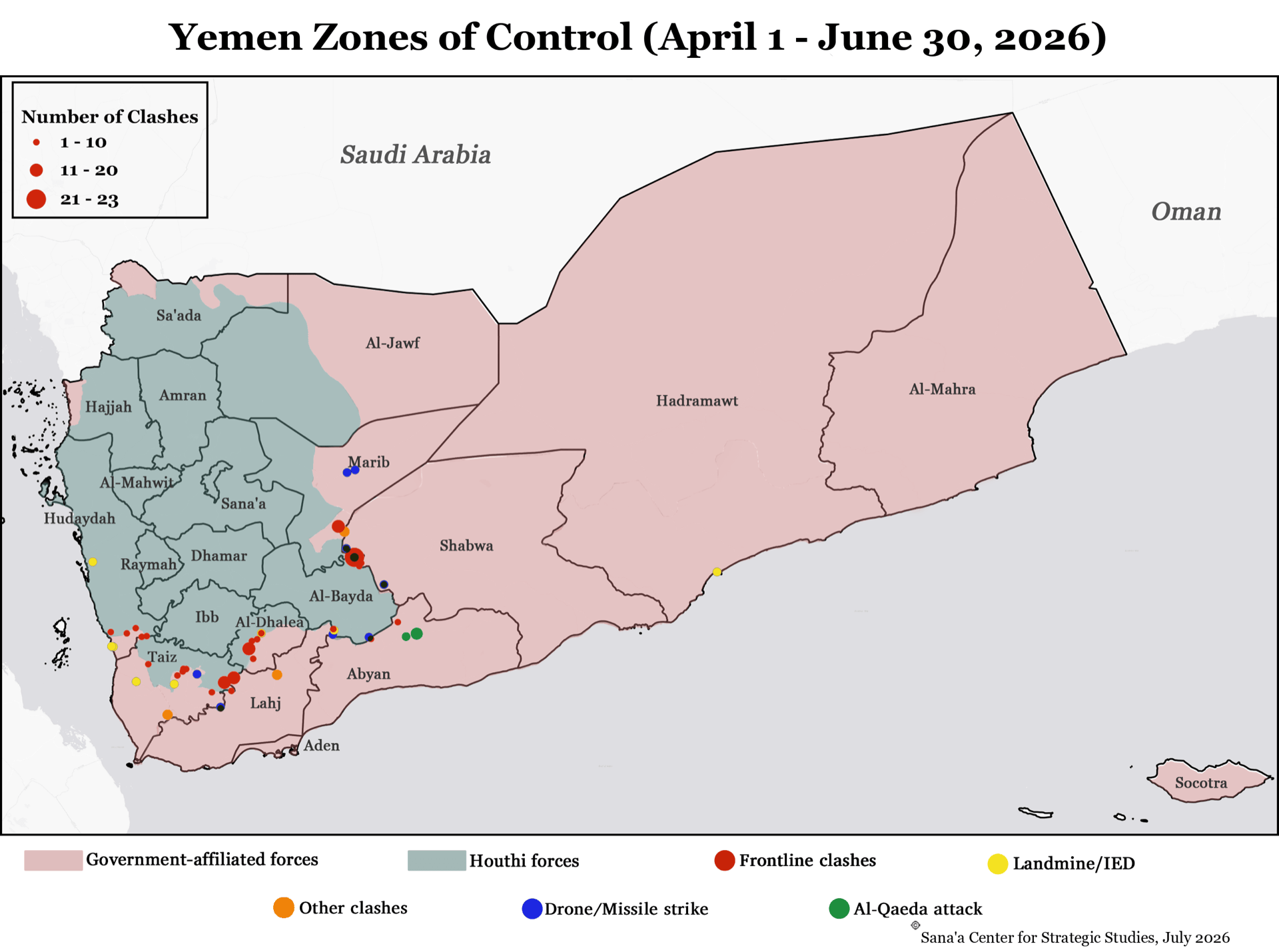
Recent weeks have seen an influx of Houthi and government reinforcements to frontlines across Yemen as the two sides brace for a possible return to full-scale fighting. Reports of Saudi arms and ammunition being supplied to multiple front lines, alongside intensified Houthi mobilization, point to the looming possibility of a ground campaign on multiple fronts. Whether it materializes will depend on whether Riyadh and the Houthis continue their path of escalation.
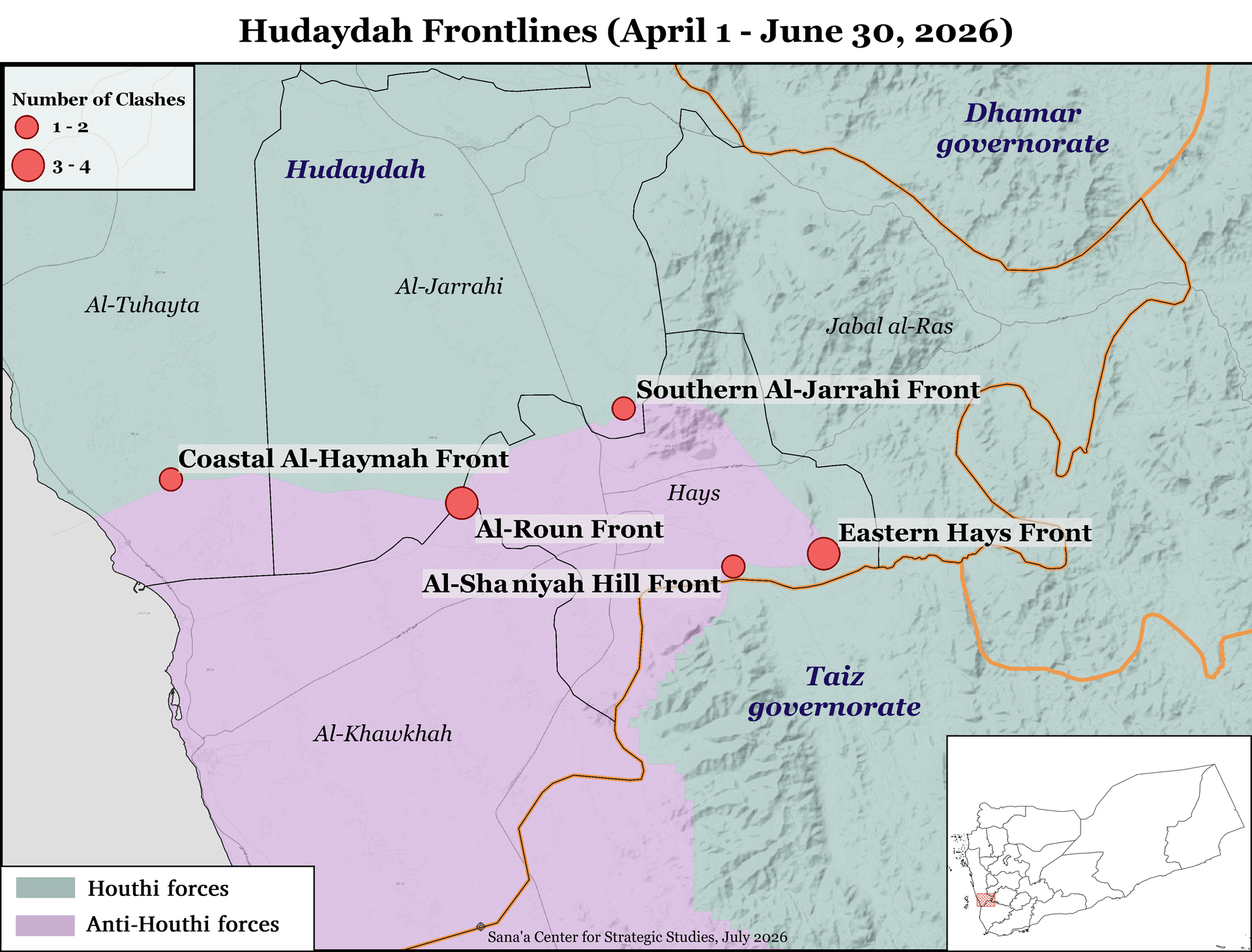
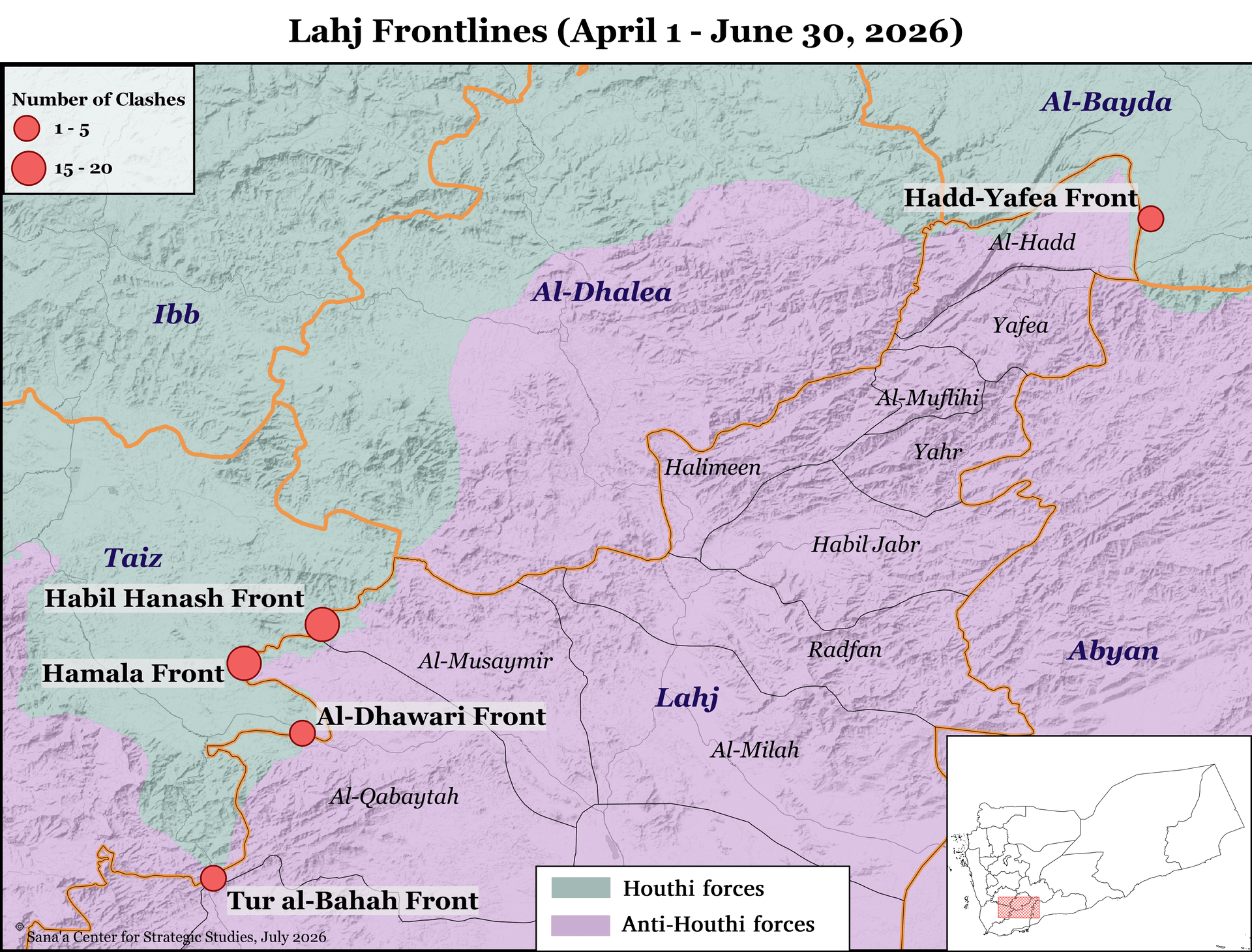
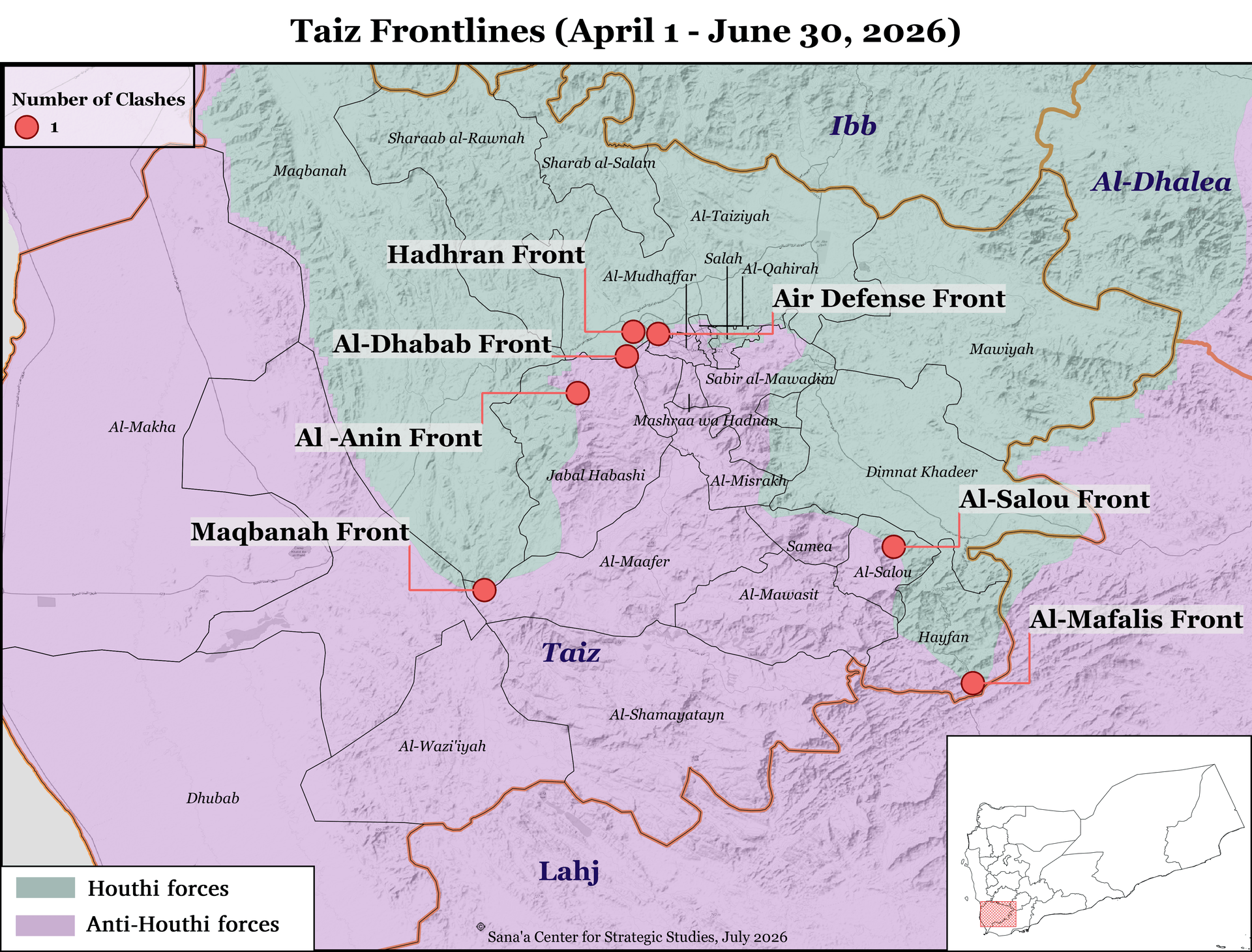
Until recently, however, Yemen’s frontlines had remained largely stable despite significant changes within the anti-Houthi military coalition. Between April and June, regular low-level fighting was reported in Marib, Taiz, Hudaydah, Lahj, Al-Dhalea, Abyan, and Shabwa, but no significant territory changed hands. Houthi operations increasingly relied on reconnaissance drones and limited probing attacks, likely intended to test newly redeployed government units following the Saudi-led restructuring process (see above). The lack of any major breakthroughs suggests that the restructuring has not yet created significant gaps in government defenses.
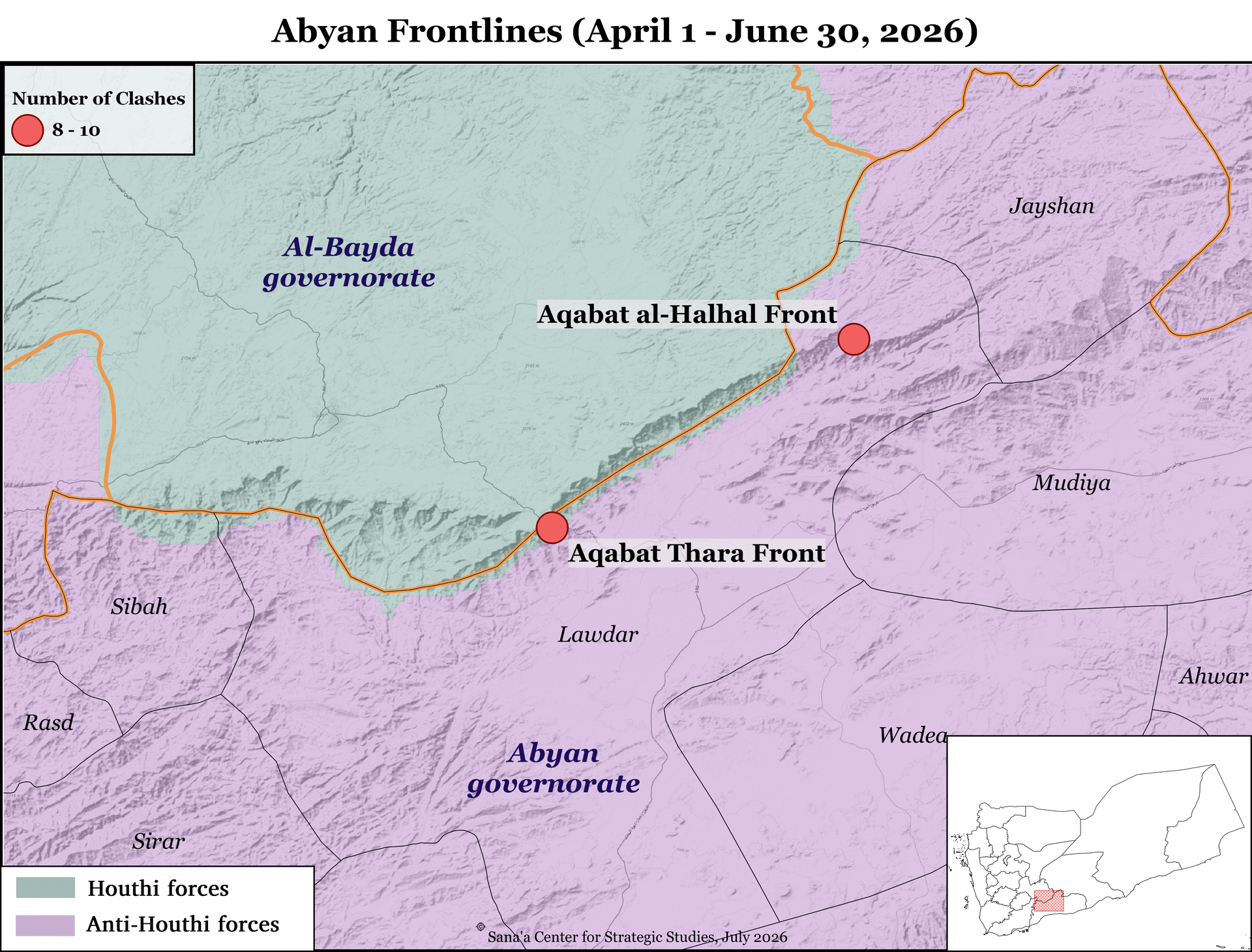
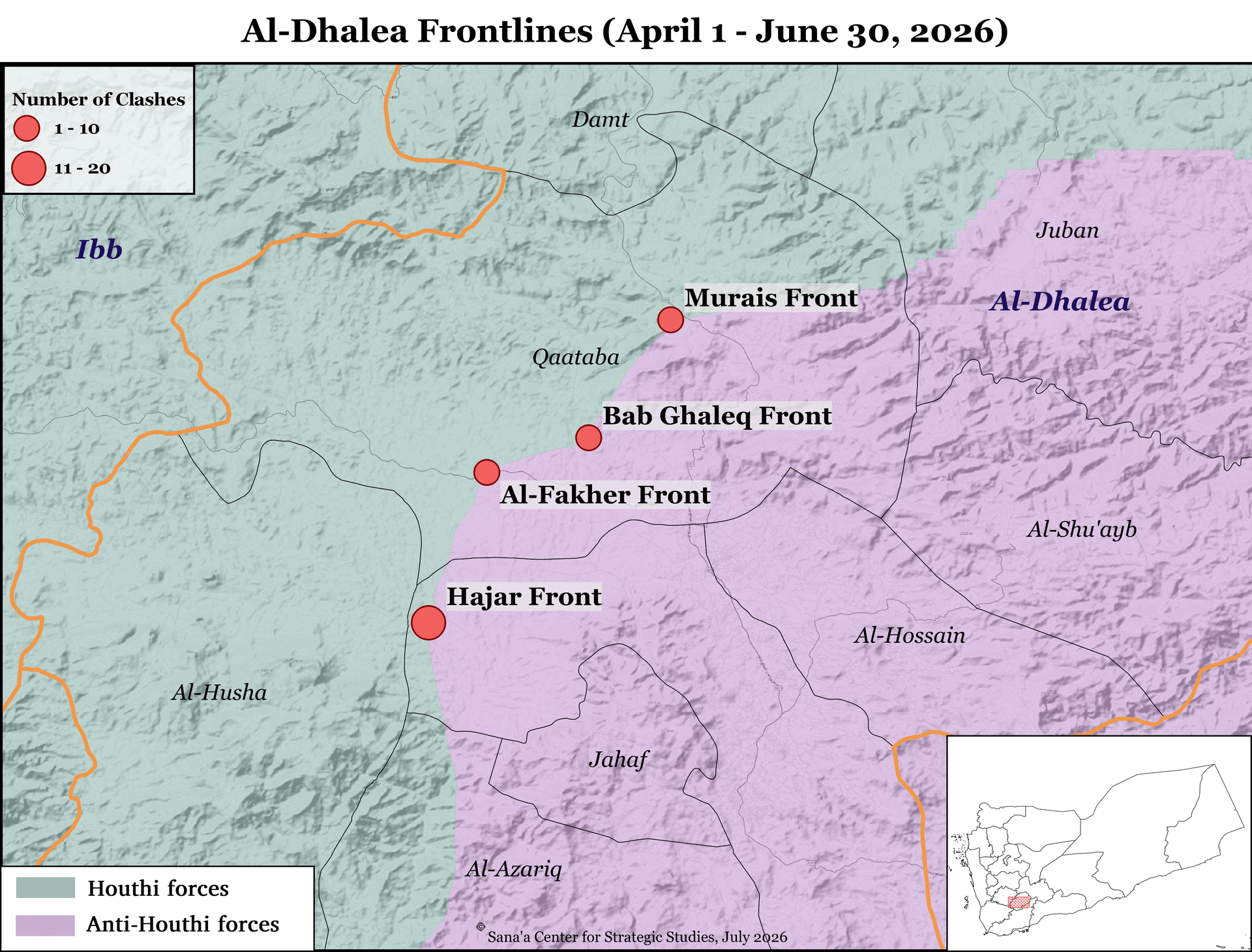
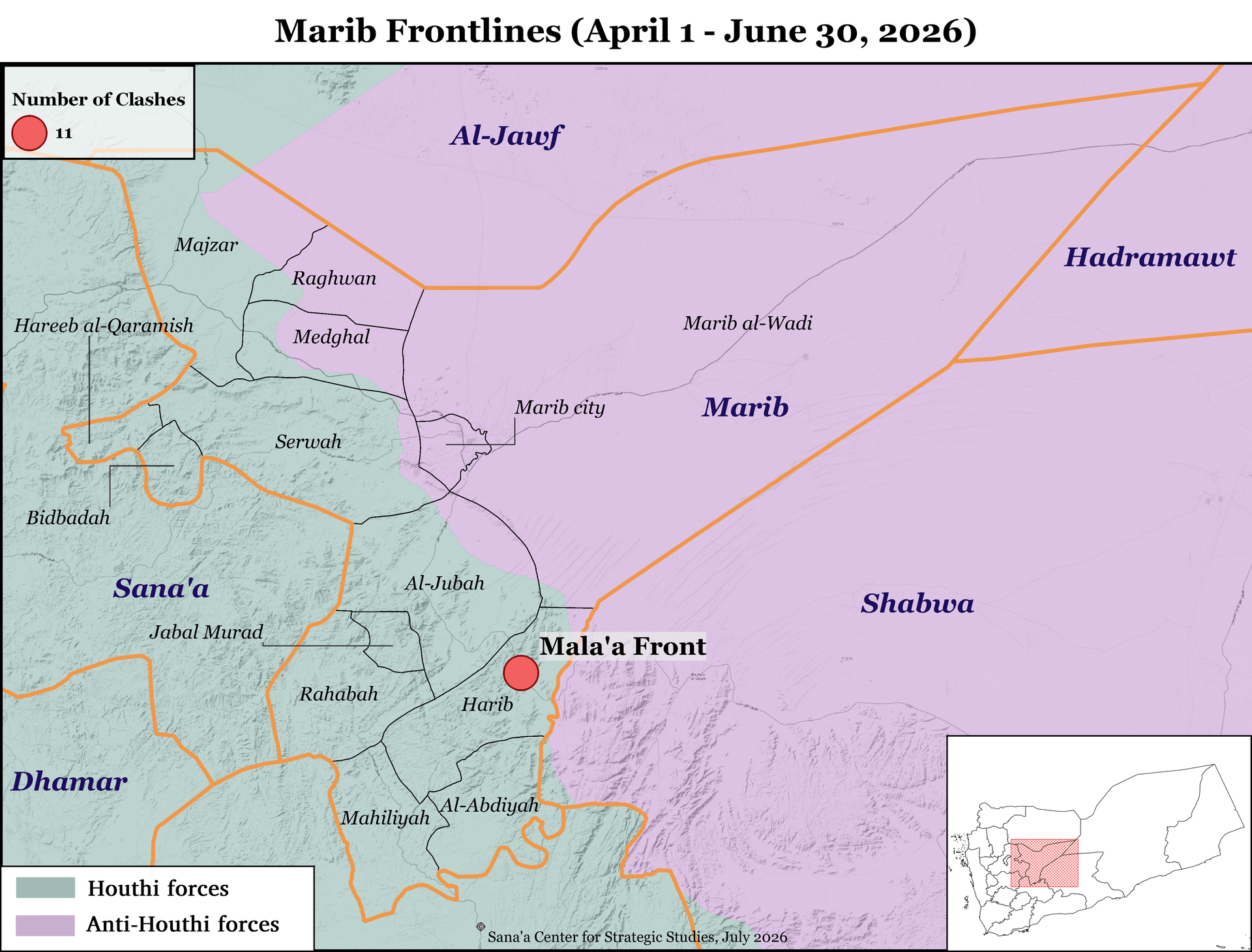
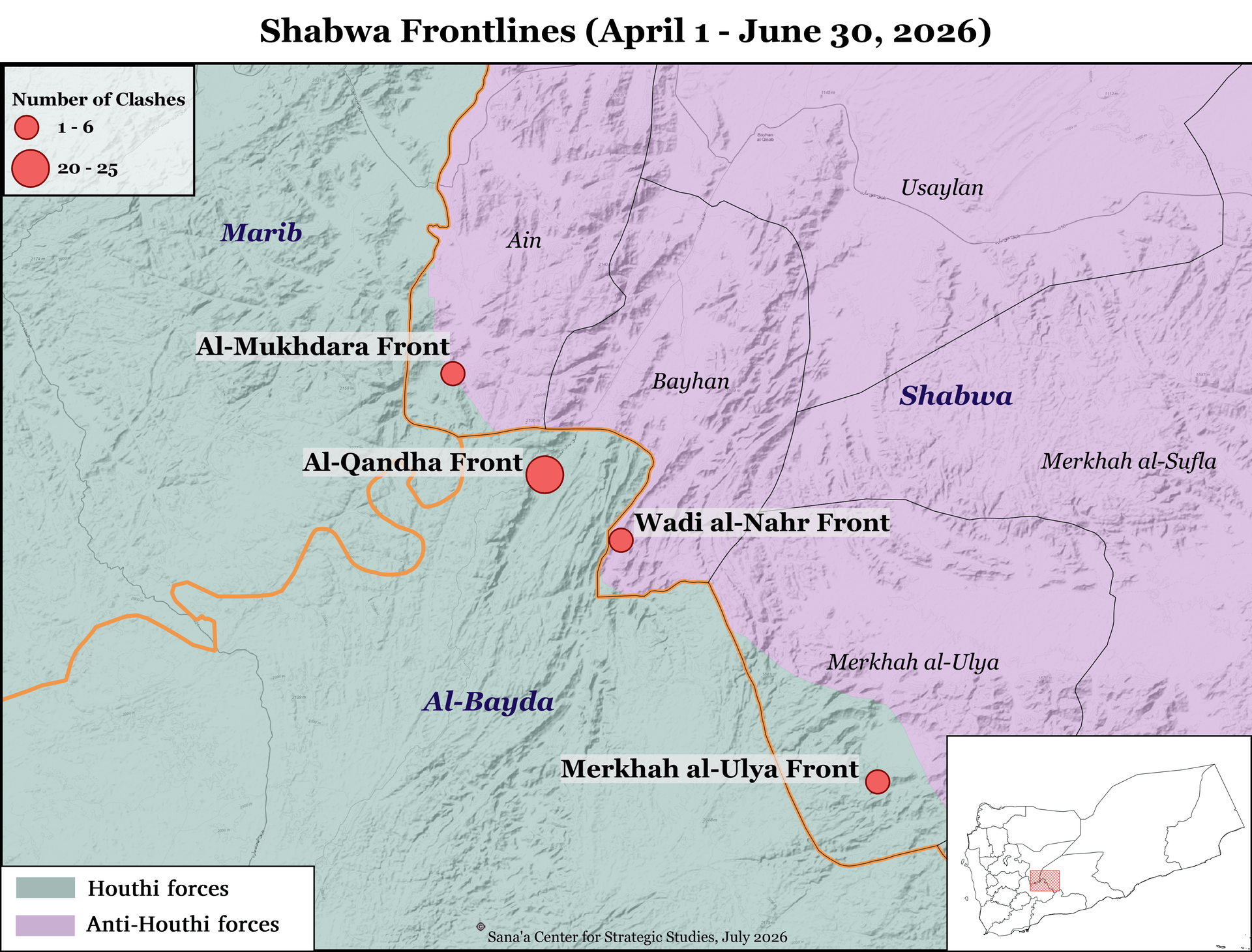
In Marib, pressure increased significantly around the Mala’a front in Harib district, where Shabwa Defense and Saba Axis forces are now holding positions previously associated with the Giants Brigades. Daily clashes in early April resulted in several casualties from skirmishes and drone strikes, while heavy fighting in early May reportedly killed a number of Houthi fighters. Houthi forces also claimed to have shot down two US MQ-9 Reaper drones over Marib in May. Local sources say the group continues to move fighters and vehicles toward the Serwah, Raghwan, and Al-Balaq fronts amid instability caused by tribal gatherings in Marib and Al-Jawf. In Shabwa, regular clashes continued along the Al-Qandha, Al-Mukhdara, and Merkhah al-Ulya fronts. Elsewhere, limited fighting continued along frontlines in Lahj and Al-Dhalea and sporadically around Taiz city. Drone attacks accounted for the vast majority of Houthi activity along frontlines in Abyan.
Fighting in Hudaydah became more sustained toward the end of the quarter, particularly along southern fronts, where Houthi forces began to regularly exchange mortar fire with Joint Forces soldiers. Between July 3 and 6, the Houthis launched one of the most significant attacks on Hudaydah’s frontlines in recent years. Houthi forces used heavy artillery, including howitzers and Katyusha rockets, in fighting that reportedly left 15 Joint Forces soldiers dead and 43 wounded, and 52 Houthi fighters dead and 66 wounded, according to military and medical sources. Despite the high number of casualties, neither side made any significant territorial gains, and the frontline has since been calm.
Other Developments in Brief
April 15: Al-Qaeda militants carried out a drone strike against pro-government counterterrorism forces in the Al-Fareed area of Mudiyah district, according to local sources. On April 22, suspected militants again attacked a position held by the 8th Support and Backup Brigade in the area, leaving one soldier wounded.
May 14: National Resistance forces handed over the newly completed, UAE-funded Bab al-Mandab Airport to the Ministry of Transport, following orders from PLC member Tareq Saleh. The ministry is reportedly working to register the facility with the International Civil Aviation Organization and prepare it to operate as Taiz International Airport.
June 4: The residence of Hadramawt Governor and PLC member Salem al-Khanbashi was allegedly targeted by three unidentified drones, in what government officials described as an assassination attempt. Al-Khanbashi was unharmed. Two days later, government air defenses reportedly opened fire on unidentified drones flying over strategic sites in Hudaydah, including the headquarters of the 2nd Military Region, Mukalla Port, Al-Rayyan Airport, and the Al-Dhabba oil terminal.
June 6: Brigadier General Yahya al-Wahish, commander of the 1st Division of the National Resistance forces and a prominent leader in the Tihama Resistance, was assassinated by a roadside bomb in Al-Khawkhah city in southern Hudaydah. Al-Wahish and his forces, then known as the Wahish Brigades, played a major role in the liberation of Al-Khawkhah during the West Coast offensive in early 2018. A committee appointed by PLC head Rashad al-Alimi later announced that its investigation indicated the assassination was tied to the Houthis. Three suspects were arrested, while seven others remain at large.
June 25: Local media reported that Houthi authorities arrested several members and affiliates of their own security and intelligence apparatus. Some detainees were reportedly moved to secret detention sites, while several officers allegedly fled Houthi-held areas for Marib.
Former Editor